
Samsung launches Penta Tandem OLED: 5-layer technology makes screens brighter and twice as durable.
Samsung's new QD-OLED Penta Tandem technology utilizes a 5-layer organic light-emitting structure, increasing brightness by 1.3 times and doubling panel lifespan.
Samsung Display has officially announced its QD-OLED Penta Tandem technology, marking a major leap forward in the global display industry. This solution not only enhances brightness but also addresses the issues of durability and burn-in, which are the biggest challenges of traditional OLED displays.
The principle of stacking 5 layers of organic luminescence.
Unlike conventional four-layer structures, Penta Tandem OLED technology stacks five layers of organic light-emitting diodes to optimize energy dispersion across the layers. This improvement allows the company to increase pixel density (PPI) for high-end 4K and 5K displays without compromising the performance or lifespan of individual pixels.

A breakthrough in brightness and energy efficiency.
Thanks to the addition of a fifth layer of material, the panel's luminous efficiency has increased significantly by 1.3 times. According to technical data, peak brightness can reach 1,300 nits for computer monitors and up to 4,500 nits for TVs (measured at 3% of the frame). Notably, despite the unprecedented brightness increase, overall power consumption remains the same as previous generations.
In terms of display capabilities, products using this panel easily achieve VESA's DisplayHDR True Black 500 certification. This ensures absolute deep black levels (below 0.0005 nits) and maximum contrast, making it well-suited for professional graphics and high-end entertainment needs.
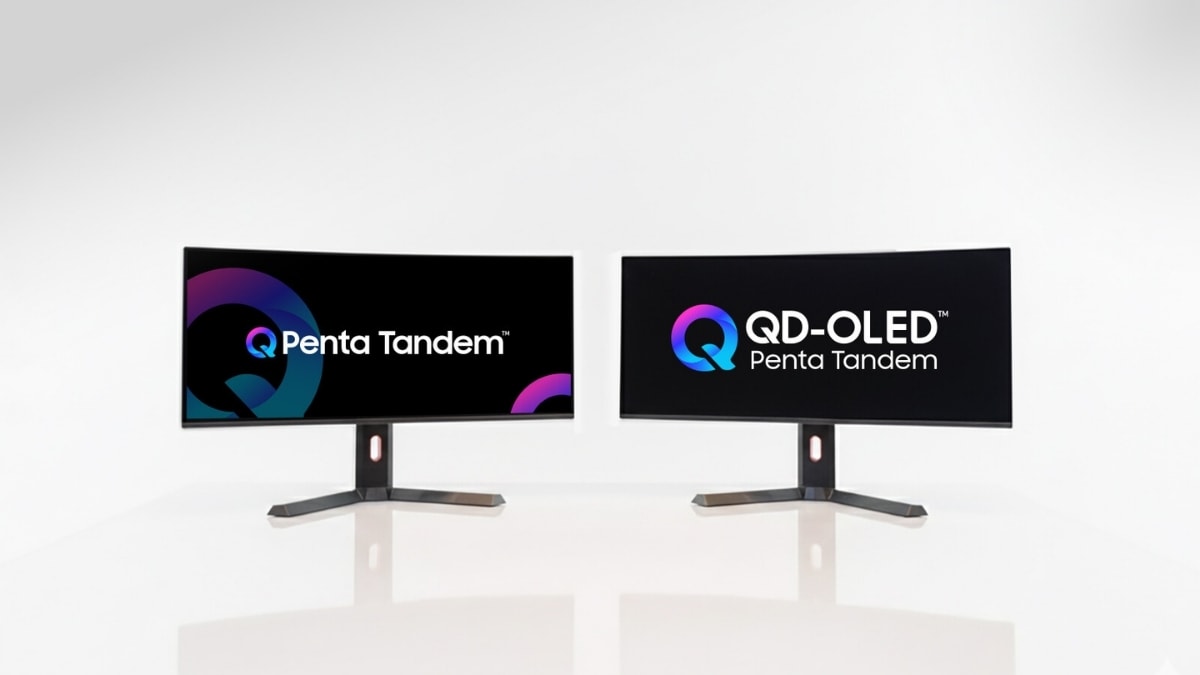
Roadmap for commercialization and practical application
Currently, Penta Tandem OLED technology is available on 27-inch UHD display panels with a pixel density of 160 PPI. Samsung expects to officially launch commercial products using this panel in early 2025.
In the near future, Samsung Display plans to expand the application of this technology to other sizes, including 31.5-inch versions and especially the 49-inch Dual QHD (5120 x 1440) ultrawide screen. This is seen as Samsung's direct response to LG's dual-layer Tandem OLED technology, promising to change the standards for brightness and durability in high-end devices.

| Specifications | Details of Penta Tandem OLED technology |
|---|---|
| Number of luminescent layers | 5 organic layers (Penta Tandem) |
| Luminous efficiency | 1.3 times higher than the previous generation. |
| Peak brightness (Monitor/TV) | 1,300 nits / 4,500 nits |
| Panel lifespan | Doubled |
| Display certification | DisplayHDR True Black 500 |


