
Russia's missile production far exceeds its Patriot interceptor missile supply capacity.
Intelligence data indicates that Russia produces approximately 113 ballistic and hypersonic missiles per month, double the current production capacity of the US PAC-3 MSE interceptor missiles.
Russia's ballistic and hypersonic missile production capabilities remain high, creating a significant gap compared to its ability to supply interceptor missiles for the US Patriot air defense system. According to data from the Ukrainian Defense Intelligence Agency (HUR), this disparity poses a serious challenge to purely defensive strategies against long-range attacks.
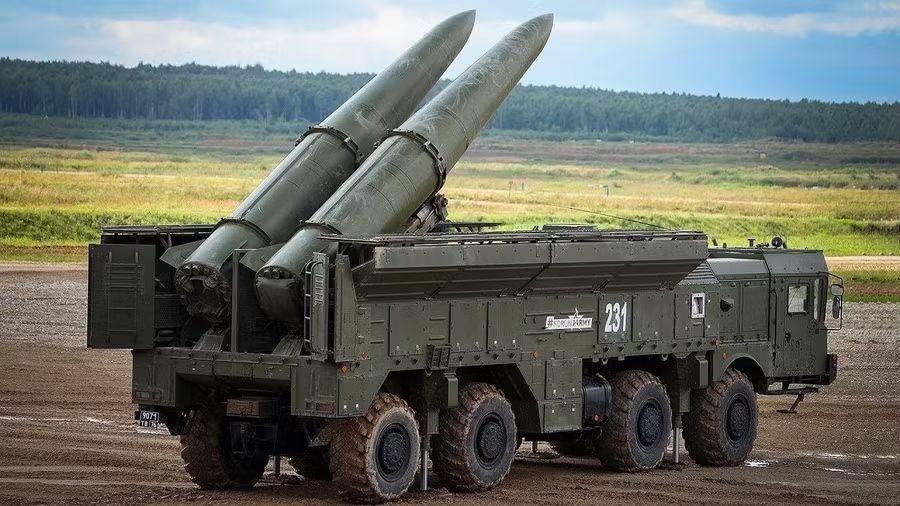
Details of Russia's monthly missile production
Reports from HUR indicate that Russia is focusing resources on producing missiles capable of penetrating the Patriot missile defense system. Monthly production could reach a maximum of 113 missiles, encompassing various types.
- 9M723 (Iskander-M) ballistic missile:60 fruits.
- RM-48U (S-300/400) ballistic missile:40 fruits.
- Kh-47M2 Kinzhal air-launched ballistic missile:10 fruits.
- Zircon hypersonic missile:Maximum 3 fruits.
The US has limited production capacity compared to demand.
Meanwhile, defense contractor Lockheed Martin's production of PAC-3 MSE interceptor missiles has yet to catch up with Russia's production scale. In 2025, projected production is around 620 interceptor missiles, equivalent to an average of 51-52 per month. Even with accelerated production in 2026 to reach the target of 700-750 units per year, this number would still only range from 58 to 63 per month.
| Comparison parameters | Russia (Attack missiles) | USA (PAC-3 MSE interceptor missile) |
|---|---|---|
| Monthly output | ~113 fruits | ~51 - 63 fruits |
| Main weapon type | Iskander-M, Kinzhal, Zircon | Patriot interceptor missile |
Notably, the supply of Patriot interceptor missiles to conflict zones is also constrained by the need to replenish strategic stockpiles. The U.S. and its allies in the Middle East, such as Bahrain, Kuwait, Qatar, the UAE, and Saudi Arabia, have used thousands of interceptor missiles in recent operations. It is estimated that between 45% and 61% of the U.S. existing interceptor arsenal has been consumed following confrontations with Iran.
Challenges to defensive strategy
Military experts believe that relying solely on interceptor missiles will not be enough to counter the threat from Russia's growing ballistic missile arsenal. Even if the U.S. diverts all its production to Ukraine, the supply would still not be able to compensate for the rate of depletion on the ground.
To address this problem, analytical reports suggest that purely defensive efforts need to be combined with offensive measures aimed at destroying missile launch systems, storage facilities, and production plants at their source. Otherwise, pressure on global air defenses will continue to increase as the capacity to produce offensive weapons temporarily gains a quantitative advantage.


