
Clean production must begin with the proper use of pesticides.
(Baonghean) - To ensure the safe and effective use of pesticides in agricultural production, the agricultural sector has implemented many proactive programs over the years. These programs have helped farmers increase productivity, yield, and quality of crops, and move towards a sustainable and environmentally friendly agricultural system.
"Warning about the overuse of pesticides."
Focus on minimizing pollution from agricultural waste.
Over the years, authorities such as the Department of Natural Resources and Environment and the Plant Protection and Crop Production Sub-Department have advised localities to organize the collection of agricultural waste in general, and plant protection waste in particular, by placing waste bins directly in some fields. To date, with investment from the province, approximately 1,600 plant protection waste collection bins have been placed in 10 districts throughout the province.
In addition, some localities have invested in their own waste collection and treatment efforts, including the Department of Natural Resources and Environment, the Plant Protection and Crop Production Sub-department, and a number of other localities. However, the collection and proper processing of this waste annually only amounts to 2-3 tons, approximately 1/10 of the total amount of plant protection waste generated each year. In 2016, out of the 2.5 tons of plant protection waste that localities registered to process, Quynh Luu district accounted for 500 kg, Dien Chau 300 kg, and Quy Hop and Nghia Dan 200 kg each.
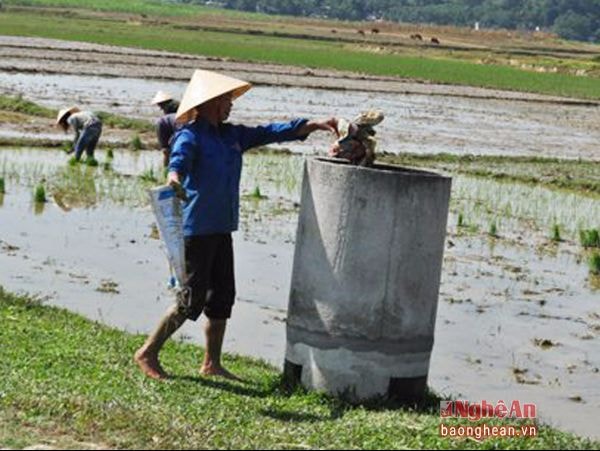 |
| Waste bins are placed in the fields of Thanh Lien commune (Thanh Chuong district). |
To reduce environmental pollution caused by waste bottles and pesticide packaging, various sectors and levels in the province have consistently focused on and implemented concrete measures linking production with environmental protection. Accordingly, the Plant Protection Sub-Department annually issues directives to localities to strengthen propaganda, training, and guidance on "Safe Use of Pesticides" for farmers. Simultaneously, they have developed pilot models of "Protecting the Environment with Farmers" (collecting waste and pesticide packaging), and "Ecological Technology" integrated with agricultural culture in the districts of Yen Thanh, Quynh Luu, Dien Chau, Do Luong, Thanh Chuong, etc.
Applying the "4 reductions" method for rice production.
During the 2016 summer-autumn rice crop season, households in Hamlet 7, Hung Tien Commune (Hung Nguyen District) implemented a rice production model based on the SRI program. This is a farming system based on the fundamental principles of using seedlings; planting sparsely to maximize photosynthesis; creating aeration in the rice paddy ecosystem to limit pests and diseases; applying fertilizer rationally to create conditions for rice tillers to develop effectively; and managing water based on the characteristics of the rice plant, draining water during tillering to encourage the rice to produce many tillers...
According to Mr. Nguyen Van Viet, the village headman and one of the households implementing the SRI (System of Rice Intensification) model for rice production, with 1.5 acres of rice fields, rice production under the SRI program reduces four key aspects: seeds, fertilizers, labor, and especially pesticides. The reason is that because the rice is planted more sparsely than in conventional methods, the amount of seeds used is reduced by 50%. Combined with rational and appropriate fertilizer investment to stimulate growth, the sparsely planted rice plants ensure sufficient sunlight, resulting in fewer pests and diseases. During the recent summer-autumn crop, leaf-rolling caterpillars appeared in large numbers in other fields, requiring farmers to spray multiple times. However, his family's rice crop, produced under the SRI program, only required one spraying, yielding 2.5 quintals per sao (approximately 1000 square meters). In previous seasons, before adopting the SRI process, yields were only 2 quintals per sao.
Ms. Nguyen Thi Xuyen, a plant protection and agricultural extension officer in Hung Tien commune, added: "The locality has nearly 180 hectares of land for two rice crops per year. From 2011 to the present, under the guidance of the district's plant protection station, the commune has implemented the SRI (System of Rice Intensification) rice production model. To date, about 130 hectares in the commune have adopted the SRI rice production program. Comparisons show that rice production under the SRI program is clearly effective, with rice yields increasing by 15-20% compared to traditional production. In particular, many rice fields have very few pests and diseases throughout the entire season, thus eliminating the need for pesticides. This is a production method that protects the environment, ensures human health, and helps farmers reduce costs from pesticides, fertilizers, and labor."
According to the Department of Crop Production and Plant Protection, the SRI (System of Rice Intensification) rice production program has been implemented in Nghe An since 2008. Over the past eight years, the Department has conducted 70 training courses for farmers and agricultural extension officers at the grassroots level. Each training course included a 1-hectare model project to demonstrate the effectiveness of the SRI program. Following the success of these models, the area of rice cultivated using the SRI method across the province now exceeds 8,000 hectares. In addition, Nghe An province also applies the ICM (Integrated Crop Management – “3 reductions, 3 increases”) rice production process on over 1,200 hectares.
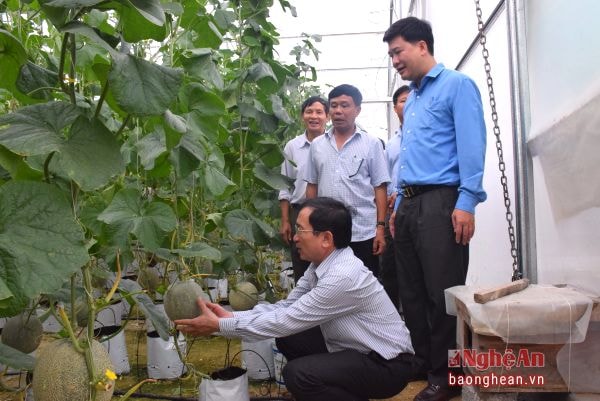 |
| Provincial leaders visit the greenhouse melon production model of Mr. Truong Van Hoa in Hoi Son commune (Anh Son district). Photo: XH |
The application of techniques from new production programs in rice cultivation helps reduce pesticide spraying by 2.3 times per crop. This limits pest outbreaks, balances the rice paddy ecosystem, lowers production costs, protects farmers' health, and preserves the environment. However, the area applying SRI or ICM programs is still very small compared to the total rice area of the province, which is over 90,000 hectares. Therefore, relevant agencies and local authorities need to strengthen communication and guidance through model projects to encourage farmers to adopt these methods, thereby reducing the use of pesticides in rice and other crops.
Expand the area for growing safe and clean vegetables.
For other vegetable crops, over the years, the agricultural sector, local authorities, and people have focused on implementing several models of clean vegetable and fruit production to supply consumers. A prime example is the cantaloupe grown in greenhouses using Israeli technology by Mr. Truong Van Hoa in Hamlet 2, Hoi Son Commune (Anh Son District) and Mr. Hoang Van Huong in Hamlet 7, Dien Thanh Commune (Dien Chau District). What's special about Mr. Truong Van Hoa's model is that the melons are grown on a substrate, without soil, opening up a new direction for agriculture in Nghe An. The fertilization process is combined with drip irrigation, delivering water directly to the roots at the required levels, and absolutely no pesticides are used. Currently, the greenhouse areas of Mr. Hoa and Mr. Huong are used to grow clean vegetables, and in the summer, they are used to grow melons.
Dien Chau district has over 2,000 hectares of land dedicated to vegetable cultivation. Every year, the District People's Committee directs the communes in the vegetable-growing areas to establish specialized clean vegetable farming zones of 5-10 hectares each, with the aim of expanding this practice to a wider area. As a result, the area of safe vegetable production in Dien Chau currently accounts for approximately 40% of the total vegetable area in the district. In the winter of 2015, Dien Thanh commune was selected by the District People's Committee to develop a pilot model for safe vegetable cultivation, in collaboration with Phu Dien Joint Stock Company for processing and marketing the products.
Besides providing training on the transfer of scientific knowledge regarding safe vegetable cultivation processes to participating households, the District People's Committee also supported Dien Thanh with 180 million VND to build a preliminary processing facility and assist farmers in promoting and selling their products. As a result, to date, all 60 hectares of Dien Thanh's vegetable-growing area have been converted to clean production according to the VietGAP model.
Quynh Luu District is considered the largest vegetable producing area in the province. According to Mr. Nguyen Xuan Dinh, Head of the Agriculture and Rural Development Department of the district, the locality has more than 1,000 hectares of land dedicated to vegetable cultivation. Currently, the district has successfully implemented a clean vegetable farming model in Quynh Luong commune with 10 hectares of specialized cultivation, certified VietGAP by the authorities. The goal is for 100% of the district's vegetable production area to adopt safe production processes. Therefore, every year, the district and commune-level specialized agencies regularly disseminate information and guide farmers on safe vegetable production to supply the market and ensure consumer health.
Towards sustainable agriculture
In the context of increasingly complex crop pest pressures, the development orientation of the agricultural sector towards increasing productivity and quality while ensuring safety, efficiency, and environmental friendliness is both a challenge and an urgent requirement. In this context, the safe and effective use of pesticides is an inseparable goal. To achieve high production efficiency, move towards sustainable production, and protect the environment, farmers need to apply a comprehensive set of technical solutions and ecological technologies. This will contribute to reducing pest pressure, helping farmers lower production costs, and moving towards clean production to meet consumer demands.
To achieve that goal, strengthening the adoption of new varieties that meet practical needs is crucial, such as those resistant to pests and diseases, with strong stems, and resistant to lodging. Simultaneously, promoting the application of biological pesticides, investing in research and application of biological preparations to reduce the use of chemical pesticides in rice cultivation, as well as other crops, is essential. Using organic fertilizers to gradually replace chemical fertilizers will improve soil quality and limit pest outbreaks.
In particular, when using pesticides, the "four correct principles" must be followed (correct pesticide, correct time, correct concentration and dosage, and correct method). At the same time, appropriate methods for solid waste disposal should be chosen to protect the environment in a sustainable and safe manner. The urgent issue now is that relevant agencies, specialized sectors, and localities need to actively guide farmers in developing safe production models that minimize or eliminate the use of pesticides to protect human health.
According to experts, the process of using chemical pesticides in the production of safe vegetables should only involve using pesticides when pests reach a damaging threshold or when the insects are still young (ages 2 and 3), as these are the most sensitive stages to pesticides. Do not spray pesticides when it is hot and sunny, when there is strong wind, when it is about to rain, or when the plants are flowering and pollinating. Avoid spraying pesticides too close to the harvest date; generally, chemical spraying should be stopped at least 5 to 10 days before harvesting. Besides promoting awareness and guiding farmers to implement clean production processes, relevant sectors, levels, and localities need to strengthen inspections of the production, trading, and use of pesticides, especially strictly managing advertising and seminars by pesticide manufacturing and trading companies, and limiting counterfeit and substandard products. Once farmers participate in large-scale model farming to create a large supply of goods, producing clean products will determine the sustainability of agricultural production in the new era. |
Reporters' Team


