
Why would anyone want to abolish the traditional Lunar New Year?
(Baonghean.vn) - While the uproar demanding the removal of neighborhood loudspeakers has been circulating online and on sidewalks recently, the idea of "abandoning the Lunar New Year and adopting the Western New Year" is now being proposed by a number of professors, doctors, and economic experts.
Although not many people joined in, they steered the story in a different direction. One or two of them on social media claimed that while Lunar New Year has a long history in Vietnam, it originated in China. Therefore, abandoning this traditional custom is a way to "break free from China" (?).
Unlike those who simply follow the trend, the proponents argue that the Lunar New Year (Tet) has a significant negative impact on the attitudes and productivity of workers; social ills (gambling, drunken public disorder, traffic accidents, etc.) increase more than usual. In particular, the wasted time due to the extended holiday period, which clashes with the working hours of foreigners, is incompatible with the integration process.
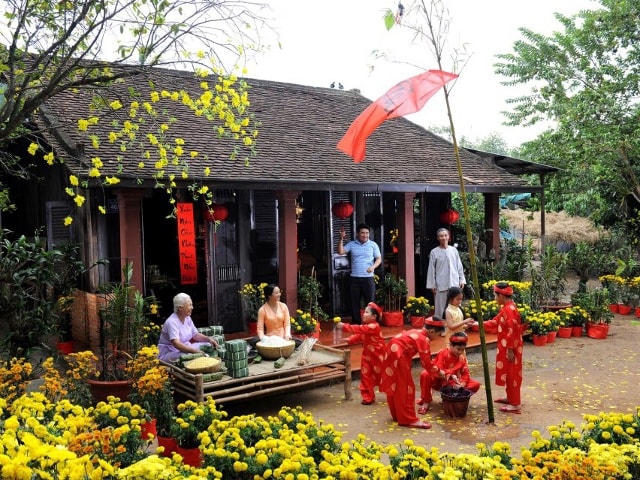 |
| Tet Nguyen Dan (Lunar New Year) is an occasion to express Vietnamese values, remembering one's roots, and for happy family reunions... (illustrative image) |
From an economic perspective, the idea of abolishing the Lunar New Year is not without basis. In recent years, workers have had nearly ten days off for the traditional Lunar New Year. Many civil servants don't actually return to work until after the 15th day of the first lunar month. Meanwhile, festivals (over 800 nationwide) almost continuously last until the end of the third lunar month. This also creates difficulties for foreigners needing to make contact, conduct business, or discuss matters.
Some argue that Japan's economic development is due to the abandonment of the Lunar New Year over a hundred years ago. Speaking of this, in a recent interview with several Vietnamese newspapers, Japanese Ambassador Hideo Suzuki stated that many Japanese people now regret abandoning the Lunar New Year. He believes that these people are only now realizing that the Lunar New Year celebration is a cultural heritage – a form of "soft power" that can help connect communities.
Returning to the topic of the traditional Lunar New Year in Vietnam. The Lunar New Year has existed for thousands of years in Vietnam. It's a time for family and clan members to reunite, a time when the community demonstrates solidarity and mutual care. It's a beautiful cultural aspect of the Vietnamese people. Furthermore, the Lunar New Year coincides with the transition from winter to spring, so flowers symbolizing happiness, prosperity, and youth, such as peach blossoms and apricot blossoms, bloom. Indeed, the Lunar New Year is also a time of harmony between nature, the earth, and humanity; between descendants and ancestors; and between the living and the dead.
That doesn't mean we don't need to address the limitations and negative aspects that often occur during the Lunar New Year. Nor should we abandon the Lunar New Year because of those limitations.
Let's try to imagine what would happen if the Lunar New Year were changed to the Solar New Year?
Viet Long


