
The famous "killer" of rice-growing eels in the rice-growing district.
(Baonghean.vn) - In Yen Thanh district (Nghe An province), no one in the eel hunting and trading community is unaware of Tran Van Than (also known as Than Hoi). He is considered by the district's eel traders as the "killer" of freshwater eels.
I started setting fish traps when I was 12 years old.
In Yen Thanh district, known for its rice cultivation, if you ask about Tran Van Than (born in 1980, residing in Trung Nam hamlet, Hau Thanh commune), everyone will respectfully acknowledge his skill in catching eels. He is famous for his eel hunting and is nicknamed the "eel killer." Thanks to eels, his family has become quite well-off and has plenty of money.
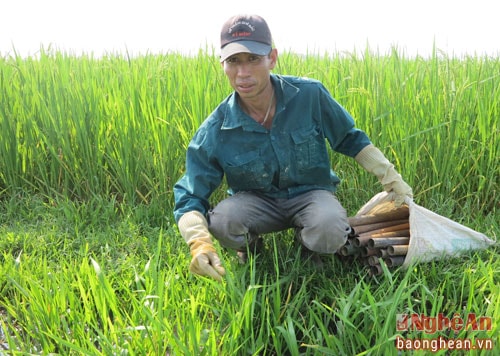 |
| Tran Van Than, the "killer" of freshwater eels. |
Thân is the youngest of three siblings. He lost his mother at the age of two, and the family constantly struggled with food shortages. His two older sisters dropped out of school after the fifth grade to help their father. Thân also finished the sixth grade, but seeing that his family couldn't afford to support his education, he stopped his studies. At the age of 12, he began earning a living by setting eel traps (also known as eel farming).
Starting at the age of 12, Mr. Than has been involved with eel trapping for 25 years. “Out of 30 days in a month, I hardly miss a single day. Whatever I do, I have to make time to go back and set eel traps. Honestly, eel trapping is in my blood. If I don't catch eels for a day, I feel like something is missing; I can't eat well or sleep peacefully. As long as I have the health and ability to move around, I will continue this profession,” Mr. Than shared.
The secret to 'luring' wild eels.
Luring eels into traps is a laborious process that requires keen observation from the person setting the traps. In other words, it's like "strategically arranging troops" so that the eels willingly crawl into the trap tubes.
The first step is selecting and designing the eel trap. Eel traps are mainly made from bamboo, about 50-70cm long depending on whether they are placed in shallow or deep water, and one end is cut off to make an entrance for the eels to enter.
"The eel traps shouldn't be too dry or too wet, otherwise the eels won't enter, or if they do, the yield won't be high. If you set traps every day, you should replace the traps once a month for the best results. The lids should be replaced twice before replacing the traps," Mr. Than shared his experience in choosing eel traps.
Besides the technical aspects of setting eel traps, the skill in choosing bait and how to deploy the traps is crucial in attracting eels. The people of Yen Thanh have a saying, "Fish get caught by the trap, eels get drunk by the bait." Accordingly, bait is very important in luring eels into traps. Eels are attracted to the smell of fish, and their favorite food is earthworms, so the bait chosen is mostly from this type of insect.
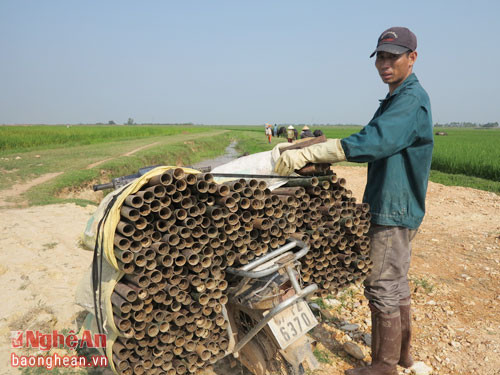 |
| Every day, Mr. Than sets about 400 bird traps. |
“In the past, finding bait was very difficult and time-consuming, but recently, it only takes about 20 minutes to get enough bait for about 400 eel traps. The simplest way is to mix dishwashing liquid with water. Then, choose a spot where earthworms are burrowing, pour the mixture on them, and after a minute you can easily catch them without having to dig, saving you time and effort. After catching the earthworms, chop them into small pieces and apply them to the trap opening before releasing them. A special thing is that the earthworms must be alive; if they are dead, they will smell bad and the eels won't enter,” Mr. Than shared his method of finding bait for the traps.
Choosing the right spot to set the traps is a process that requires experience. Therefore, not everyone can successfully set the traps and place them in the right spot where eels are found. With 25 years of experience in eel hunting, Mr. Than shared: "You have to choose a place with algae in the water to set the traps; it's certain that there will be eels there, and big eels at that. However, eels rarely live in puddles with algae, and no matter how good the bait is, setting traps there rarely yields eels. Setting traps in ditches yields bigger eels than in rice fields."
However, eel traps should not be placed in areas with strong currents because the eels will not be able to enter them. If placing them in canals or ditches, the water level should be just right; if the water is too high or too low, the eels will not seek food. If placing them in rice fields, a water depth of 10-15cm will yield more eels than in fields with shallow or stagnant water. A crucial rule is to absolutely avoid flooding the ventilation channels, otherwise the eels will suffocate and die.
Besides releasing eels into the fields, after the harvest, Mr. Than also often catches eels by hand. For him, just spotting an eel nest and reaching in with his finger to pull the eel out is as easy as taking something out of his pocket.
"Transforming" thanks to eels.
Thanks to freshwater eels, Tran Van Than's family, who were once impoverished and barely made ends meet, have now undergone a dramatic transformation.
Freshwater eel has been voted one of the top 10 must-try specialties for anyone visiting Nghe An province. Recently, freshwater eel has become an indispensable dish in restaurants and hotels.
Because freshwater eels prefer to live in low-lying areas, they thrive in the Yên Thành region. Not only Mr. Thân, but many people in this area have become wealthy thanks to freshwater eels. However, the supply of eels in this central Vietnamese rice granary never runs out.
“Every night, with 400 eel traps, I catch 8-12kg of eels, sometimes up to 15kg. If I buy unprocessed eels, 1kg costs 130,000 VND. After processing and cleaning, 1kg of eels costs 160,000 VND. That way, I earn over 1 million VND every night,” Mr. Than said.
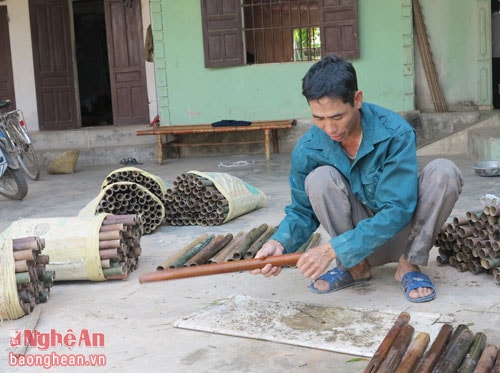 |
| Each night he caught over 10 kilograms of eels. |
Thanks to eel farming, Mr. Than was able to build two rows of houses, one horizontally and one vertically, buy a motorbike, a TV, a refrigerator, a tractor, a plow, nearly a dozen buffaloes and cows, and two wedding tents for rent. Having accumulated wealth, Mr. Than even deposited the remaining money into the bank. Mr. Than also revealed that his family intends to buy a combine harvester to rent out for profit.
Previously, they had to import eels or traders come to buy them, but now, Ms. Ha (Mr. Than's wife) processes them herself and sells them at the market, which not only fetches a higher price but also provides employment for the family. "Every morning we have over 10 kg of eels, but they're all gone by noon. Some days we even have to gather eels from other people who set traps, but they're all sold out early."
"People trust and buy my eels because Mr. Than produces them himself, and they are genuine wild eels. Furthermore, because I'm not a professional trader, I can adjust the price a little, so customers are happy to buy. In addition, by-products like eel bones, heads, and tails help in poultry farming, so the birds grow faster," Ms. Ha happily explained.
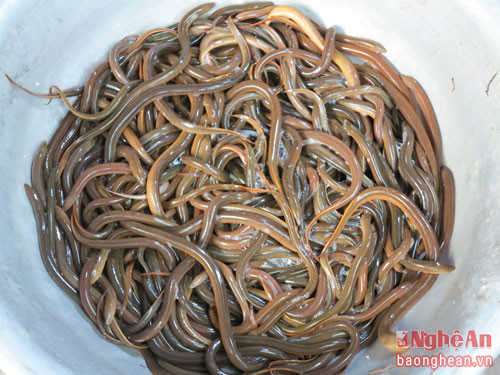 |
| With the current price of freshwater eels at 130,000 VND/kg, Mr. Than earns over 1 million VND per night. |
Mr. Nguyen Viet Linh, Chairman of the Farmers' Association of Hau Thanh commune, said: "Mr. Than's family is a prime example of household economic development. From raising eels in the fields, Mr. Than has become noticeably wealthy. From lacking food and clothing, they now have a spacious house, savings, and have purchased all the necessary household items."
Le Dinh Quyet


