
Saudi Arabia suffers $10 billion in losses and faces the risk of running out of Patriot missiles.
Conflicts in the Middle East have cost Saudi Arabia more than $10 billion, while also severely depleting its stockpiles of Patriot and THAAD air defense missiles in the face of large-scale attacks.
Saudi Arabia is facing a dual economic and security challenge as financial losses exceed $10 billion amid escalating regional conflict. This situation is occurring alongside a significant depletion of its stockpiles of interceptor missiles for strategic air defense systems such as Patriot and THAAD.
Economic damage and national budget adjustments
According to data from the Wall Street Journal, the Saudi Arabian economy has recorded losses exceeding $10 billion. The primary cause stems from a decline in oil revenues due to shipping restrictions through the Strait of Hormuz, disrupting supply chains and export production. In addition, the cancellation of major international events, notably the Formula 1 race, has further exacerbated the financial burden.
Under pressure from the costs of military campaigns, the Saudi Arabian government and state-owned enterprises are being forced to consider adjusting the timelines of many key infrastructure projects. Plans for high-rise buildings and megacities may be temporarily suspended to prioritize the reallocation of resources to the rapidly growing defense budget.
Pressure on the Patriot and THAAD air defense systems.
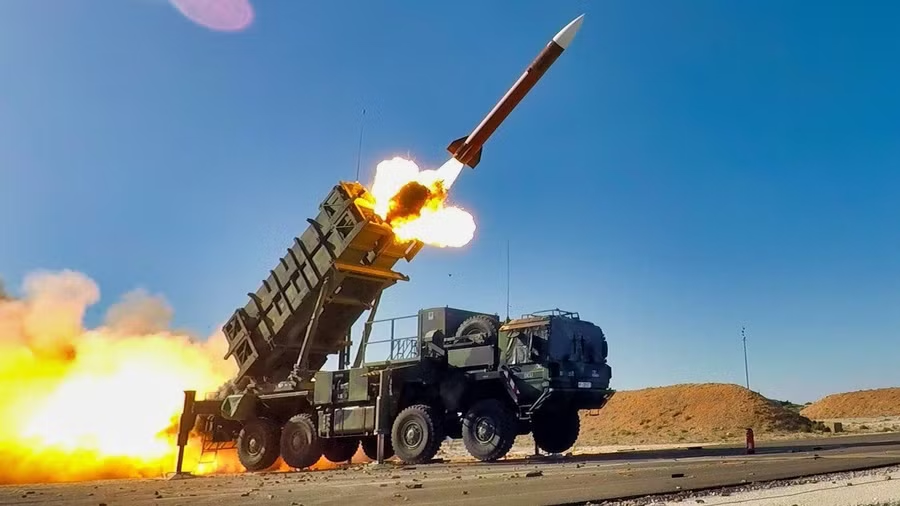
From a military standpoint, the defensive capabilities of Saudi Arabia and its allies are at significant risk. According to the New York Times, stockpiles of interceptor missiles for the Patriot and THAAD systems are rapidly dwindling. Figures from the United Arab Emirates (UAE) Ministry of Defence indicate that Iran has launched approximately 500 ballistic missiles and over 2,100 UAVs since the conflict began.
Although the exact stockpiles are kept secret, the high frequency of interceptions is pushing ammunition depots to dangerously low levels. If the conflict continues, not only Saudi Arabia but also other US allies such as Israel, Ukraine, South Korea, and Japan could become more vulnerable due to the global shortage of air defense equipment.
The context of the conflict and the counterattacks.
The situation has become more tense since February 28th, when the US and Israel launched military operations targeting objectives in Iran, including the Tehran region, in response to missile and nuclear threats. Iran retaliated with actions targeting Israel and US military bases in Bahrain, Jordan, Kuwait, Qatar, Saudi Arabia, and the UAE.
The increased intensity of fighting not only causes direct damage to infrastructure but also forces countries in the region to reconsider their long-term defense strategies in the context of the fragmentation of high-tech weapons supplies from the US across multiple fronts.


