
Chinese supercomputer surpasses US, leading the world in processing speed.
For the first time in nearly a decade, China has reclaimed the top spot in the supercomputing field as its LineShine system surpassed the US's El Capitan to lead the global Top 500 rankings.
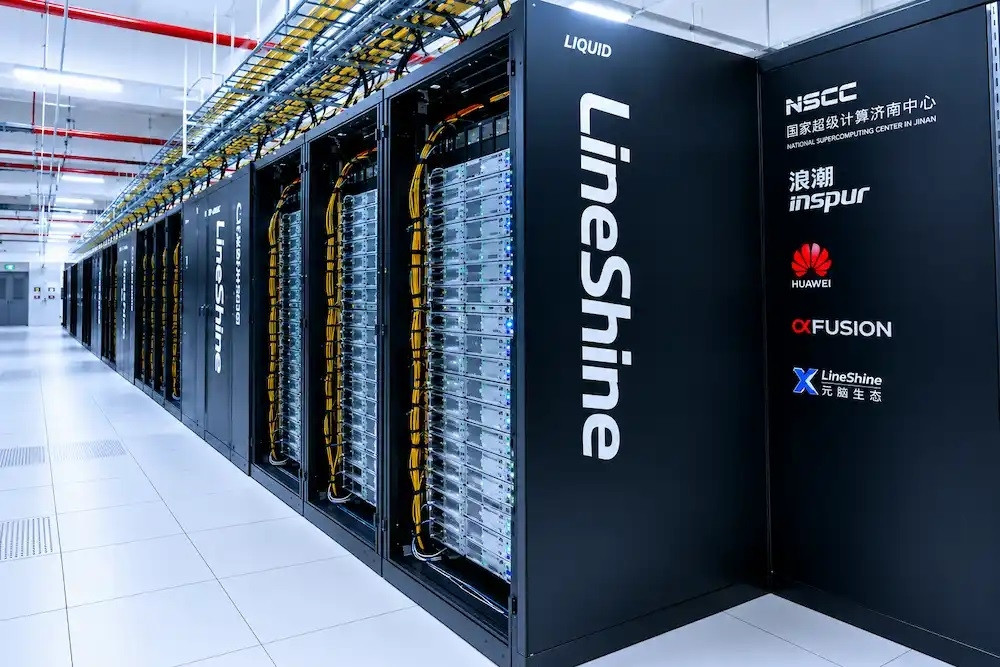
China has just marked a significant milestone in the global technology race with the debut of its LineShine supercomputer, which immediately rose to the top of the Top500 ranking – a prestigious list that assesses the world's most powerful supercomputers.

This marks the first time since 2017 that a Chinese supercomputer system has ranked number one, surpassing leading American competitors and confirming a new milestone in the country's high-performance computing capabilities.
LineShine surpasses El Capitan to become the world's fastest supercomputer.
According to the Top500 ranking published on June 23, the LineShine supercomputer located at the National Supercomputing Center of China in Shenzhen has achieved a computing performance of up to 2,198 exaflops.
This figure means the system is capable of performing over 2 quadrillion calculations per second, allowing LineShine to surpass the US's El Capitan and become the most powerful supercomputer on the planet.
Previously, El Capitan, located at Lawrence Livermore National Laboratory in California (USA), was the world's leading system. After the latest update of the Top500, this machine has dropped to second place.
Notably, LineShine is a completely new name in the rankings but immediately took the top spot, demonstrating the rapid development of the high-performance computing industry in China.
Unlike the trend of artificial intelligence, LineShine only uses a CPU.
One of LineShine's unique features is that the system operates entirely on traditional central processing units (CPUs) instead of graphics processing units (GPUs), the type of hardware that is now considered standard in artificial intelligence (AI) systems.
In a context where modern supercomputers increasingly rely on GPUs to meet AI computing demands, LineShine's approach demonstrates a different direction.
To operate, the system consumes approximately 42.2 megawatts of electricity, reflecting the enormous scale of these world-leading computing machines.
The increasingly important role of supercomputers
Supercomputers have processing speeds thousands of times faster than conventional computers and are becoming a strategic infrastructure for many countries.
These systems are used in many critical fields such as medical research, climate change modeling, weather forecasting, complex physics simulation, new materials research, robotics development, virtual weapons testing, and ultra-large-scale data analysis.
Supercomputing capabilities are now also considered one of the indicators reflecting a nation's scientific and technological strength.
Only five exascale supercomputers have been publicly confirmed.
According to Top500, there are currently only five publicly confirmed exascale supercomputers in the world.
Following LineShine and El Capitan from the US, the next spots are occupied by two other US systems located at national laboratories in Tennessee and Illinois.
Meanwhile, Germany's Jupiter supercomputer has dropped to fifth place.
Besides the US, China, and Germany, other countries with systems among the top 10 most powerful supercomputers in the world include Italy, Switzerland, and Japan.
In the United Kingdom, 11 systems are on the Top 500 list. The most notable is Isambard-AI from the University of Bristol, currently ranked 11th globally. This system is equipped with approximately 5,400 advanced Nvidia AI processors.
In the Oceania region, Setonix in Western Australia is the most powerful supercomputer, ranking 86th globally.
Europe accelerates investment in large-scale AI infrastructure.
The increasingly fierce competition between the US and China in the field of supercomputing is also prompting Europe to step up investment.
Last year, the European Union (EU) announced a €20 billion plan to build large-scale computing centers to support the development of the next generation of AI models.
These facilities, known as “AI Gigafactories,” will support research and innovation in fields such as healthcare, biotechnology, industrial manufacturing, robotics, and scientific discovery.
According to the EU strategy, the most high-performance AI centers currently available can be equipped with up to 25,000 advanced AI processors. However, future gigafactories are expected to possess more than 100,000 AI processors, creating superior computing power.
The energy and environmental problem
Alongside the technological race, the energy consumption of supercomputers and AI data centers is also becoming a major concern.
These facilities require enormous amounts of electricity to operate, and also consume a lot of water for their cooling systems.
An EU official said that future AI centers need to be powered by renewable energy to the maximum extent and must have mechanisms for water reuse to reduce environmental impact.
However, many environmental organizations warn that the boom in energy-intensive AI data centers could increase pressure on the energy system and affect Europe's greenhouse gas emission reduction targets.
The emergence of LineShine not only marks a new step forward for China in the field of supercomputing but also shows that the global competition for computing infrastructure and AI is entering a more intense phase than ever before.
With AI becoming a driving force for economic and scientific development, supercomputing capabilities are increasingly seen as a decisive factor in determining a nation's technological standing on the international stage.


