
Students drop out due to rising tuition fees.
(Baonghean) - Due to lack of money to pay tuition fees, many students have had to abandon their dream of attending university because they worry they won't be able to afford the costs for four years of study.
Since her eldest son was admitted to Hanoi University of Technology, the family of Ms. Tran Thi Dung in Dang Son commune, Do Luong district, has had to implement a strict budgeting strategy.
Hanoi is expensive; a small room of less than 10 square meters costs about 1,500,000 VND per month to rent, plus food, living expenses, and tuition fees. So, no matter how frugal she is, she still has to send about 3,500,000 VND to her child each month. That's a huge amount of money for a farming family.
To pay for their child's education, the couple had to apply for a government loan. They haven't finished paying off the old loan, and now, hearing that tuition fees are going to increase further, she is extremely worried and doesn't know how they will manage for the remaining two years of their child's schooling. Not to mention, the increase in tuition fees might also lead to increases in other school expenses.
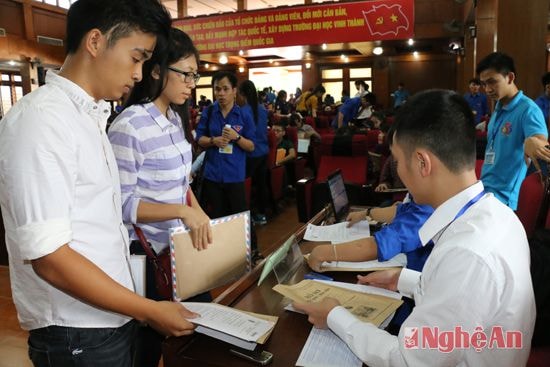 |
| Students enrolling at Vinh University. |
In rural and mountainous areas, it's evident that almost every family with children attending universities and colleges applies for student loan support. According to the Policy Bank's calculations, nearly 600 billion VND is needed annually to disburse funds to help poor households with children studying abroad. A rough estimate suggests that a family needs to provide at least 30-35 million VND per year for a university student. If tuition fees increase, this figure will rise significantly.
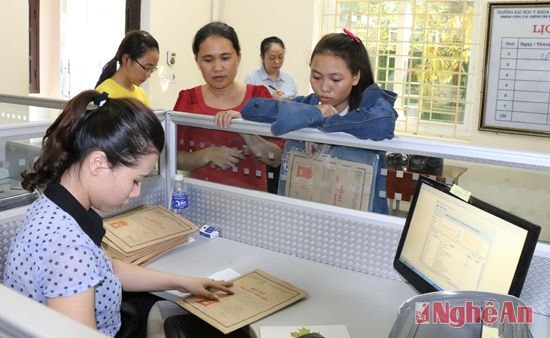 |
| Processing student enrollment at Vinh Medical University. |
For example, in Nghi Long commune, Nghi Loc district, the family of Mr. Tran Van Giap, despite their son enrolling in the college program at Vinh University of Technology for the 2015-2016 academic year, has already paid nearly 4 million VND in initial fees, with more than two-thirds of that being tuition for the first semester. Due to a lack of funds, many students have had to abandon their dream of attending university because they worry about not being able to afford the four years of study.
At the beginning of this school year, upon inquiring at Vinh University, we learned that many students who had applied for admission had to drop out and pursue other careers due to difficult family circumstances. Meanwhile, even if they borrowed money from the bank, they might not be able to repay it immediately after graduation because finding employment is becoming increasingly difficult.
The new tuition fee increase was announced by the Government on October 2, 2015. Accordingly, the tuition fee increase will be gradual and differentiated by field of study. At public universities (not financially autonomous), the increase will be 10% per year from the tuition fee ceiling of the 2014-2015 academic year, and is expected to range from VND 605,000 to VND 880,000 per month depending on the field of study. For financially autonomous universities, tuition fees for some fields of study will increase significantly.
Accordingly, the maximum tuition fee for economics-related fields for the 2015-2016 academic year is 17.5 million VND (for a 10-month academic year). Other fields of study will have higher fees, with the medical and pharmaceutical fields proposed to have a maximum of 45 million VND per year. With this new regulation, tuition fees for economics-related fields will increase threefold, and for medical and pharmaceutical fields fivefold compared to current rates. This tuition fee increase is part of a roadmap to reform the operational mechanisms and gradually grant full autonomy to public higher education institutions, aiming to improve training quality and reduce state budget expenditures.
In fact, research conducted at several universities and colleges in the province over the past years shows that tuition fees have increased annually. Specifically, for universities and colleges managed by the Provincial People's Committee, fee collection has been implemented according to Decision No. 59/2012/QD-UBND dated August 20, 2012.
Specifically, tuition fees for social science majors gradually increased from 365,000 VND/month (2012-2013) to 430,000 VND/month (2013-2014) and 480,000 VND/month (2014-2015); tuition fees for natural science majors increased from 420,000 VND to 570,000 VND/month. For medical and pharmaceutical majors, tuition fees increased from 500,000 VND/month in 2012-2013 to 700,000 VND/month in 2014-2015.
Professor Nguyen Trong Tai, Rector of Vinh Medical University, stated: Compared to other universities, the medical and pharmaceutical fields have the highest tuition fees. Therefore, given the current financial situation of many families, increasing tuition fees may create difficulties for some parents and students. However, if tuition fees are not increased, schools will face difficulties in their operations and it will also affect the quality of student learning.
Currently, at our school, students spend up to 60% of their time interning at hospitals, resulting in significant costs for consumables and equipment. Without the support from the hospitals, the tuition fees paid by the students over the past period would certainly not be sufficient. Furthermore, the school's tuition fees are currently set by the province, making them lower than the national average. Therefore, the school must also be frugal in its spending during the teaching and learning process.
For example, in the same anatomy course, the students from Hai Phong Medical University who went to Vinh for training dissected 42 animals. However, due to limited funds, the students from Vinh Medical University only dared to use less than half of that number.
Although Vinh University does not collect tuition fees monthly, the fee per credit has increased by approximately 10% since the 2015-2016 academic year. Specifically, while the fee was 180,000 VND/credit in previous years, it has now increased to 200,000 VND/credit. On average, students take 30-35 credits per year, so the tuition fee for one year is approximately 6-7 million VND.
Professor Dinh Xuan Khoa, Rector of Vinh University: The current tuition fee of the university is within the average range as stipulated by the Government. The university has also calculated to try to increase it, even if it increases, so as not to affect students' studies. After the increase, the university will also have more resources to invest in teaching and learning equipment, scientific research projects, and scholarships for students will gradually increase.
According to the established roadmap, starting from December 1, 2015, the new tuition fees will be applied to all levels of education. In our province, the Department of Education and Training has already surveyed and gathered opinions from schools to develop a new tuition fee plan from preschool to university level before submitting it to the Provincial People's Council.
Mr. Thai Huy Vinh, Deputy Director of the Department of Education and Training, stated that: The increase in tuition fees must be based on State regulations and documents from the Ministry. In addition, it must also be based on the practical situation of the locality and the needs for educational development…
However, during implementation, the State should have mechanisms and policies such as increasing the loan amount for poor students to cover tuition fees. The State also needs to have policies to support universities located in mountainous areas that still face many difficulties in terms of funding, facilities, and tuition fees that are insufficient to cover expenses. At the same time, there should be specific preferential policies for students from poor households, ethnic minority students, or children of families with meritorious service to the revolution. Funds should be established to support diligent students with good academic achievements.
My Ha


