
Digitalization of terrestrial television and its implementation roadmap.
(Baonghean) - According to the Ministry of Information and Communications' roadmap for television digitalization, analog television broadcasting will completely cease after 2020. The problem is that many people are still unaware of this information and don't understand why analog television broadcasting needs to stop and television needs to be digitized…
The necessity of a digitalization project.
On December 27, 2011, the Prime Minister signed Decision No. 2451/QD-TTg approving the "Scheme for digitizing terrestrial television transmission and broadcasting by 2020".
The goal of this decision is to transform the terrestrial television transmission and broadcasting infrastructure from analog to digital technology in a modern and efficient manner; gradually expand the coverage of terrestrial digital television to serve economic, cultural, and social development, providing diverse, rich, and high-quality television services; form and develop a market for terrestrial digital television transmission and broadcasting to attract social resources; and create conditions for reorganizing and restructuring the system of radio and television stations nationwide.
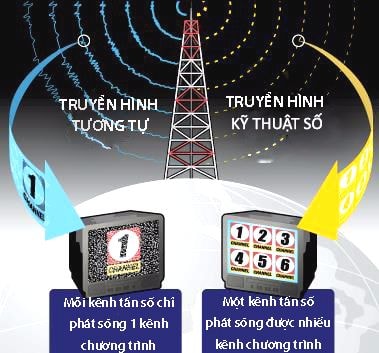 |
| Digital television helps save bandwidth. |
According to the decision, the goal is to ensure that by December 31, 2020, 100% of households nationwide with television sets can watch digital television through various methods. Viewers of terrestrial digital television, replacing analog signals, will be able to watch many more channels with better sound and image quality, and an increased number of channels. Digital television signals will no longer experience interference like analog signals.
With analog television, only one television program channel can be transmitted per 8 MHz frequency channel, whereas the DVB-T2 digital standard (Digital Video Broadcasting - Terrestrial - the standard chosen by Vietnam) allows for the transmission of approximately 20 regular television programs.
With its advantageous bandwidth usage, this "surplus" can be used to develop fourth-generation (4G) broadband mobile communication services and other wireless communication services.
Implementation roadmap
Vietnam will implement digitalization alongside the cessation of analog terrestrial television broadcasting in four phases. Phase 1 will involve the digitalization of terrestrial television in five centrally-governed cities: Hanoi (formerly), Ho Chi Minh City, Hai Phong, Da Nang, and Can Tho. These cities will cease broadcasting all television channels on the analog infrastructure and switch entirely to digital terrestrial television before December 31, 2015.
Phase 2 will involve digitalization in 26 other provinces, including Hanoi (expanded), Vinh Phuc, Bac Ninh, Quang Ninh, Thai Nguyen, Ninh Binh, Khanh Hoa, Binh Duong, Dong Nai, Ba Ria - Vung Tau, Vinh Long, Dong Thap, etc. Within this group, broadcasters will completely switch to digital terrestrial television before December 31, 2016.
Phase 3 continues to expand to 18 other provinces and cities including Thanh Hoa, Nghe An, Ha Tinh, Quang Binh, Binh Dinh, Phu Yen, Binh Phuoc, Soc Trang, Ca Mau... with a final deadline of December 31, 2018. Finally, Phase 4 will proceed with the remaining provinces in remote and disadvantaged areas such as the northern mountainous region, the Central Highlands... with a final deadline of December 31, 2020.
From November 1st, 2015, the Vietnam Television Digitalization Steering Committee announced Da Nang as the first ASEAN city to complete its television digitalization. To switch off analog television broadcasting in Da Nang, a series of tasks were implemented. First, VTV upgraded its digital television coverage in Da Nang and northern Quang Nam to ensure quality television reception for residents. On October 28th, 2015, Da Nang and northern Quang Nam also completed the provision of digital television receivers to poor and near-poor households in the area.
According to current estimates, in Vietnam, there are over 12 million households using antenna arrays to watch television, approximately 5 million households with paid television subscription contracts (cable or satellite), and nearly a similar number of households with terrestrial receivers that do not meet the new standards. For households already using paid television services, there is no need to change equipment unless other needs arise. For the remaining households, switching equipment and technology is necessary, however, the extent of the switch will depend on their specific future needs.
| According to the plan, from April 1, 2014, all televisions using LCD, LED, and other screen technologies with screen sizes exceeding 32 inches, whether domestically produced or imported into Vietnam, must integrate the function of receiving terrestrial digital television signals according to the DVB-T2 standard, in compliance with national technical regulations. One year later, from April 1, 2015, the above regulation will apply to televisions with screen sizes of 32 inches or less. |
Change the receiver
In reality, not everyone can answer questions related to the digitalization of terrestrial television, such as: Why is digitalization necessary? Why buy a new television when the TV at home is still working perfectly? Why should you buy a TV with integrated digital terrestrial television signal reception according to the new standard now? And many other related questions.
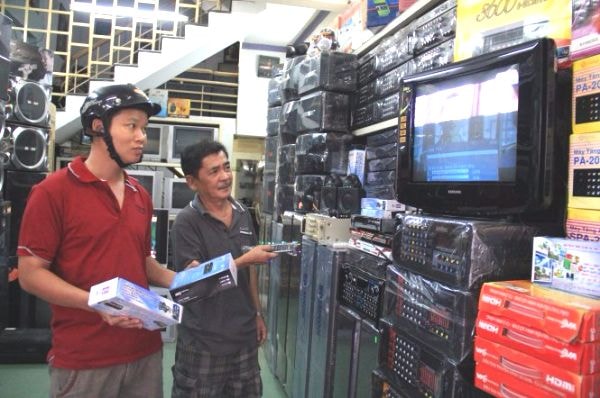 |
| Consumers should choose televisions with built-in digital tuners. |
The reality is that not all receiving devices are compliant with the new regulations. If consumers in cities in Group 1, as mentioned above, buy a TV that does not meet the DVB-T2 standard, they will likely have to purchase an additional digital receiver or opt for a cable TV subscription if they want to watch television programs from the beginning of 2016, even if their need is only for broadcast channels.
Those using TVs without built-in DVB-T2 can purchase an additional set-top box to receive the signal instead of buying a new TV. Households with TVs that already comply with the new standard may not need to buy a decoder if their needs are limited to watching channels that broadcasters do not encrypt for propaganda purposes.
Upon investigation, it was found that not everyone fully understands the above regulation, especially how it directly affects them. By early August 2016, at major electronics supermarkets in Nghe An, when asked about purchasing TVs for their families, most customers only focused on the manufacturer, screen size, and resolution… without knowing or paying attention to the fact that receiving devices must integrate the DVB-T2 standard after April 1, 2014, on devices larger than 32 inches.
| The nationwide television digitalization roadmap is divided into four phases. Phase 1 will implement terrestrial television digitalization in five centrally-governed cities. Nghe An is one of 18 provinces in Phase 3, with a deadline of December 31, 2018. The remaining provinces, located in remote and mountainous areas such as the North and Central Highlands, have a deadline of December 31, 2020. |
According to the roadmap, once regional terrestrial digital television broadcasting service providers are established and enter the broadcasting market, people will be able to watch even more television channels. At that time, people in a province will not only be able to watch channels from their own province but also channels from other provinces in the same region. A requirement in the implementation of the project is to avoid interrupting the ability to watch all the broadcast television channels that Vietnamese television stations are currently providing to viewers, especially after the cessation of analog broadcasting. It is important for users to know that the implementation roadmap for each region will be specifically defined and will be completed entirely by 2020.
Phan Nguyen Hao(Nghe An Department of Information and Communications)


