
The fate of the Zimbabwean president after the coup.
President Mugabe could rely on loyal forces to launch a counterattack, but if that fails, he will be forced into exile.
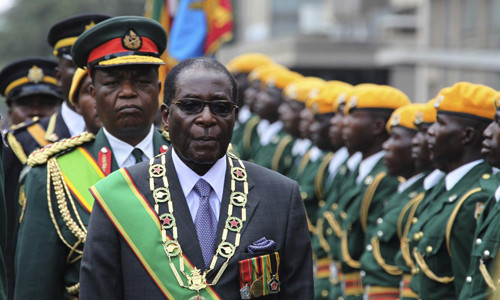 |
| President Robert Mugabe reviews the Zimbabwe honor guard in 2009. Photo: AP. |
On November 15, the Zimbabwean army unexpectedly deployed armored vehicles to secure key positions in the capital Harare and placed President Robert Mugabe under house arrest. Although Zimbabwean military leaders refuse to acknowledge it as a coup, this event could end Mugabe's 37-year rule.
Through the mediation of South African envoys and Zimbabwean church leaders, the country's military is seeking to negotiate with President Mugabe to ensure a bloodless transfer of power, but Mugabe remains adamant about not stepping down, plunging the country into an uncertain future with many possible scenarios, according to the BBC.
Mugabe resigns
Just hours after General Sibusiso Moyo announced on television that the Zimbabwean military was taking over power, rumors surfaced that 93-year-old President Mugabe would soon make a formal statement to the nation announcing his resignation.
However, that did not happen, as Mugabe insisted he remained the country's sole legitimate ruler and refused to resign before next year's elections. Nevertheless, observers believe President Mugabe is currently in a very weak negotiating position, making his resignation a highly probable outcome.
If Mugabe agrees to step down, former Vice President Emmerson Mnangagwa would take over the leadership of the ruling Zanu-PF party. Many believe that Mugabe's decision last week to dismiss his deputy Mnangagwa was the "last straw" that led to the military coup.
Mugabe remains in power.
Despite being under house arrest, Zimbabwean military generals still refer to Mugabe as "Mr. President." Many officers in the military, as well as those in the ruling Zanu-PF party, have been close allies of Mugabe since he led the Zimbabwean liberation movement.
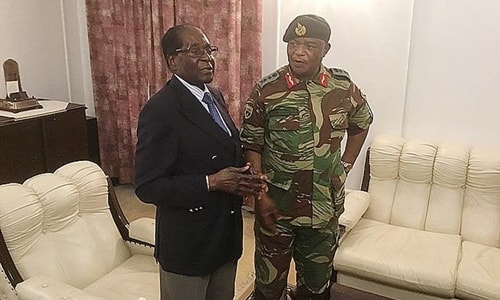 |
| General Chiwenga speaks with Mr. Mugabe while the latter is under house arrest. Photo: News24. |
According to many analysts, the Zimbabwean military has no animosity towards President Mugabe. What angers them is the power grab by First Lady Grace Mugabe, who for months has sought to oust Vice President Mnangagwa to become Mugabe's sole successor.
Nick Mangwana, a representative of the Zanu-PF party in the UK, said that Mugabe could remain president in name until the party holds its national congress in December. At that time, Mnangagwa could be officially elected as party chairman and become the new national leader.
However, it is also possible that Mugabe will remain president until the end of his term and only step down when the people of Zimbabwe elect a new leader in the general election next year.
Mugabe organizes a counterattack.
According to commentator Lebo Diseko, the current coup is not an attempt to change the regime in Zimbabwe, but rather an internal power struggle within Zanu-PF, the party that still wields considerable influence within the military. The Zimbabwean military is considered the armed wing of the Zanu-PF party.
In addition to officers who had served Mugabe for many years, the Zimbabwean president also commands the Presidential Guard, comprised of the most elite and loyal members of the military.
Therefore, Mugabe could still rally forces to launch a counterattack to quell the coup and regain power. However, observers believe this scenario is highly unlikely.
With Mugabe under house arrest, it was difficult for him to rally support from the soldiers, as television and radio stations were under military control. The Presidential Guard's barracks were also surrounded by army soldiers as they advanced into the capital.
When General Constantino Chiwenga issued a warning about the consequences of the "purge" within the Zanu-PF party last week, around 90 senior military officers stood behind him, showing support for the armed forces commander. This suggests that not many officers are willing to defend President Mugabe under the current circumstances.
Mugabe was forced into exile.
If the Zanu-PF party and military generals fail to reach an agreement on the transfer of power, or if a counterattack attempt fails, it is highly likely that Mugabe will have to leave the country and live in exile.
In this case, South Africa was the most likely place for Mugabe to turn to. It was a country where he was highly respected by the people, largely due to his past support for the fight against apartheid.
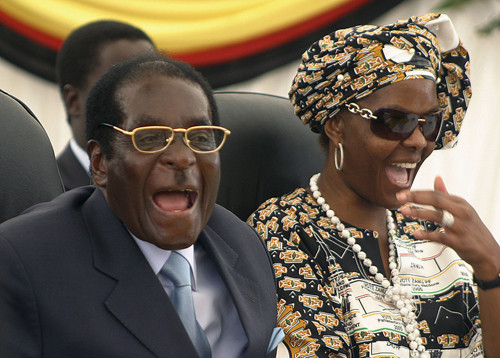 |
| Mr. Mugabe and his wife, Grace. Photo: AFP. |
In fact, the opposition EFF party in South Africa has called on the government to be "ready to welcome President Mugabe as a political refugee." The Mugabe family is believed to own numerous properties in South Africa.
However, his wife, Grace, may face some trouble if she seeks asylum in South Africa. In August, she was accused of assaulting model Gabriella Engels in a Johannesburg hotel room, but was later acquitted due to diplomatic immunity. Despite this, Engels is now lobbying a South African court to revoke Grace's immunity.
If Engels' efforts are successful, Grace could face prosecution for assault if she seeks asylum in South Africa. In that case, the Mugabe family could relocate to other countries such as Singapore or Malaysia, where they also own significant real estate.
According to VNE
| RELATED NEWS |
|---|


