
Coach Park Hang-seo analyzes how to counter the opponent's playing style.
By outsmarting the Philippines, coach Park Hang-seo helped Vietnam secure a crucial away victory using his familiar weapon.
Starting diagram
The semi-final saw a crucial adjustment by coach Sven-Goran Eriksson. Instead of the 4-4-2 formation used throughout the group stage, the Philippines started with a 4-2-3-1, with captain Phil Younghusband as the lone striker and supported by the trio of Schrock, Bedic, and Reichelt.
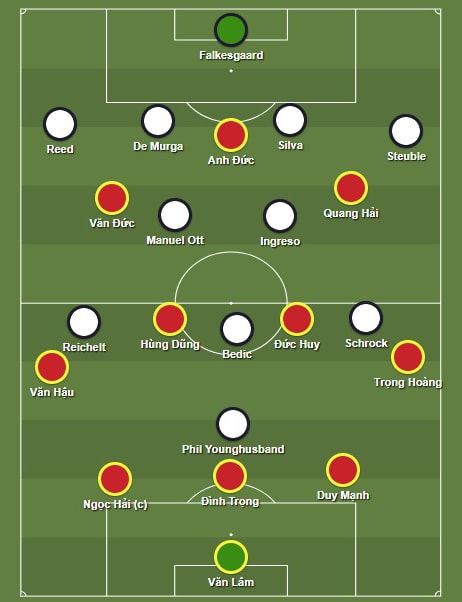
Coach Eriksson's adjustment can be seen as a way to cope with the Philippines' personnel losses after the group stage, when key players – notably the versatile Sato and central midfielder Strauss – had to return to their clubs. Additionally, he may also want the Philippines to have better control of the midfield by increasing the number of players in that area.
Vietnam, meanwhile, remained faithful to their familiar 3-4-3 formation. The most notable detail is that the central midfield pairing from the match against Cambodia – Hung Dung and Duc Huy – remained unchanged. Coach Park Hang-seo clearly wanted to increase the fighting ability of the midfield. Compared to the Quang Hai - Xuan Truong pairing, Hung Dung and Duc Huy are superior in terms of tackling ability and positional awareness.
In Vietnam's formation, the mobility of the attacking midfield duo Quang Hai and Van Duc is crucial. When attacking, both will drop back to play closer to Anh Duc, leaving the flanks open for wing midfielders Van Hau and Trong Hoang. When defending, they will drop back to play level with the central midfielders. In this setup, Vietnam will switch to a 5-4-1 formation.
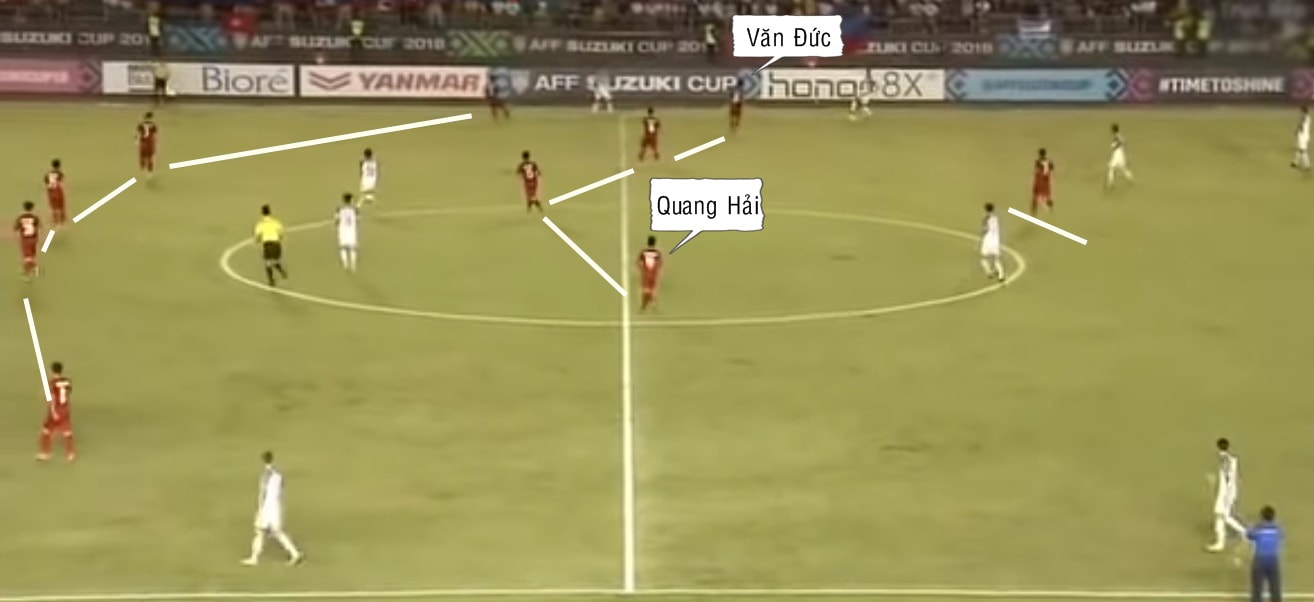
Apply pressure from midfield.
At times, the Vietnamese players pushed forward, putting pressure near the Philippines' penalty area, but the defensive strategy throughout the match remained a pressing mid-block approach. This means they only started pressing intensely when the opponent brought the ball to the halfway line.
With this pressing style, the Philippines' center-backs are free to pass the ball back and forth. But when the ball reaches one of their midfielders, Vietnam's central midfielders will quickly close in to put pressure on them. Coach Park Hang-seo's intention is to force the Philippines to abandon their plan of building play sequentially through the midfield. The opponent will either have to pass the ball back to their center-backs or make early passes, often long passes that are mostly inaccurate.
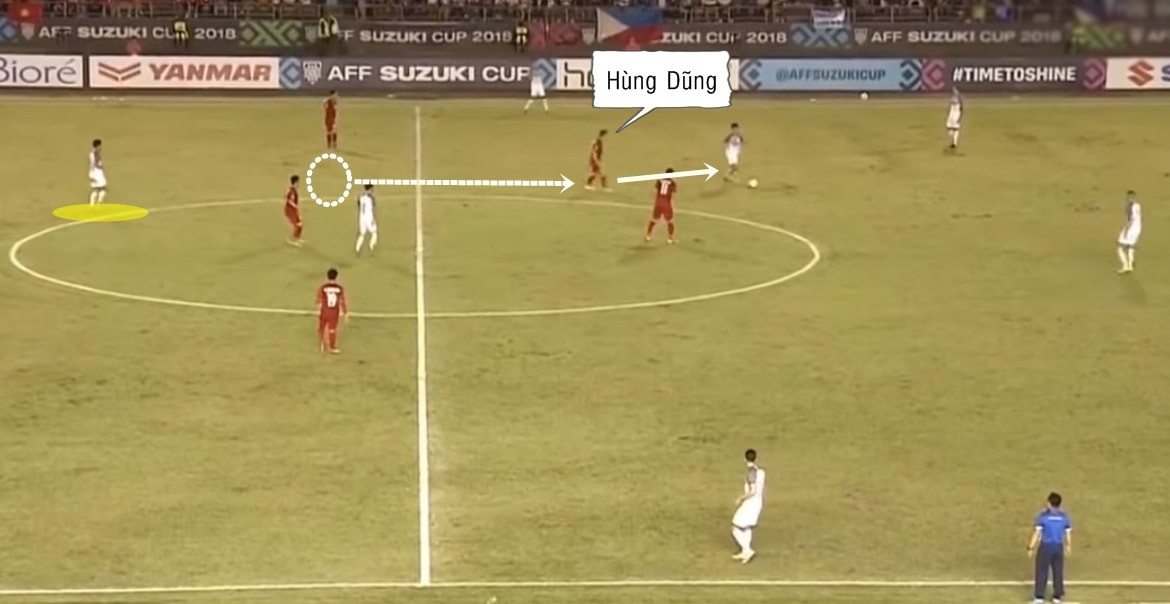
In that situation, Hung Dung abandoned his midfield position to push forward and put pressure on the Philippines' midfielder, Manuel Ott, who had the ball. Their number 10, Bedic, was completely unmarked at that moment. However, Hung Dung's early pressure prevented Ott from risking a pass to Bedic, forcing him to pass back to the center-back to start all over again.
Unable to build attacks through the center, the Philippines were forced to move the ball to the flanks. However, this was something that coach Park Hang Seo had anticipated and prepared for. Every time the ball was passed to the Philippines' full-backs, a "pressing signal" was activated. The two attacking midfielders, now playing as wingers, would immediately apply intense pressure.
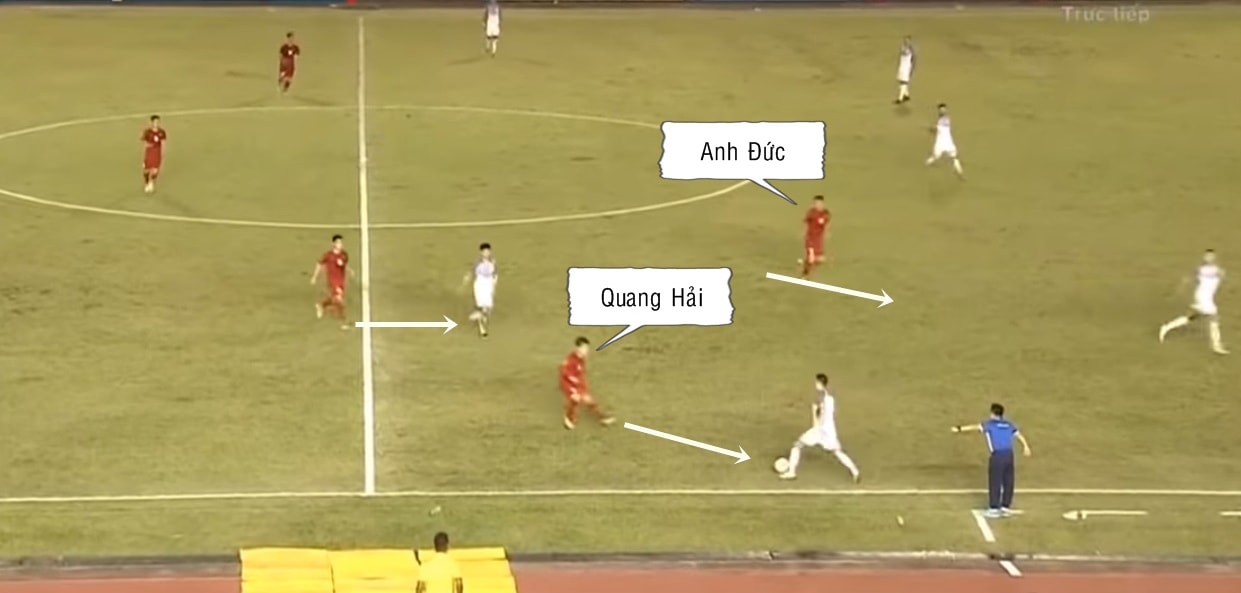
In that situation, the Philippines' left-back, Steuble, didn't have many passing options. The most viable option was to turn back and pass to the nearest center-back. If he tried to move the ball forward, the Philippines' receiving player would immediately be put under immense pressure.
Here's Phil Younghusband – who had to leave his forward position to drop back and receive the ball from Steuble. But as soon as he touched the ball, Quang Hai was there to both pressure the ball and block any attempt to pass it back to Steuble by shielding the ball from the opposing left-back. Behind Younghusband, Duy Manh was also applying intense pressure. Meanwhile, Hung Dung blocked the remaining passing option.
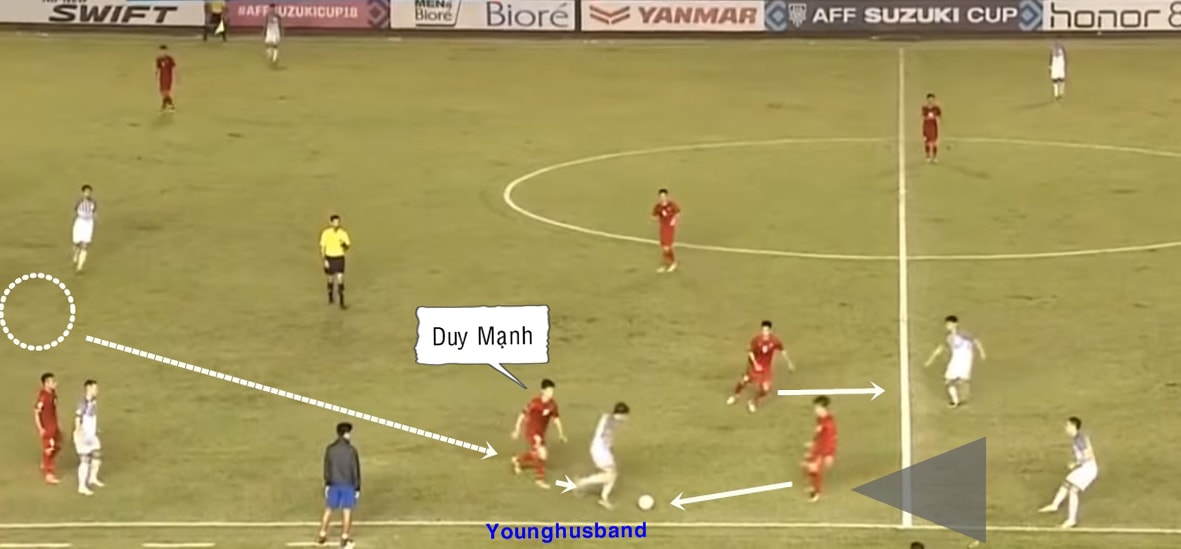
This pressing style was employed by Vietnam throughout most of the match, at least while their physical condition remained stable. As a result, the Philippines were unable to consistently push their formation forward. Their familiar tactic of overlapping on the flanks and using a large number of players against a smaller number – which had been very effective in the match against Thailand – was almost completely absent.
The Philippines therefore resorted to many long passes, hoping to exploit the gaps between Vietnam's wide center-backs and wingers when these players – Trong Hoang or Van Hau – pushed forward. However, due to the low quality of the passes and the lack of support for the recipients, such attacks were often disjointed and easily neutralized by Vietnam's defenders.
Vietnam's direct attacks
Like Vietnam, the Philippines often defend with a mid-block. However, unlike our opponents, we have quite a few options for moving the ball forward. The common thread in these options is their directness. Defenders frequently launch through passes to midfielders, while midfielders always try to get the ball behind the opponent's defense.
Both of Vietnam's goals followed the same pattern: a winger passed the ball behind the Philippine defense for the forwards to run onto. For the opening goal, Van Hau provided the pass for Anh Duc's header. For the second goal (2-1), Trong Hoang chipped the ball to Van Duc, who broke free. The Philippine defenders were completely passive in the face of the unexpected and clever movements of the Vietnamese forwards.
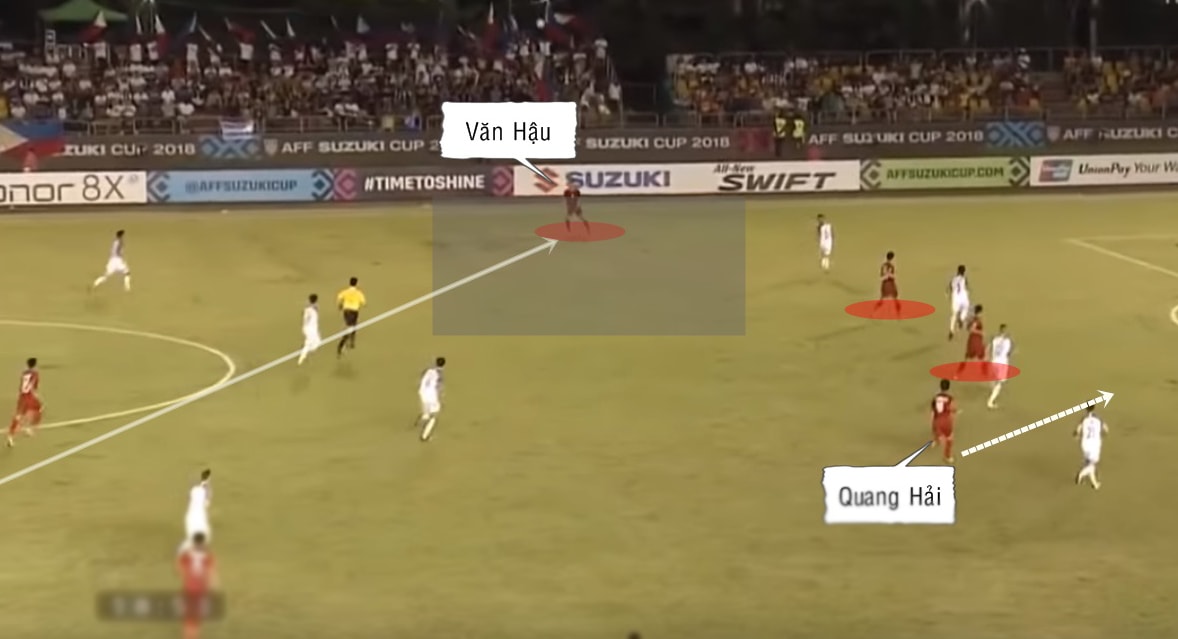
The situation where Quang Hai missed the opportunity to increase the score to 2-0 in the first half is also a prime example of the directness in Vietnam's playing style. It began with a powerful diagonal pass from Duy Manh to Van Hau, who received the ball in a very comfortable position, with four Philippine defenders pinned down by three Vietnamese attackers. After controlling the ball, Hau immediately chipped it into the penalty area following Quang Hai's run. Thanks to his earlier start, Quang Hai had completely occupied the space between the Philippine center-back and left-back. However, his touch was not precise (using his shoulder), otherwise Vietnam would have scored a second goal in the first half.
The movement and positioning of Quang Hai and Van Duc, especially Van Duc, who was praised by coach Park Hang Seo after the match, played a crucial role in Vietnam's attacking plays. As analyzed, the Philippines defended in the mid-block, with a 4-2-3-1 formation. However, one of their two defensive midfielders often had to push forward to put pressure on Vietnam's central midfielders. In that case, only one defensive midfielder remained in front of the Philippines' defense, and there was plenty of space beside him.
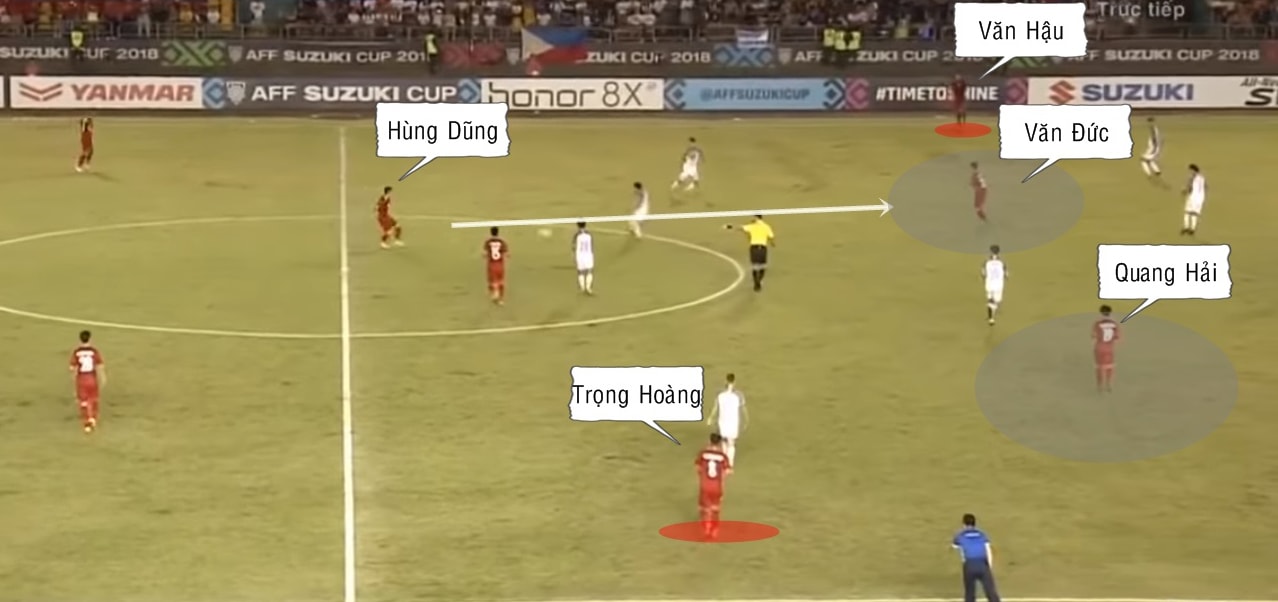
Quang Hai and Van Duc will proactively attack this space. Their positioning, combined with one or both wingers pushing forward to contain the Philippines' full-backs, will clearly confuse the opponent. If the central defenders push forward, they will be easily bypassed, leaving large gaps behind them. By maintaining their positions, Hai and Duc will have the opportunity to receive the ball, turn, and attack directly through their defense.
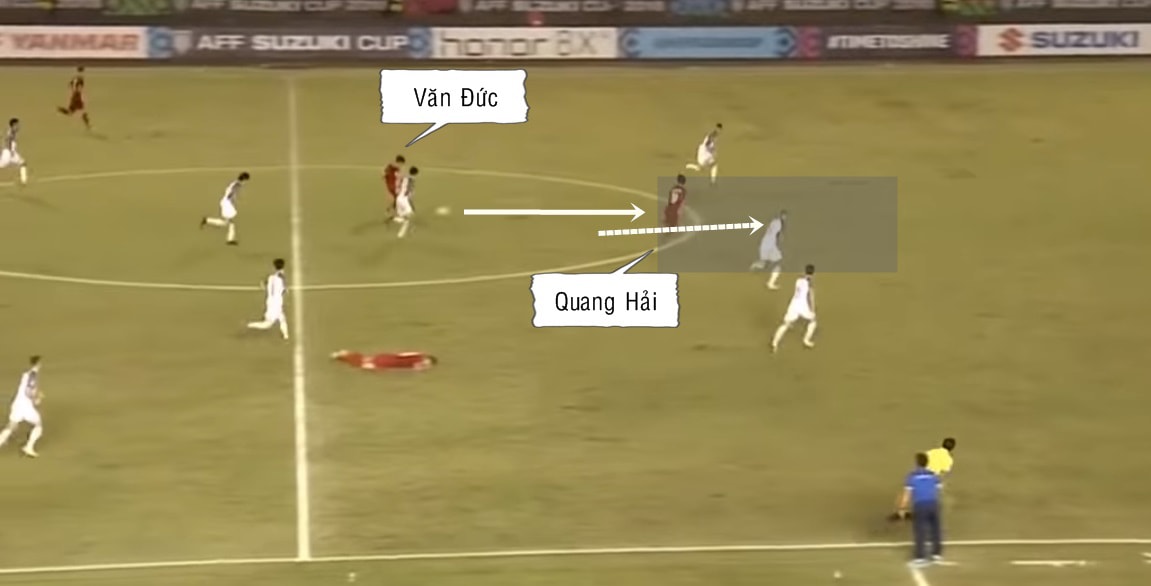
As in this situation, Philippines' center-back De Murga decided he needed to leave his position to steal the ball from Van Duc. But the Nghe An player easily bypassed him with a skillful turn. At that moment, a large gap appeared in the Philippines' defense at the exact spot De Murga left. Quang Hai proactively attacked this gap. Van Duc also made a good through pass. But Hai lacked the stamina to challenge the two Philippines defenders.
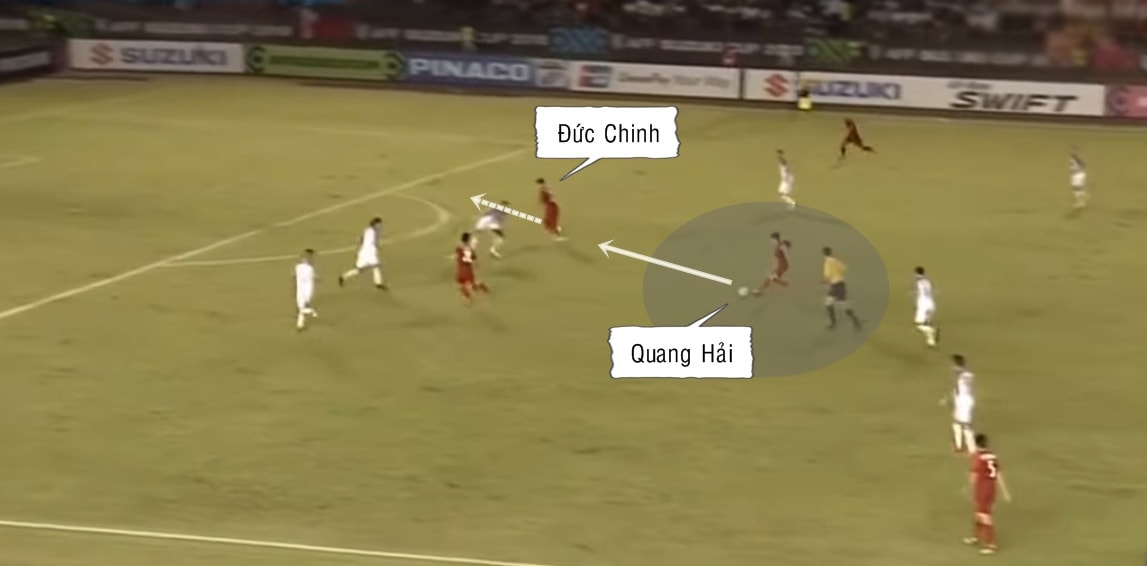
In another situation, when the opposing defender decided to hold his position, Quang Hai had the opportunity to receive the ball from Ngoc Hai's through pass. The number 19 player had plenty of space and time to receive the ball, turn, and then thread a pass to Duc Chinh. In this situation, Chinh could have done more if he had been a little more decisive.
Key takeaways
Overall, Vietnam deserved the victory. If Duc Chinh or Cong Phuong had been more clinical, the team could have scored at least two more goals. However, the match against the Philippines also revealed some issues that coach Park Hang-seo must address if he wants his team to reach the top.
Firstly, there's the issue of concentration. Vietnam's first goal conceded in the 2018 AFF Suzuki Cup stemmed from a systemic lapse in concentration, not from Ngoc Hai, Van Hau, or any individual. That goal came from a situation where Quang Hai wasn't aggressive enough in his challenge after an opponent's throw-in. Schrock still found space to pass to Bedic.
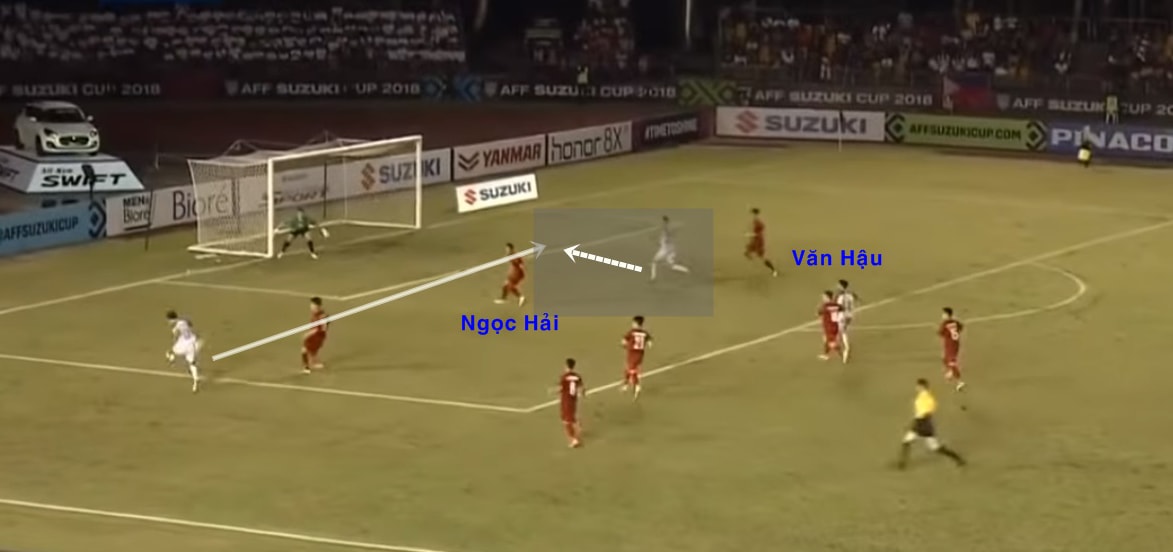
When Bedic received the ball, Duc Huy's challenge wasn't aggressive, allowing the Philippine player to comfortably flick the ball down the wing to Phil Younghusband, who had already started moving. Having the advantage of moving early and reaching high speed, the Philippine captain comfortably dribbled the ball near the end line and delivered a beautiful cross into the box for Reichelt to rush in and shoot past Van Lam.
In this situation, it's difficult to blame either Ngoc Hai or Van Hau. The play happened too quickly, the cross was tricky, and the Philippine player also moved very cleverly. The Vietnamese players should have neutralized the threat early on, as soon as it emerged.
The same was true for the Philippines' second significant chance, Reichelt's close-range tap-in at the end of the match. In that play, our defensive system revealed enough weaknesses.

As shown in this image, two Vietnamese center-backs were pressing Phil Younghusband. The other two defenders, Ngoc Hai and Van Hau, were distracted by the opposing player's diagonal movement, resulting in no one noticing Reichelt quietly advancing. Schrock, who has excellent footwork, delivered a perfect pass to Reichelt, but fortunately, the latter's shot went over the crossbar. In this situation, the Vietnamese midfielders should have immediately pressured Schrock to prevent him from shooting. It's undeniable that we were aware of this player's danger.
Another issue was physical fitness. Constantly applying high-intensity pressure severely depleted the Vietnamese players' stamina, especially in the two key positions of Quang Hai and Van Duc. From around the 70th minute onwards, the defensive system began to crumble as the players lacked the energy to both press and maintain their positions. As a result, the opposing team started creating more attacking opportunities on the flanks than on the flanks.
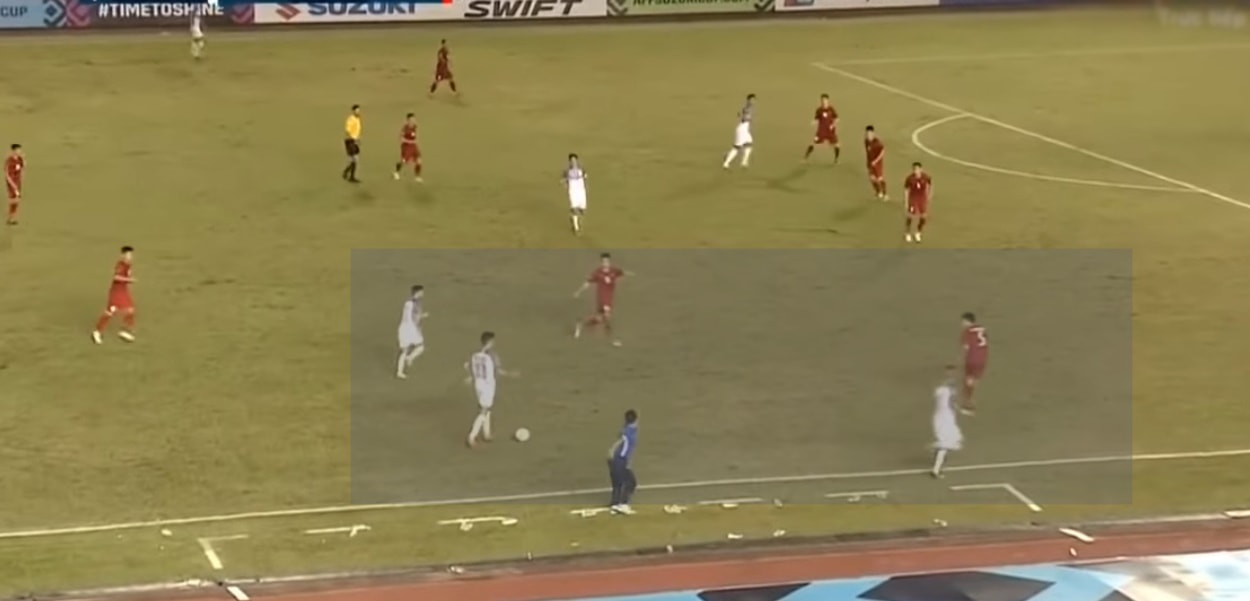
In this situation, Vietnam's defenders no longer received the same support from the attacking midfielders as before. The Philippines thus created a 3-on-2 situation on the wing, something they had failed to do throughout the first half. The final 20 minutes were also the period when the Philippines created the most dangerous attacks on Vietnam's goal. Besides coach Eriksson's sensible adjustment of bringing James Younghusband onto the field and switching to a 4-4-1-1 formation to increase the Philippines' presence in Vietnam's penalty area, the decline in the visiting players' physical condition can also be considered a contributing factor...
A 2-1 away win is certainly advantageous for Vietnam. However, the difference is only a narrow one-goal margin, and Vietnamese fans surely haven't forgotten the nightmare of the 2014 AFF Cup, when we lost 2-4 to Malaysia at home despite leading 2-1 in the first leg. In the return match at My Dinh Stadium on December 6th, Vietnam must, on the one hand, continue to exploit their ability to neutralize the opponent's playing style, but on the other hand, must also consider a strategy to settle the match early, while their physical condition is still good.


