
North Korean Su-25s carry new cruise missiles: are they nuclear-capable?
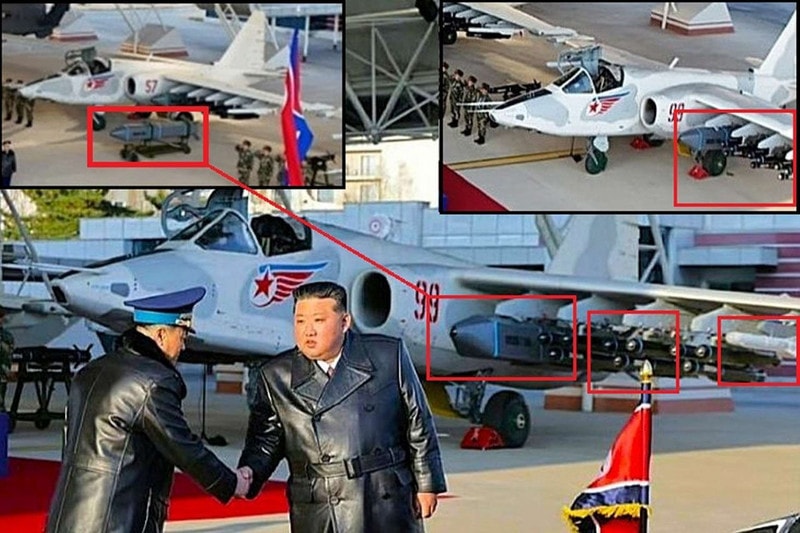
North Korea showcased a cruise missile mounted on a Su-25; TWZ assessed it to be capable of carrying a nuclear warhead, with an estimated range of 200–500 km, allowing it to be launched beyond air defense range.
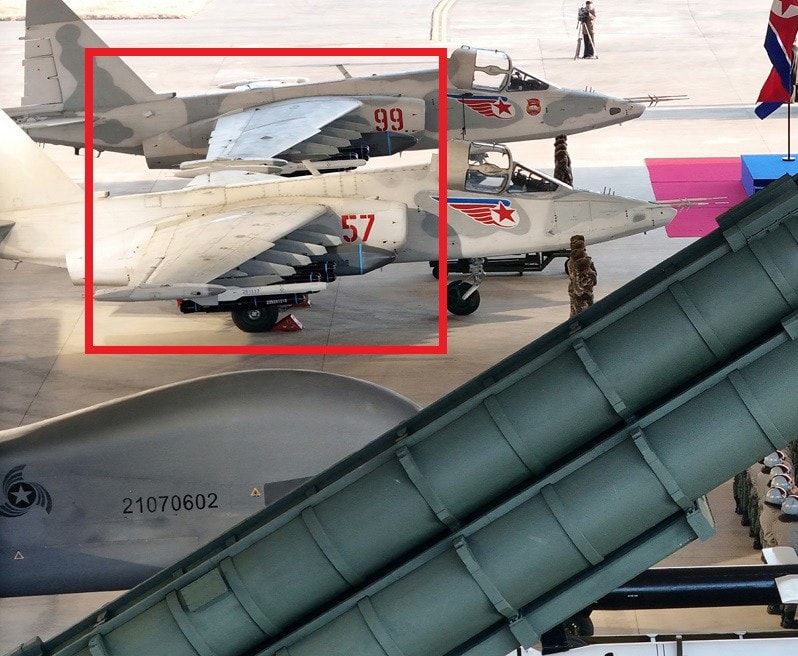
According to The War Zone (TWZ), the new generation air-launched cruise missile unveiled by North Korea and mounted under the wing of the Su-25 could be equipped with a nuclear warhead. South Korean analysts estimate the weapon's range to be 200–500 km, allowing it to be launched beyond the interception range of many air defense systems and strike high-value targets at predetermined coordinates. Army Recognition suggests that this new configuration could transform the Su-25 into a multi-role attack platform.
Overview
The missile was unveiled during the 80th anniversary celebration of the Korean People's Air Force (KPAAF). TWZ suggested the possibility of "a larger cruise missile equipped with a tactical nuclear warhead at some point in the near future." No official information on detailed specifications is currently available.
Technical analysis
TWZ noted that the Su-25's underwing missile resembles the German Taurus KEPD 350 and shares similarities with the Russian Kh-69. However, the source did not disclose details about guidance, warhead, or engine. Available information is limited to morphological identification and estimated range.
Tactics used
With an estimated range of 200–500 km (according to South Korean analysts), the missile allows for standoff deployment, reducing the risk to the launching aircraft from enemy air defenses. The appropriate attack method involves targeting high-value targets at predetermined coordinates, utilizing terrain and an optimal flight path to penetrate air defense networks.
In its traditional role, the Su-25 is a low-altitude fire support aircraft. The addition of long-range cruise missiles expands its capabilities to include high-precision, long-range combat, reducing the need for deep penetration into dangerous areas.
Comparison and similarity
The fact that the new missile model "resembles" the Taurus KEPD 350 and has some "similarities" to the Kh-69 (according to TWZ) only reflects a visual resemblance; these systems are both air-launched cruise missiles, optimized for precision strikes against fixed targets. The source did not provide further quantitative data for a more in-depth comparison.
Impacts and uncertainties
According to Army Recognition, the new configuration could transform the Su-25 into a multi-role attack platform. However, there has been no official confirmation regarding range specifications, warhead type, or guidance capabilities. TWZ's assessment of the potential for equipping tactical nuclear warheads is stated as a possibility and lacks publicly available evidence.
New generation air-to-air missiles
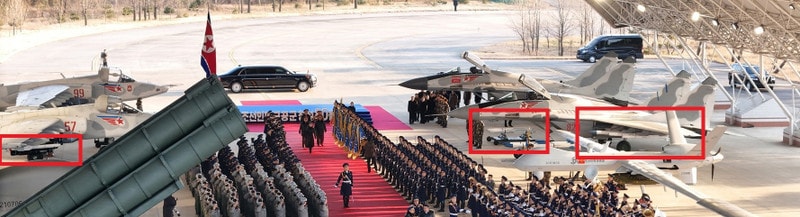
In addition to cruise missiles, North Korea also showcased a short-range air-to-air missile that resembles Germany's IRIS-T. The source did not provide details about the technical and tactical capabilities of this missile.
Summary of data by source
| Characteristic | Information by source |
|---|---|
| Platform | KPAAF Su-25 |
| Type of weapon | New generation air-launched cruise missiles |
| Similar in appearance | Similar to the Taurus KEPD 350; shares similarities with the Kh-69 (TWZ). |
| Estimated range | 200–500 km (according to South Korean analysts) |
| Usage plan | Attack a high-value target at predetermined coordinates. |
| Safety for aircraft carriers | Launched beyond the range of many enemy air defense systems. |
| Nuclear capability | TWZ: A larger version carrying a tactical nuclear warhead is possible in the near future. |
| Impact on Su-25 | Army Recognition: Transforming the Su-25 into a multi-role attack platform. |
| Air-to-air missiles | Appearance resembles IRIS-T; technical and tactical specifications have not yet been announced. |
Overall, current assessments are based on visual observations and opinions from TWZ, Army Recognition, and several South Korean analysts. The system's actual specifications and capabilities will need confirmation from official announcements or independent testing.


