
Su-35 in the Ukrainian battlefield: achievements and limitations
The Russian Aerospace Forces' Su-35 fighter jet holds the record for not being shot down in air combat in Ukraine, while also revealing its limitations compared to newer generation opponents.
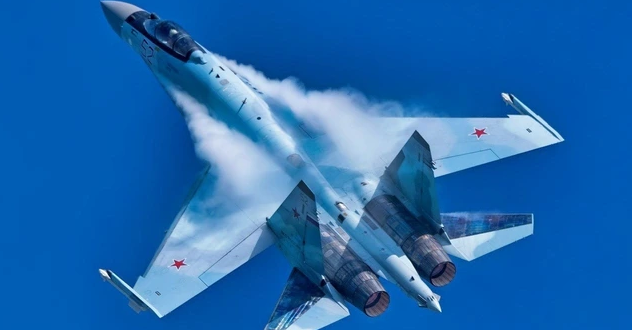
The Su-35 is currently one of the most effective fighter jets of the Russian Aerospace Forces operating in Ukraine. According to Rostec Corporation, the Su-35S variant is used as a key tool in pursuit, air superiority, and ground attack missions, and has not been shot down in air combat after approximately three and a half years of engagement.
Overview of the role of the Su-35 in Ukraine
Rostec describes the Su-35S as a "multi-role hunter-killer aircraft," capable of air combat, ground target engagement, and air defense suppression. The aircraft can carry air-to-air missiles, air-to-ground cruise missiles, and guided rockets, allowing for medium- to long-range attacks.
The corporation's report asserts that the Su-35 production line is operating stably and that this fighter jet "is particularly trusted by the military in all types of combat." On the Ukrainian battlefield, the Su-35 performed both escort missions and participated in suppressing enemy radar and air defense systems during coordinated attacks.
Technical specifications and mobility
Designed based on the Su-27 airframe and a philosophy of super-maneuverability.
The Su-35 was developed based on the Su-27 airframe, but according to the philosophy of "super maneuverability, versatility, and high self-protection." The aircraft is equipped with AL-41F1S engines with 3D thrust vector control, allowing it to perform extreme maneuvers such as the Pugachev Cobra or Herbst Maneuver.
These maneuvers allow the fighter jet to change its angle of attack abruptly, creating an advantage in close-range dogfights when it needs to disengage or take a position to fire air-to-air missiles.
Irbis-E radar and electronic self-defense system
The Su-35 uses the Irbis-E passive phased-array radar with a target detection range of up to 350 km under favorable conditions. This radar can track up to 30 targets and simultaneously engage 8 targets using missiles such as the R-77 or R-27.
The Khibiny electronic countermeasures system mounted on the wings reduces the probability of being locked onto by enemy radar, increasing survivability against medium-range anti-aircraft missiles. This system supports the Su-35 when penetrating areas with high air defense density, especially during ground attack missions.
Multipurpose firepower and ground attack weapons
Despite being designed primarily for air superiority missions, the Su-35 is still fully equipped with air-to-ground weapons. In the early stages of the conflict, the Su-35 is believed to have participated in numerous escort and air defense suppression missions, using Kh-31P anti-radar missiles and Kh-29TD electro-optically guided missiles to attack high-value ground targets.
The ability to combine air-to-air missiles with ground-attack weapons, along with the capability to carry guided rockets, allows the Su-35 to quickly switch between formation protection and tactical target engagement missions.

Combat tactics and the "fire support" model
The Su-35's multi-role capabilities make it the "backbone" in coordinated fire operations. The aircraft can destroy enemy fighter jets, helicopters, and UAVs, while also acting as a guide for surface-to-surface missiles or attack UAVs to approach tactical targets.
Moscow is deploying a “firepower mutualization” approach, combining the Su-35 with the S-400 ground-based air defense network, Buk-M3 systems, and UAV target designation systems. In this model, the Su-35 is a link in an integrated combat architecture, receiving and sharing target data instead of operating as a standalone platform.
At the operational level, when operating in conjunction with the A-50U early warning aircraft and long-range air defense systems, the Su-35 can utilize target data beyond its own radar range, enhancing the effectiveness of beyond-visual-range air-to-air combat.
Airborne performance and risks from ground-based air defense
According to published reports, the Su-35 is said to have achieved a higher number of air victories than any other fighter jet in the post-Cold War era. One notable battle took place on March 5, 2022, when Russian pilots reported shooting down four Ukrainian Su-27 fighters near Zhytomir in a single mission.
Many sources claim that the Su-35 also shot down several MiG-29s, Su-24Ms, Su-25s, Mi-8 helicopters, and dozens of UAVs of various types. During three and a half years of combat, the Su-35 has not been recorded as being shot down in air combat.
However, at least three Su-35s were shot down by Ukrainian air defenses while operating at low altitudes or attacking ground targets. This reflects the significant risks of using 4++ generation fighter jets in a densely air-defense environment, especially if they have to descend to increase the accuracy of air-to-ground weapons.
Technological limitations ahead of the next generation of fighter jets.
Although still considered one of the most maneuverable aircraft in the world, the Su-35 is beginning to reach its technological limit when compared to newer generation rivals. Western analysts believe that the Irbis-E radar is inferior to the active electronically scanned array (AESA) radar on the F-35 or J-20 in terms of signal processing and jamming capabilities.
The Su-35's airframe uses fewer composite materials, resulting in a larger radar cross-section compared to aircraft designed to stealth standards from the outset. Its infrared signature reduction and data link capabilities are considered only average, limiting its survivability in long-range dogfights against opponents with more advanced sensors and data networks.
To compensate for the gap, Russia has integrated the R-77M air-to-air missile into the Su-35. This missile has a range of over 180 km, uses an active radar seeker, and increases the ability to destroy beyond-visual-range targets. Along with this are upgrades to the fire control software, allowing the Su-35 to expand its air-to-air combat capabilities at the operational level, especially when receiving target designation data from the A-50U and ground-based air defense networks.
| Category | Highlights by source |
|---|---|
| Irbis-E Radar | With a detection range of up to 350 km, it can track 30 targets and simultaneously engage 8 targets using R-77/R-27 missiles, but it is inferior to AESA radars in terms of signal processing and anti-jamming capabilities. |
| Engine and maneuverability | The AL-41F1S engine features 3D vector control, enabling maneuvers such as the Pugachev Cobra and Herbst Maneuver, increasing close-range air superiority. |
| Stealth and Survival | The fuselage uses less composite material, has a larger radar cross-section than fifth-generation aircraft, and has average infrared stealth and data link capabilities. |
| Air-to-air weapons | Integrating the R-77M, with a range of over 180 km, with an active radar seeker increases its ability to destroy targets beyond visual range. |
Production, export, and industrial significance
According to Vadim Badekha, General Director of the United Aircraft Corporation (UAC), Moscow is accelerating the Su-35 production line to both supplement its domestic fleet and fulfill new contracts with foreign countries.
In 2025, Algeria, Iran, and Ethiopia confirmed orders for the Su-35, with Iran expected to commission its first batch as early as next year. This demonstrates that the Su-35 maintains significant export potential, especially for countries needing powerful fighter jets but lacking the financial resources or access to fifth-generation combat aircraft.
The production lines at Komsomolsk-na-Amure are highly automated, with almost entirely domestically sourced materials for the airframe and radar, thereby reducing reliance on imported components. According to analysts, maintaining large-scale Su-35 production also helps Russia secure its industrial base, facilitating the transition to the Su-57 in the coming years.
Overall, the Su-35 remains the cornerstone of the Russian fighter force in the Ukrainian battlefield, combining maneuverability, multi-role firepower, and a network of ground support. Simultaneously, technological limitations compared to newer generation fighters force Moscow to continue upgrading its weapons and sensor systems, and gradually transition to more modern platforms.


