
Use AI in teaching, but avoid overuse.
The application of artificial intelligence (AI) in teaching is gaining attention and being implemented by many teachers and schools, contributing to enriching lesson content and innovating teaching and learning methods. However, alongside the clear benefits, the introduction of AI into education also raises a number of issues that need consideration.
Assistancereasoneffective in teaching
Applications of artificial intelligence (AI)Voice integration is gradually becoming a familiar "virtual assistant" in the Biology lessons of Ms. Bui Thi Nga, a teacher at the Quynh Luu Vocational Education and Continuing Education Center. Through the AI virtual assistant, teachers and students can interact directly through question-and-answer sessions. Questions related to the lesson content are answered by the AI using voice, then further prompts students to ask additional questions or relate Biology knowledge to real-life situations.
According to teacher Bui Thi Nga, Biology has long been considered "difficult" by students in the continuing education system. Meanwhile, the facilities and teaching equipment for the subject at the Quynh Luu Vocational Training and Continuing Education Center in particular, and many continuing education centers in the area in general, only meet basic requirements such as models and pictures. After a long period of use, many pieces of equipment are old and damaged, causing considerable difficulties in innovating teaching methods.

“The idea for the AI virtual assistant application stemmed from the desire for a tool to help store images and pre-prepared lesson content, while also being able to answer students' questions. The Biology knowledge is automatically searched and compiled by the AI, so if we want to switch to other subjects like Mathematics, Literature, or Chemistry, we just need to adjust and change the software to use it,” Ms. Nga shared.
Through the application process, Ms. Nga believes that the virtual assistant's answers are generally quite accurate, especially for theoretical content. For application-based questions and those relating to real-world situations, with more interaction and deeper questioning, the AI will provide more diverse suggestions. However, to use it effectively, teachers need to play a central role in guiding, selecting information, and instructing students to utilize this tool effectively and in line with the lesson objectives.
However, according to Ms. Bui Thi Nga, AI virtual assistants should only be used for about 15 minutes after each lesson, once students have grasped the basic knowledge. This time is for consolidating, expanding, and further stimulating their curiosity and eagerness to learn.
Technology is merely a supporting tool. AI cannot and should not replace the role of teachers – those who directly guide, inspire, and motivate students to actively explore and discover knowledge.
Ms. Bui Thi Nga, a teacher at the Quynh Luu Vocational Education and Continuing Education Center.
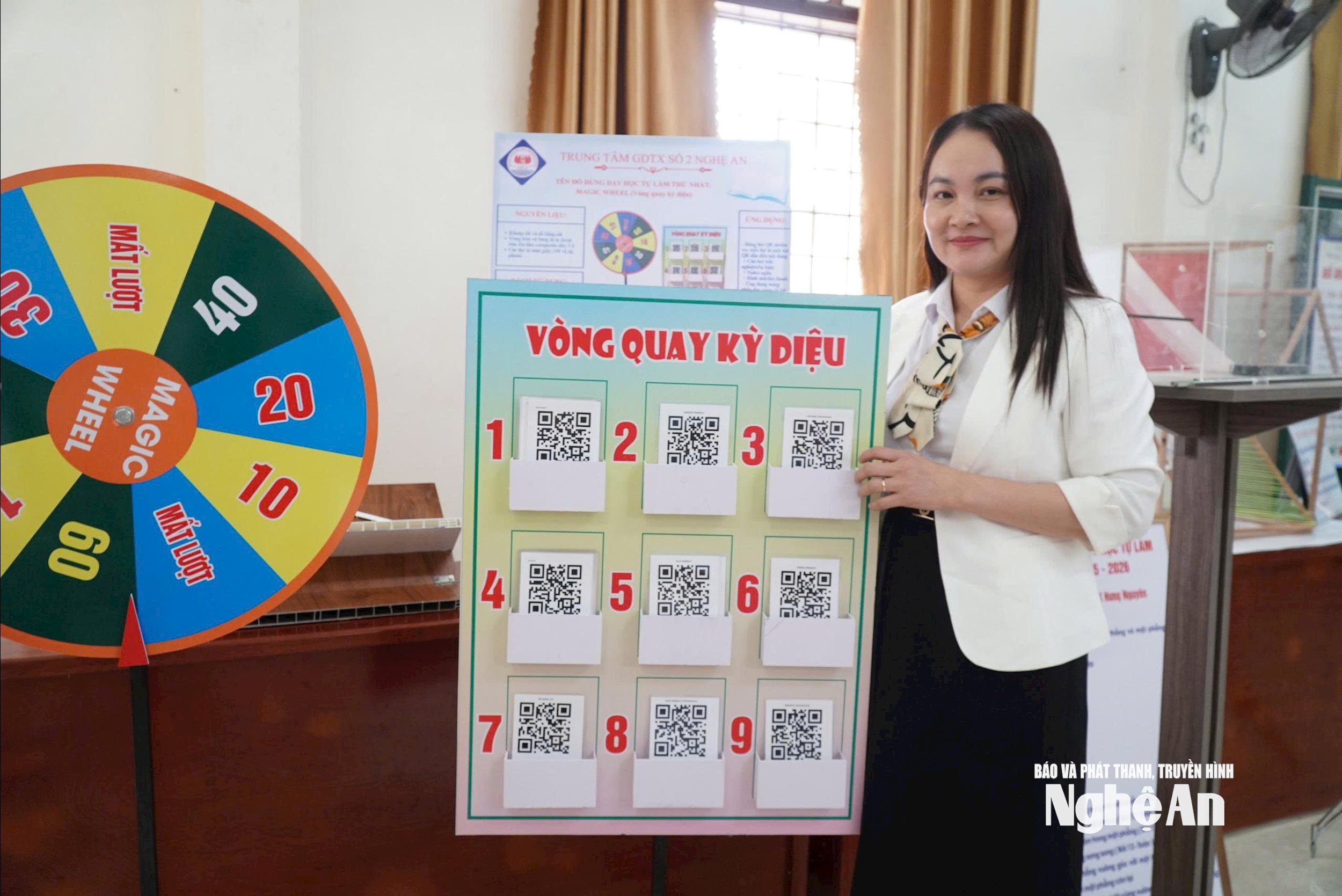
For teacher Nguyen Thi Thu Hien from Thai Hoa Vocational Training and Continuing Education Center, during the teaching of Chemistry, stemming from the reality that many students were hesitant and found it difficult to access knowledge due to the abstract and fragmented nature of the subject, she proactively applied AI technology to her lessons through the project "Discovering Elements - 29 Technological Touchpoints"..This project also recently won first prize at the High School Level Self-Made Teaching Aids Competition organized by the Department of Education and Training.
In this device, instead of just using a traditional periodic table, teacher Thu Hien has created a periodic table integrated with QR codes.,Transforming each chemical element into a "digital touchpoint" helps students access knowledge in a more intuitive and flexible way.
A highlight of her approach is the integration of AI into specific learning content. When scanning a QR code, students not only read basic information about the element but also gain access to the AI-Storybook.ButThis is where AI transforms scientific data into short stories about the history of discovery, properties, and roles of elements in everyday life. This approach helps students remember knowledge more naturally, and is especially suitable for students who learn through visual and linguistic means.
In addition, the teacher uses a specialized AI chatbot for each group of elements (metals, nonmetals, noble gases). Through the chatbot, students can ask questions, learn about the properties and applications of each element, and get AI assistance in solving exercises related to the element they are studying. This interaction takes place during or after class, helping students proactively expand their knowledge according to their individual abilities and needs, instead of simply receiving information passively from the teacher.
In practical exercises, she also utilizes AI to build virtual experiment and chemical reaction video systems..The videos are personally selected, edited, and background noise is removed by her, along with instrumental music, to ensure accuracy, conciseness, and a scientifically engaging learning experience for students.
Furthermore, she also uses AI to design multiple-choice questions and quick assessments through Google Forms, helping students check their understanding immediately after learning. All digital content linked to QR codes can be updated and edited flexibly on the digital platform without needing to reprint the materials, saving costs and ensuring that learning materials are always up-to-date.
A double-edged sword
The application of AI in teaching is currently being used effectively by many schools and teachers. The education sector has also recently conducted numerous training programs and professional development sessions on improving the effectiveness of AI application in schools.
Practical implementation has shown that the application of AI in teaching is an inevitable trend. However, alongside the positive effects, there are still downsides, affecting both teachers and students.
Recently, after receiving the end-of-term exam review materials from her teacher, Ms. Le Thi Hanh's daughter, currently studying at a junior high school in Thanh Vinh ward, was surprised to realize that the materials assigned by the teacher were a product of AI. "When reading the questions, my daughter wondered why all the answers were wrong and suspected the teacher had used AI to create the lesson. Later, in class, the teacher explained that because they had just received training, they were using the application and had carelessly not checked the results," Ms. Hanh added.
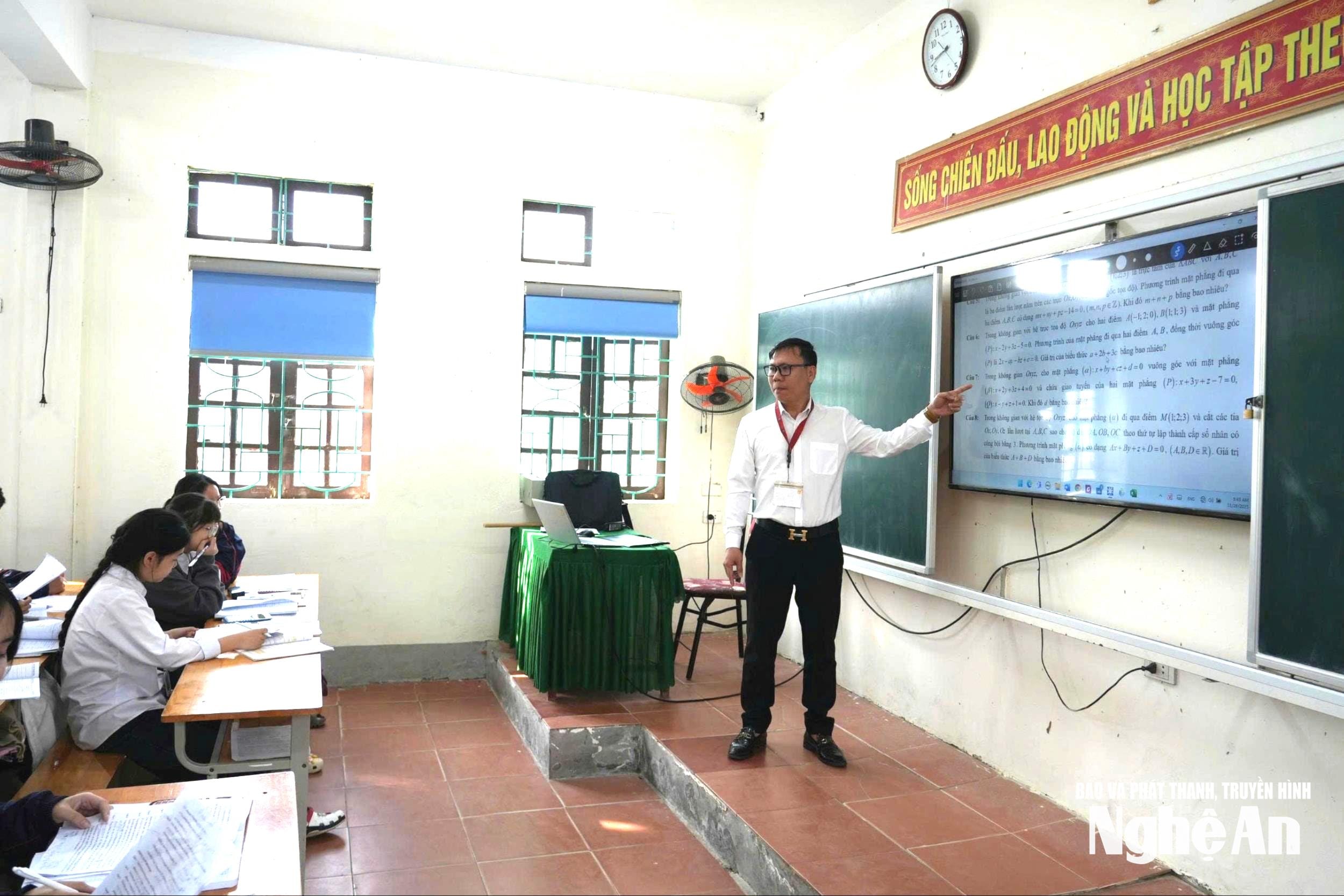
As a teacher with over 20 years of experience, Ms. Tran Thi Tuyet Hong from Nguyen Xuan On High School said that without experience, AI would be a "double-edged sword".
Many people say that using AI would be very beneficial for teachers when preparing lesson plans. But I've tried it and found it ineffective. My subject is science, so there are many formulas and data that are encoded when transferred to Word. This might be because the program we use is free and therefore not optimized.
In fact, it's much faster and safer for teachers to use readily available learning materials to create their lectures. AI only helps build the basic structure; to make it good and engaging, you have to "fill in the gaps" and "rebuild" it.
Teacher Tran Thi Tuyet Hong - Nguyen Xuan On High School
Based on her own experience, teacher Tran Thi Tuyet Hong also believes that not only teachers are susceptible to the misuse of AI, but it is also very dangerous for students if not supervised: "Now, students can just take a picture of their homework and ask AI to solve it to get the answer. Therefore, in addition to reminding and warning students, I believe that clear regulations are needed. Otherwise, students will gradually become passive, dependent on AI, and lose their ability to think critically and develop other skills in their studies."


