
Revising personal income tax: A reasonable third option needs to be added to better reflect reality.
The Ministry of Finance is studying revisions to the personal income tax (PIT) schedule, aiming to reduce the number of tax brackets from seven to five and widen the income gap between brackets. The goal is to ensure greater fairness in income regulation while simplifying tax calculation. Currently, two proposed adjustments to the tax schedule are being widely discussed in the public.
Two proposed options and their impacts
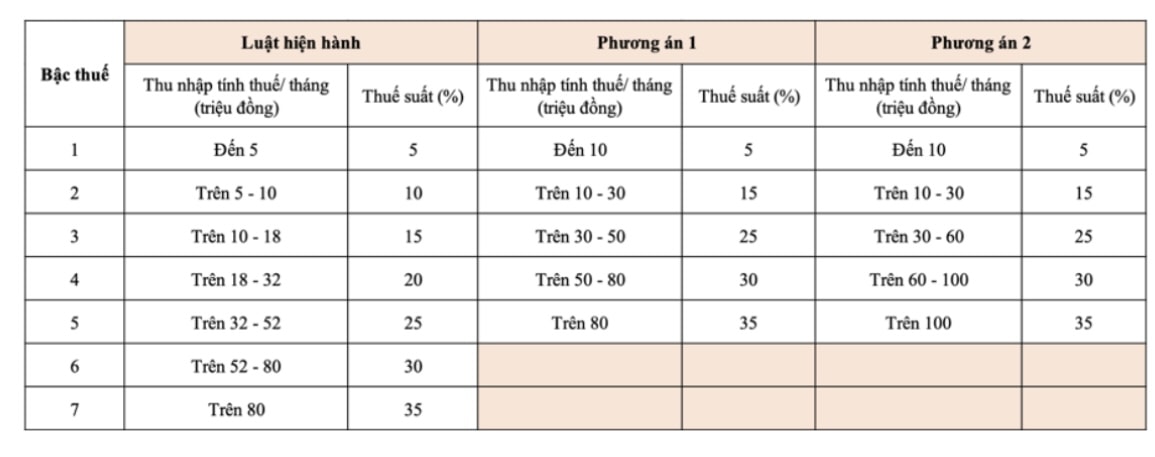
Option 1 suggests that taxpayers in tax bracket 1 will receive a tax reduction if the personal allowance is increased. Those in tax brackets 2 and above will also see a reduction in their tax liability compared to current rates.
Option 2 goes further, offering greater tax incentives for high-income earners. Specifically, individuals with taxable income of VND 50 million/month or less will still receive the same tax reduction as in Option 1, while those with taxable income above VND 50 million/month will receive a larger reduction.
Overall, continuing to apply the progressive tariff system is consistent with international practice. Reducing the number of tariff brackets from 7 to 5 also contributes to simplifying the tariff system, making it easier to calculate and manage.
Nevertheless, the maximum tax rate in Vietnam (35%) remains moderate compared to the rest of the world. For example, Finland has the highest tax rate at 57.3%; Japan, South Korea, and China are all at 45%; and the Philippines and Indonesia also reach 35%. The number of tax brackets in Asian countries ranges from 5 to 13, while in Europe, North America, and Australia, the number of brackets is usually from 5 to 6. This shows that the current proposal from the Ministry of Finance is reasonable in line with the general trend.
Personal deductions and real-life situations
Along with adjusting the tax schedule, the Ministry of Finance is also proposing two options for adjusting the personal allowance in the draft Resolution of the National Assembly Standing Committee.
- Option 1: Adjustment based on the Consumer Price Index (CPI). The deduction for taxpayers is VND 13.3 million/month, and for dependents is VND 5.3 million/month.
- Option 2: Adjustment based on average per capita income and GDP growth rate per capita. The deduction is VND 15.5 million for taxpayers and VND 6.2 million for dependents.
However, both options are causing public concern as they do not accurately reflect the sharply rising cost of living. The basic salary in 2020 was 1.49 million VND/month, which has now increased to 2.34 million VND – a rise of over 57%. Meanwhile, the personal allowance has not changed accordingly, leaving workers feeling disadvantaged.
Shortcomings that need to be addressed.
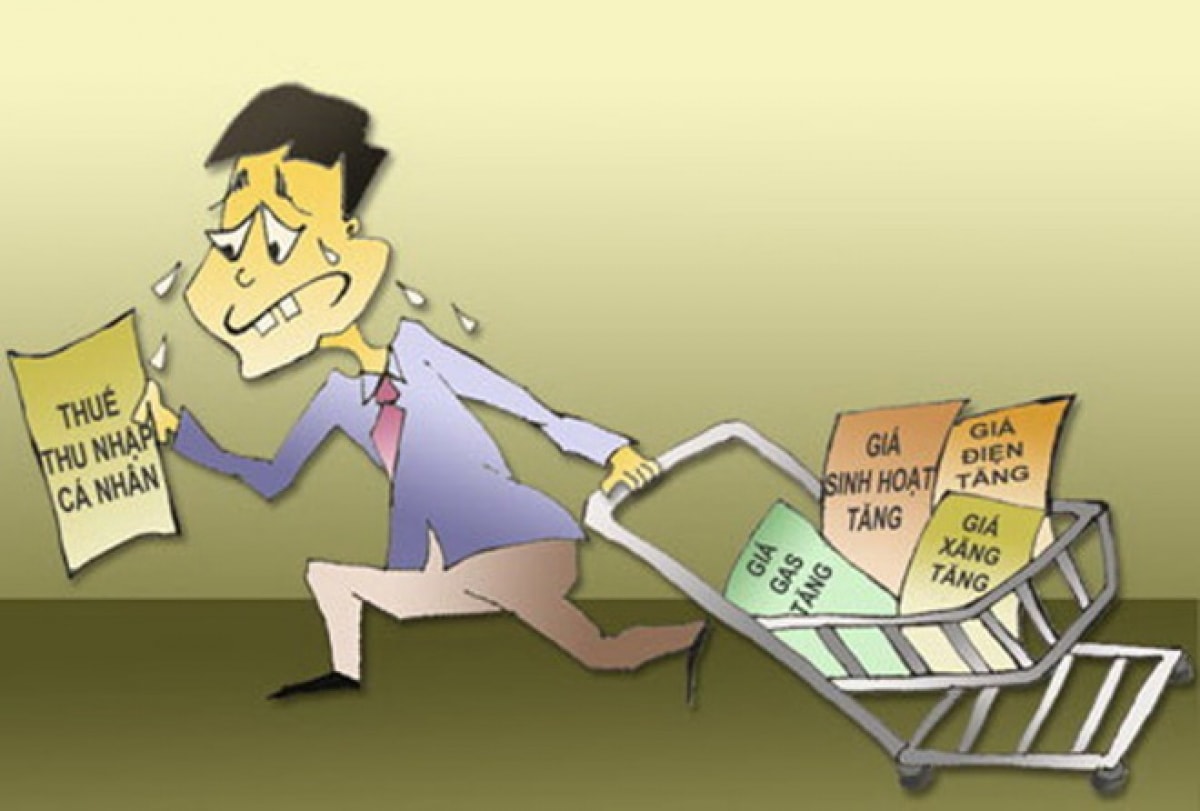
Besides the fact that personal allowances are not realistic, the current tax schedule also has too close a tax bracket, making it easy for taxpayers to fall into a higher tax bracket with only a negligible increase in income. This creates anxiety and even discourages people from striving, because the more they work, the heavier the tax burden becomes.
The complexity of tax calculation not only creates difficulties for taxpayers but also puts additional pressure on tax authorities. Furthermore, this could lead some individuals to evade or circumvent taxes, affecting the transparency and fairness of the tax system.
Currently, the personal income tax threshold after deductions is 11 million VND/month. However, many localities such as Ha Tinh and Ninh Thuan have proposed raising this level to between 16 and 25 million VND/month to more accurately reflect the actual cost of living. In reality, in major cities, an income of 11 million VND/month is barely enough to cover rent and children's school fees.
Both current adjustment options rely on only one factor: CPI or income/GDP per capita. This leads to a policy gap, as it fails to consider the overall context of the cost of living, inflation, real income, and changes in people's consumption patterns.
Therefore, a third, more comprehensive approach is urgently needed: combining both the rate of inflation (CPI) and the growth of per capita income/GDP. This approach would more accurately reflect current living conditions, ensure fairness among taxpayers, and maintain stable revenue for the state budget.
Developing a third option also demonstrates a proactive approach, listening to and responding positively from the authorities to the legitimate aspirations of the people and experts. More importantly, it is a concrete step towards improving tax policy, aligning it with real-life situations and development trends.
Reforming personal income tax is not simply a technical problem, but also a social issue, related to trust and the demand for fairness in policy. When tax policies are built on a rational, fair, and practical basis, people will readily agree, and implementation will become more effective and sustainable.
In the context of current development and integration, it is necessary to recognize that the highest goal of all reform policies is to use the happiness of the people as a measure, to place people at the center and as the driving force of development.
Therefore, in addition to the two options currently being considered, it is essential to add a third option – a balanced, scientific, and humane choice that ensures a harmonious balance of interests between the State, the people, and society as a whole in the process of long-term reform and development.


