
The harmful consequences of misjudging talent.
(Baonghean) - The other day, I went back to my hometown and met my younger brother, who graduated from university two years ago but still hasn't found a job. He's just sitting around at home doing nothing. When we met, all I heard was him complaining and lamenting. After chatting for a while, I heard him blaming life, society, and his family, as if no one appreciates or employs talented people. I suddenly felt incredibly sad. To be honest, I felt less sad for society and more sad for my brother.
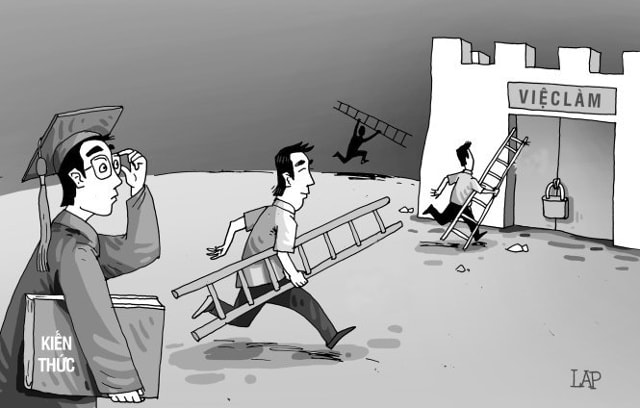 |
| From learning to doing. Image from the Internet. |
In Vietnam, for a long time, many people have held the belief that graduating from university automatically places them among the ranks of the talented and capable. If they obtain a top-tier degree, they might even think no one is better than them. And if they have a master's or doctoral degree, their arrogance is off the charts. Therefore, many, upon encountering difficulties in their careers after graduation, readily resort to the phrase: "Society doesn't value talent," or "Our homeland doesn't know how to utilize talent." They might even go so far as to say that there are no places for talented people these days.
Within the scope of this article, it's difficult to fully define what constitutes a talented person. However, I believe that simply completing a degree, purely in terms of having a diploma, and thinking that one is talented is certainly unconvincing. After all, that's purely about the programs one has studied and learned. That is, the part of the individual that has acquired knowledge. In simpler terms, it means acquiring knowledge from others, from teachers, schools, and research activities of various natures, environments, and levels. This may involve experiments and trials, and may yield certain initial results.
Anyway, that's still the basic acquisition and absorption of theory, simulation of practice, or the initial approach to familiarizing oneself with practical and experimental methods. To simply hold a degree and consider oneself talented or gifted is perhaps an outdated and mistaken notion, a misconception of talent from a bygone era, not necessarily the present day.
Because of the misconception that having a degree means belonging to the elite, many people only focus on attractive programs, holding their degree and waiting. Many are so delusional that they refuse to participate in any challenging job opportunities, instead staying home to depend on their families, stuck in menial jobs day after day with the naively optimistic thought: hiding and waiting for their time to come.
In fact, from East to West, it has always been the same: a degree is merely a legal certification of a training program for an individual who has participated in, completed, and met the requirements for completion of the program and passed the prescribed exams. A truly talented person, however, must be someone who applies their skills and knowledge in theory or practice, achieving positive results, making an impact, and gaining recognition within a specific time and place.
Simply put, a talented person is someone whose work, research, or practical application is valuable, impactful, and recognized. However, if an individual has only completed one level of education, whether university or higher, and has not yet left a significant mark in terms of intellect, labor, theory, or practice, yet considers themselves talented, that is truly a misconception.
From those involved in social management, agency and unit management, employers, to employees, it is necessary to recognize who is truly talented and who is mistaken about talent, in order to utilize them appropriately. In particular, individuals must avoid misjudging talent, which can lead to a mentality of dependence and reliance, wasting labor resources for society and becoming a burden to society, their families, and themselves.
I believe that the case of my younger cousin from the same hometown, who has just graduated from university and considers himself talented, is clearly a misconception. The harmful thing is that because of this misconception of talent, he doesn't bother to seek opportunities, doesn't accept risks to participate in challenging work, and just "waits for things to fall into his lap."
This is truly one of the misconceptions that needs to be eradicated so that those who have completed their education have a correct understanding of job opportunities and do not become superfluous members of their families or society.
Duc Duong
| RELATED NEWS |
|---|


