
Antimatter spacecraft will help humans travel through space.
Humanity's dream of interstellar travel may become a reality thanks to an antimatter propulsion system developed by American physicists.
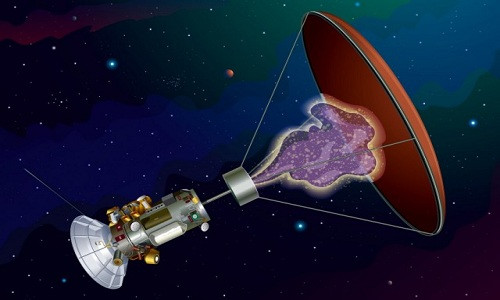 |
Illustration of an antimatter spacecraft. Photo: Steven Howe. |
According to Forbes, two American physicists, Gerald Jackson and Steven Howe, have spent a decade researching antimatter propulsion systems. Their idea is to use 17 grams of antihydrogen material to propel a spacecraft carrying a 10 kg probe to Alpha Centauri, the closest star system to our solar system, over a period of 40 years. The large spacecraft, weighing 100 kg and measuring 5 meters in diameter, would be made of carbon and coated with depleted uranium.
The thrust is generated by antimatter material stored in the probe. When antihydrogen is fired at the spacecraft, the uranium atom undergoes fission. The main product of this fission is two atoms of similar size moving in opposite directions at high speed. One atom collides with the spacecraft, propelling it forward while the other disappears into space. Using this method, the spacecraft can reach speeds of approximately 10% the speed of light and reach the edge of the solar system in just 10 years.
However, one of the main problems the research team needs to address is how to store antimatter. Antimatter is the inverse version of ordinary matter created by humans. Antimatter particles such as positrons and antiprotons have the same mass as electrons and protons but carry opposite charges. When matter and antimatter meet, they annihilate each other, creating pure energy. Researchers are still unsure whether the universe was formed from matter or antimatter.
The idea of an antimatter propulsion system was first proposed in 2003 at the Particle Accelerator Conference in the United States. The research team is planning to build a small-scale model of the propulsion system for testing.
According to VnE
| RELATED NEWS |
|---|
;


