
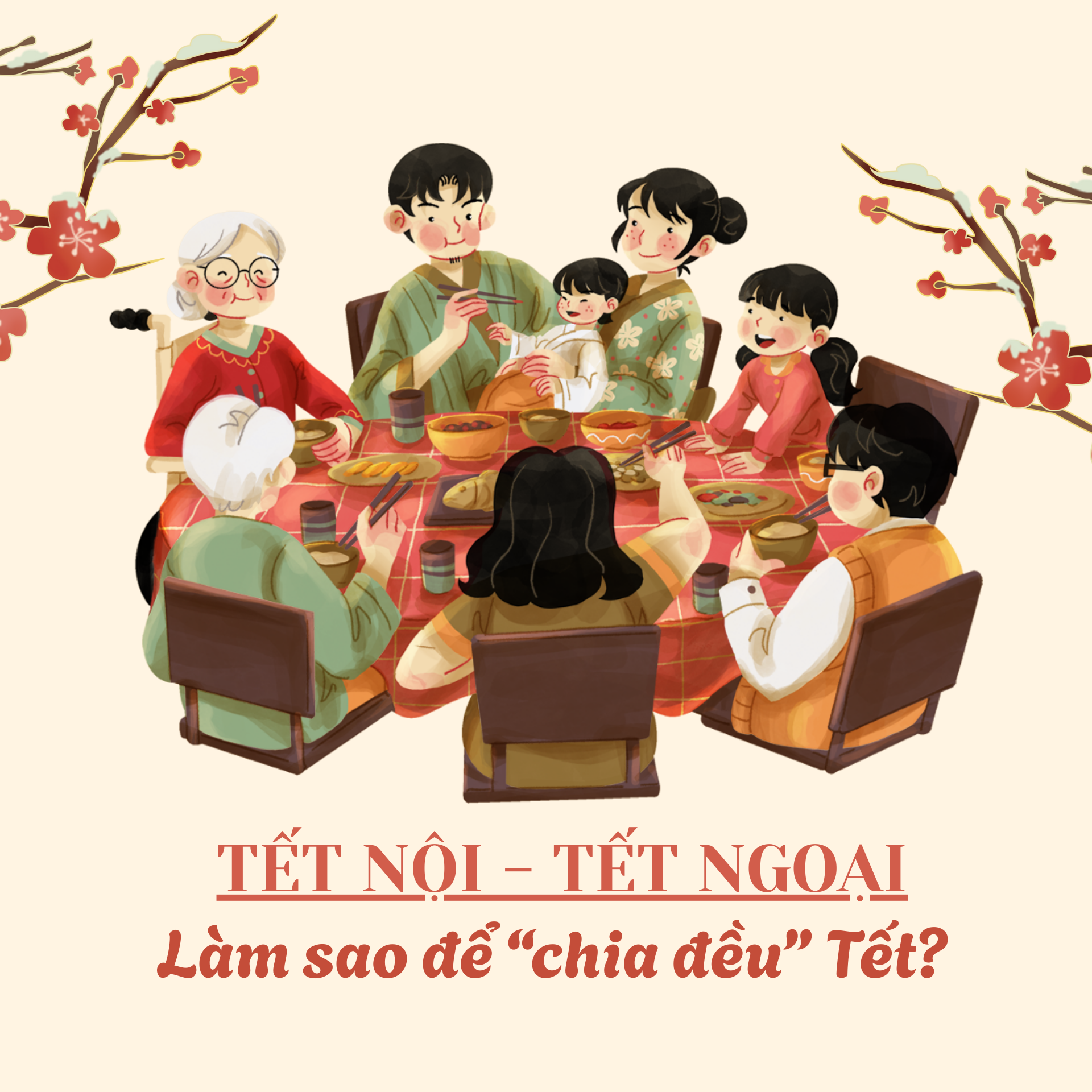
Tet with the husband's family vs. Tet with the wife's family: How to 'divide' Tet equally?
Tet (Vietnamese Lunar New Year) arrives with a mix of excitement and worries. One of the biggest concerns for many daughters-in-law is where to celebrate Tet this year. The debate about celebrating Tet with the husband's or wife's family might seem old-fashioned, but every year it remains a hot topic of discussion.
Content and design:Phuoc AnhFebruary 11, 2026
*****
For many generations, Tet (Lunar New Year) was associated with the idea of daughters-in-law staying at their husbands' homes and returning to their husbands' homes to take care of the rituals and offerings. This was once considered natural and appropriate given the social context where extended families lived together, transportation was difficult, and travel was not easy. After marriage, women almost completely shifted to a different lifestyle, with new responsibilities and established obligations.
However, as social life changes, nuclear families become more common, and children often work and establish careers in other places. Many couples only have a few short days off for Tet (Lunar New Year). This limited time makes the choice of celebrating Tet with the wife's family or the husband's family a matter of careful consideration.
For many women, Tet (Lunar New Year) is both a source of anticipation and pressure. They want to fulfill their duties to their husband's family but also yearn to return to their parents and siblings during the first days of the new year. This internal conflict often unfolds silently. Many choose to suppress their desires to maintain outward harmony, but the feeling of being left behind lingers, simmering through each Tet season.
On the husband's side, the desire for reunion is also very genuine. For many parents, Tet (Lunar New Year) is a rare occasion when all their children and grandchildren gather together. The presence of the daughter-in-law signifies a complete and warm family. Once the son has married, the daughter-in-law's role in preparing for Tet is often taken for granted, and few consider it necessary to change. This default assumption of the obvious leads to a mismatch in perspectives and dialogue between generations, sometimes turning sincere wishes into invisible pressure.
The debate over whether to celebrate Tet (Vietnamese New Year) with the husband's family versus the wife's family cannot be viewed simply through the lens of right or wrong. It reflects the clash between long-standing customs and the pace of modern life, where family relationships need to be rearranged in a more flexible way. The important thing is not to stick to a rigid pattern, but to be able to listen and adapt to suit each specific circumstance.
It's also important to recognize that not every family has the means to "share" the Lunar New Year celebrations equally. Some families only have an elderly person waiting for their children and grandchildren. Other young families live too far away and can only return to their hometown once a year. In such situations, rigidly adhering to a single principle can easily lead to increased stress. When empathy is prioritized, many problems naturally find solutions.
On social media, debates often escalate to confrontation. Personal stories quickly become general conclusions. Individual pain is sometimes used as evidence to negate entire traditions. This perspective easily leads to a loss of sensitivity in matters concerning family and emotions.
In reality, what many women long for isn't to win the debate over whether to celebrate Tet with their husband's family or their own, but to have their feelings acknowledged as legitimate. Missing their parents and siblings during Tet shouldn't be something they have to humble themselves to beg permission for. Wanting their husband's family to share in preparing for Tet isn't an unreasonable demand either. When these feelings are heard and understood, the choice of celebrating Tet with the husband's family or their own will feel much less burdensome.
In this story, the husband undoubtedly plays a leading role. When a man is sensitive enough to understand his wife's inner struggles, and proactive enough to have frank discussions with both families, many conflicts can be resolved from the outset. Harmony lies in sincerity and responsible conduct.
Ultimately, Tet (Vietnamese New Year) is not just a place to return to; it's about feeling accepted, slowing down, and being with loved ones without the pressure of pleasing everyone. When a woman feels respected in both her husband's and her parents' homes, the question of whether to celebrate Tet with her husband's family or her own parents' will no longer trouble her as much as before. Perhaps it's time to look at this issue with a gentler perspective. Instead of clinging to old customs, each family can choose an arrangement that suits their circumstances, as long as no one feels left out. Tradition only truly has value when it fosters connection and consensus.
Tet is a time for people to come closer together. When love takes precedence over customs, and when dialogue is opened sincerely, whether to celebrate Tet with the family or the extended family will no longer be a matter of debate. At that point, Tet is simply Tet, a moment of genuine reunion, where everyone returns home to a sense of peace and tranquility.


