
NATO's ambition to use magnets to destroy Soviet submarines.
NATO once had ambitions to deploy a series of magnets to detect and neutralize Soviet submarines.
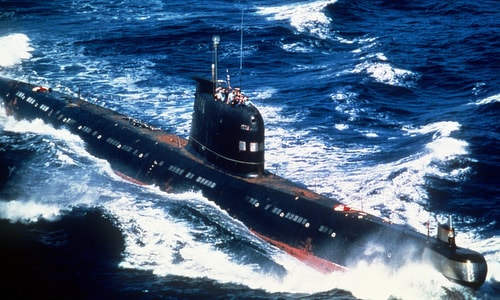 |
Soviet submarines were a source of fear for NATO navies. Photo: National Interest. |
At the height of the Cold War, the Soviet Union possessed hundreds of powerful submarines, forcing Western planners to do everything they could to counter them. One of the most absurd ideas was the "light magnetic bomb," aimed at increasing the detectability of Soviet submarines and rendering them inoperable, according to National Interest.
Historian Steve Weintz notes that by the late 1940s, technology acquired from Germany enabled the Soviet Union to perfect a powerful and modern submarine fleet, capable of threatening NATO's shipping lanes. During the Cuban Missile Crisis of 1962, the Soviet Union possessed the world's largest submarine force, with approximately 300 diesel-electric and nuclear submarines.
The Soviet Union's underwater fleet was far superior to NATO's. This forced the West to seek every possible solution to counter Soviet submarines. A Canadian scientist proposed a solution: creating an underwater noise-generating device, primarily composed of magnets capable of adhering to the metal hulls of Soviet submarines to make them easier to detect.
This magnet would not firmly attach to the hull, but only loosely. Movement in the water would cause the magnet to strike the hull, creating loud noises and revealing its location. The device was simple, but required considerable time and effort to remove. It could reduce the combat readiness of the Soviet submarine squadron.
In late 1962, the British Navy sent the diesel submarine HMS Auriga to Canada to participate in anti-submarine warfare training with the Canadian Navy. Britain had previously assisted Canada in establishing its submarine force, so the two countries frequently conducted joint exercises.
The aging Auriga spent much of its time simulating Soviet diesel submarines in anti-submarine warfare exercises with U.S. and Canadian forces. During one three-week exercise, HMS Auriga became a target for other surface warships, aircraft, and submarines, including the U.S. Navy's new nuclear submarine.
During this exercise, Auriga was attacked with magnet bombs. A Canadian patrol aircraft dropped a large number of magnets onto the area where HMS Auriga was operating. This measure seemed bizarre, but it was surprisingly effective. The magnets clung to the Auriga, causing a series of clanging sounds, all of which were identified on the exercise force's sonar system. However, a series of problems subsequently arose.
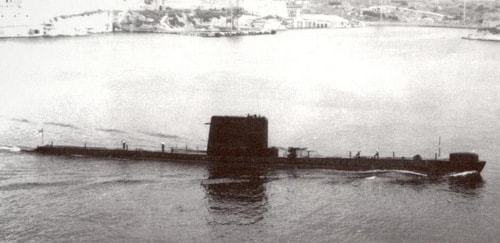 |
HMS Auriga was the first submarine to be hit by a magnetic bomb. Photo: National Interest. |
When HMS Auriga surfaced at the end of the exercises, magnets had gotten into holes and grooves in the hull. They were everywhere and could not be removed at sea. After weeks in dry dock in Halifax, the magnets were finally removed, costing the British Navy considerable money and manpower.
Magnetic bombs had a similar effect on Soviet submarines, forcing many to return to port instead of completing their patrol missions. However, given their enormous submarine fleet, the shortage of a few vessels wasn't a major problem for the Soviet Union.
But NATO didn't have the same advantages as its rivals. Anti-submarine warfare crews couldn't train with targets hit by magnetic bombs. Nor did they have enough ships to conduct such expensive exercises. The magnetic bomb idea worked precisely as intended, but it wasn't suitable for large-scale deployment. As a result, the project was canceled after only a few deployments.
According to VNE
| RELATED NEWS |
|---|


