
Success from the 'Happy Family' Club model
(Baonghean) - Established in 2013, the "Happy Family" club in Quynh Yen commune, Quynh Luu district, has brought positive results in population and family planning work. Through practical activities, the club has also contributed to reducing domestic violence, strengthening bonds of love among family members, and connecting families with the community.
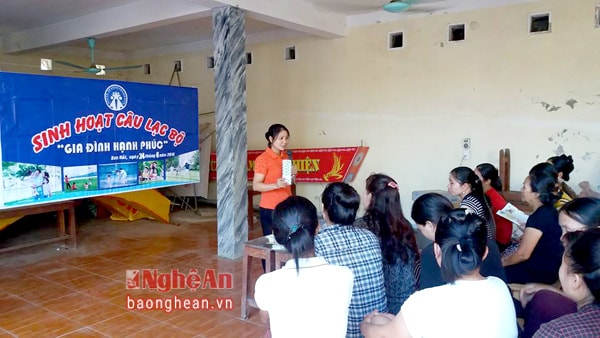 |
| Activities of the "Happy Family" Club in Son Hai commune (Quynh Luu district). Photo: PV |
Quynh Yen commune is a unique commune with nearly 9,000 inhabitants and a large residential area divided into two separate zones. Given its specific conditions, it faces many difficulties in mobilizing and educating the people to effectively implement population policies.
According to Ms. Ho Thi Hong, a population officer and head of the "Happy Family" Club in Quynh Yen commune, "When the club was first established, it faced many difficulties in encouraging couples to participate. Because most people here are farmers, many still hold strong patriarchal views and always want to have many children, especially sons, to continue the family lineage..."
Since its inception, the club's leadership and core members have been very focused on regularly meeting with newly married couples to promote the importance of having fewer children and spacing out births appropriately for better childcare.
In particular, for couples who have only daughters, the club has assigned members to be responsible for monitoring and understanding their feelings. If any couple is found to have a desire to have a third child, the club will coordinate with officials from relevant departments, agencies, and organizations to provide counseling, persuasion, and analysis to help them understand the negative consequences of having many children.
Through accessible, easy-to-understand, and memorable methods of communication and advocacy, many couples have become more aware of the burden of having many children and the importance of family planning in building a happy family. Outdated customs and patriarchal ideologies are gradually being eliminated, and men are increasingly sharing responsibilities with women in all aspects of life.
Many women confided that they used to be very hesitant to talk about issues related to reproductive health and family planning; but now, thanks to participating in the club, they can freely exchange information about using contraceptives and how to interact with family members.
With many practical activities that meet the requirements of building happy families and serve as a useful place for women and mothers to socialize, the number of members participating in the club is increasing. Initially, there were only 50 members, but now the number has reached 150.
With the motto "Building happy families, peaceful, civilized, and progressive villages," over the years, members of the Club's Steering Committee have visited each household in the commune to disseminate information on population and family planning, reproductive health care, the Law on Gender Equality, the Law on Prevention of Domestic Violence, and gender imbalance at birth...
The club holds a meeting once every quarter at the commune's cultural center. During the meeting, content on population and family planning policies is conveyed to members. Participants learn about the responsibilities of families and the community towards adolescents and young people, so they can share information with their children and help them take the right actions in reproductive health care and safe reproductive health practices for their happiness.
Members participating in the club's activities are encouraged to practice family planning, have two children to raise them well, and build a prosperous and equal family.
In addition to promoting and encouraging the effective implementation of population policies, members also share experiences in livestock farming, crop cultivation, family economic development, and how to care for and raise well-behaved, academically successful, and accomplished children.
Many couples who are members of the Happy Family Club have developed economically, and their children are doing well in school, a prime example being the family of Mr. Bui Tran Trung and Ms. Ho Thi Nga (Hamlet 2). Mr. Trung himself comes from a large family. Previously, due to economic difficulties, he and his wife worked hard and independently. Through research and learning from experience, they boldly started growing vegetables on a large scale, bringing economic benefits to their family.
To date, besides having a stable life, Mr. Trung and Ms. Nga's two children are both excellent students, filial, and successful. Similarly, the family of Ms. Ho Thi Mai, in Hamlet 1, diligently raised pigs and chickens, developing their agricultural economy to support their two children through university, who now have stable jobs.
Through club activities, members also share their joys and sorrows in life, encouraging and supporting each other to overcome difficulties. Every year, the club also establishes a fund to provide timely support to families experiencing bereavement, celebrations, or illness.
To date, 100% of couples of reproductive age in the club are using safe contraception methods. The awareness of the people of Quynh Yen commune regarding population and family planning has undergone many positive changes, and people accept the model of smaller, happier families.
In particular, the rate of having a third child or more decreased from over 56% (in 2012) to 40.7% (in 2016). In 2016, two hamlets (Hamlet 1 and Hamlet 4) had no one having a third child or more. Each year, there are 20-30 cases of intrauterine device (IUD) insertion. Non-clinical contraceptive methods increased from 15% (in 2013) to 25% (in 2016).
Besides disseminating information on family life issues, the club also serves as a place for members to share their personal experiences on how to maintain family happiness, raise children, live culturally, love each other, be more responsible towards their families, and build solidarity within the community, creating conditions for women to better fulfill their roles as mothers and wives.
Ms. Le Thi Hoai, a member of the club, shared that since joining, she has gained more knowledge about building a happy family and learned many useful experiences. She has effectively applied this knowledge to her family life, learning to choose her words carefully to help her and her husband understand each other better. She also encouraged her husband to participate in the club's activities so that they can both progress together.
| Mr. Hoang Dinh Tung, Director of the Population and Family Planning Center of Quynh Luu district, said: “The 'Happy Family' clubs established in communes benefiting from the plan for organizing communication and reproductive health care in special and particularly difficult areas are a very effective model, attracting the attention and participation of a large number of members. We believe this is a good and meaningful model for communication and advocacy work on population and family planning, and we will try to seek approval to expand it in the future.” |
Encouraged to focus on building prosperous and equal families, the club members have promoted positive values, eliminated outdated customs, respected women, eliminated gender inequality, and always emphasized love and sharing in maintaining family happiness. It can be affirmed that the "Happy Family" model is a very effective model in implementing population and family planning policies and should be replicated.
Le Thi Ngoc Ha
(Deputy Head of Communications and Education Department)
| RELATED NEWS |
|---|


