
Vinh City is struggling to address the problem of beggars.
(Baonghean.vn) - Having studied in Da Nang and then developed his own project to address the problem of homeless beggars, after 12 years, beggars still swarm the streets of Vinh.
The local authorities are indifferent.
At dawn on a day in early March, at the intersection in front of Vinh Market, we saw three beggars appear. As soon as they arrived, they quickly dispersed, each taking a different spot. One sat under the traffic light heading from Phan Dinh Phung Street towards the intersection, another sat on the road, leaning casually against the median strip at the corner of Quang Trung Street, and another sat on the opposite side. Not to mention, there was another who regularly sat in front of the main pavilion in Vinh Market, about 200 meters away. It seemed that each position here was clearly defined as a "territory," with no one daring to take another's spot, even if they arrived earlier.
"They've been operating since very early in the morning. They didn't just arrive now. They just came out after begging for money at the Vinh wholesale market," said an elderly woman who sews shoes by the roadside. "They get a lot of money. We work hard all day but we don't even earn a fraction of what they do," she added.
 |
Begging at the end of Le Hong Phong street. Photo: Tien Hung |
At the same time, we arrived at the roundabout where Nguyen Phong Sac, Le Hong Phong, Le Nin, Truong Thi, and Vo Nguyen Hien streets intersected. There, four beggars were also operating. Two of them occupied prime spots at the traffic lights, on the section from Nguyen Phong Sac street. The other two shared the area around the traffic lights coming from Le Hong Phong street. As soon as the red light appeared, these people quickly weaved through the crowded traffic stopped in the middle of the road, holding out their hats to beg for money. Once the rush hour was over and traffic thinned out, they began counting the money. Some even casually used their smartphones for entertainment. Throughout the morning, they even relieved themselves on the spot several times, causing embarrassment to many passersby.
"Occasionally, the authorities come to check and chase them away. But when they're chased away from one place, they move to another. Then the next day, we see them reappear, continuing to beg for money. Sometimes, we've seen even more of them than the day before after an inspection," said a taxi driver who regularly parks here.
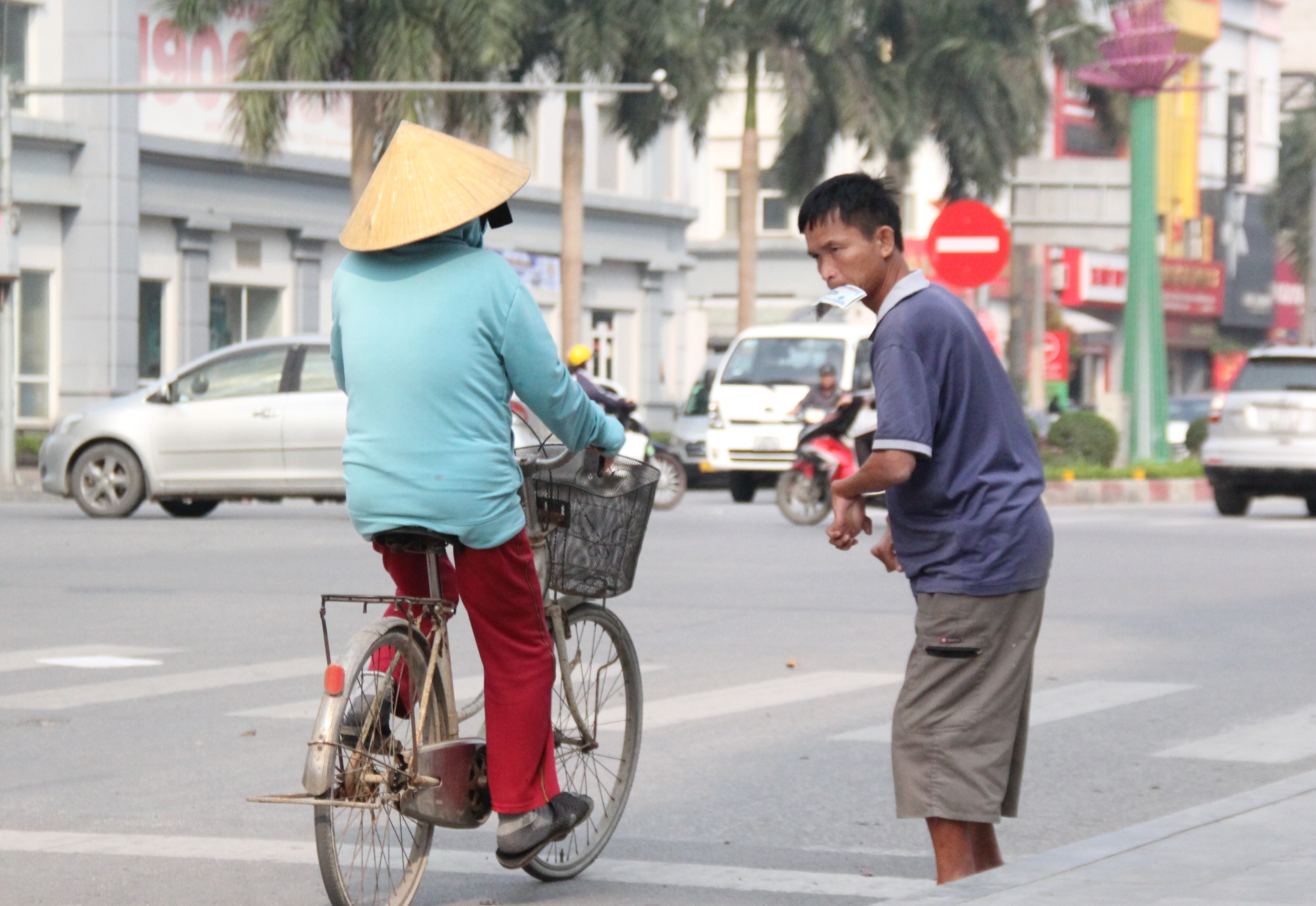 |
A beggar was seen standing on Tran Phu Street, in Hong Son Ward, on the afternoon of March 6th. However, the ward's leaders claimed "there were none." Photo: Tien Hung |
Similarly, begging is also prevalent in areas such as the Triangle intersection; the intersection of Nguyen Van Cu, Nguyen Sy Sach, and Le Hong Phong streets; and the intersection of Pham Dinh Toai and Le Nin Boulevard. In response to this situation, on February 24th, Nghe An Newspaper published an article reflecting on the beggars swarming the streets of Vinh City. Mr. Thai Thanh Ha, Head of the Department of Labor, War Invalids and Social Affairs of Vinh City, acknowledged the recent increase in begging and stated that the department would establish a task force to address this problem.
On February 27th, the Department of Labor, War Invalids and Social Affairs of Vinh City issued a document to the Chairmen of the People's Committees of wards and communes and the Head of the Vinh Market Management Board, regarding strengthening guidance on resolving the issue of homeless beggars. The document stated that, to address the problem of homeless beggars, the city has issued numerous directives. However, monitoring has revealed that some wards and communes have not implemented these directives effectively. Propaganda, patrols, and inspections have not been carried out regularly. The primary method used has been to expel them from the area. Approaching, verifying their circumstances and family backgrounds, and classifying them for coordinated action with relevant agencies and units to resolve the issue completely has been very limited. Furthermore, many wards and communes have not submitted periodic reports on the results of their implementation.
"Following the directives of the Vinh City People's Committee, the Department of Labor, War Invalids and Social Affairs requests the Chairmen of the People's Committees of wards and communes, and the Head of the Vinh Market Management Board to strictly implement the city's directives, and to strengthen the implementation of comprehensive and effective solutions to address the issue of homeless people begging for food and money in the area. Report the results of implementation to the Department of Labor, War Invalids and Social Affairs before the 25th of each month for compilation and reporting to the Vinh City People's Committee," the document states.
For areas where beggars and vagrants frequently appear, the Department of Labor, War Invalids and Social Affairs requests that the Chairmen of the People's Committees of the wards strengthen their direction to functional forces to regularly patrol, identify, and approach these individuals, create dossiers, verify their circumstances, locate their relatives and permanent residences, and determine their hometowns in order to develop a plan for definitively resolving the issue, following the guidelines in the document issued by the People's Committee of Vinh City in July 2022. They should also coordinate with the Department of Labor, War Invalids and Social Affairs to organize the transfer and handover of homeless beggars with unknown addresses to social welfare facilities in the province.
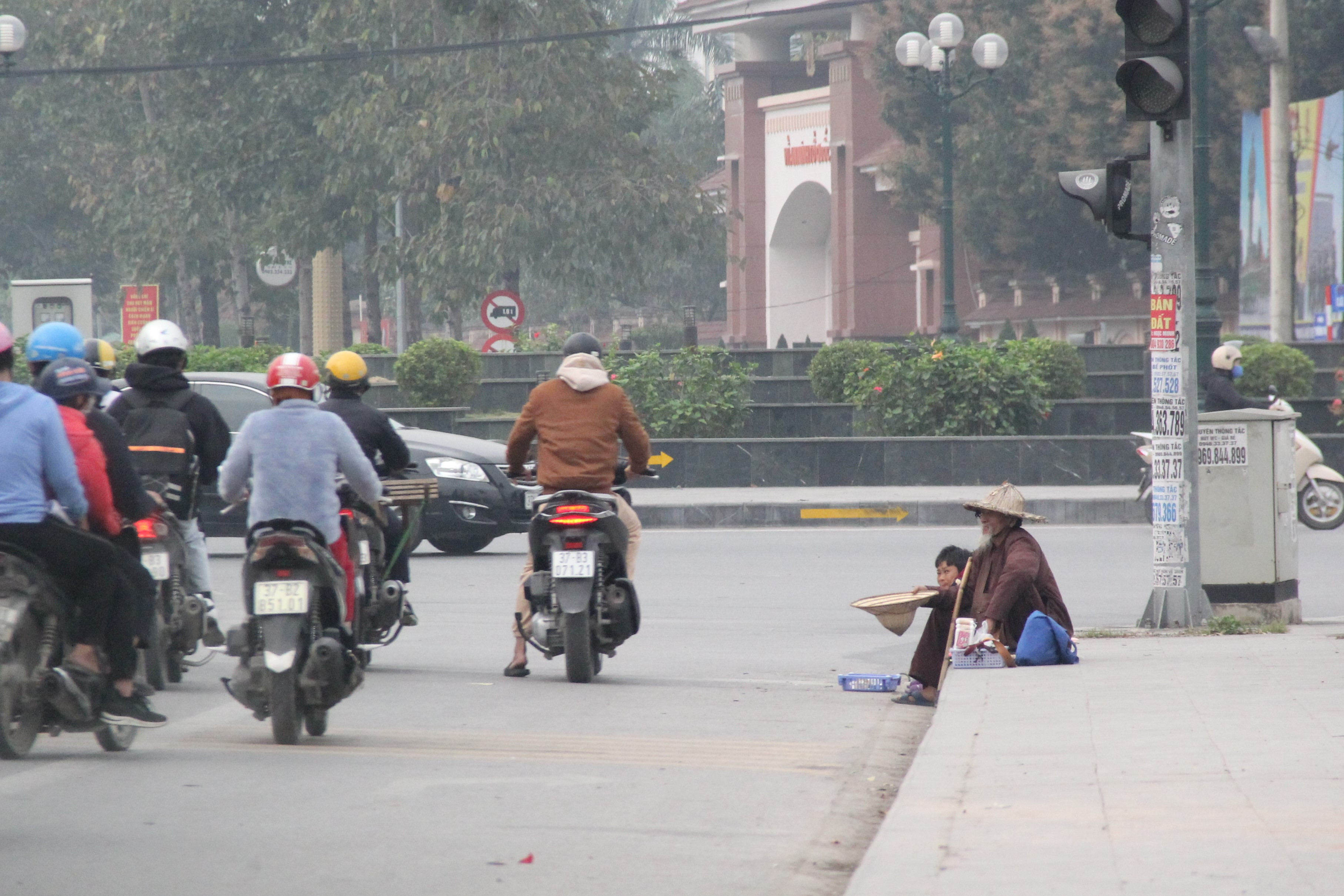 |
Two beggars sit together in the same spot on Nguyen Phong Sac Street. Photo: Tien Hung |
"Kidnapping and abandoning"
Despite the city of Vinh establishing a task force and issuing directives to ward leaders, reporters observed that the number of beggars on Vinh's streets has not decreased in recent days. "We have made great efforts, but we must admit that the solutions implemented so far have been like 'catching a thief and letting him go.' The results have not been very effective," said Mr. Nguyen Ngoc Duong, Deputy Head of the Department of Labor, War Invalids and Social Affairs. Mr. Duong was recently assigned the task of leading the team responsible for addressing the issue of begging in the area.
Mr. Duong stated that, according to procedure, after receiving a report of beggars, the task force will go to the scene to investigate. If the area falls within the jurisdiction of a particular ward, they will contact the relevant ward's authorities. Then, they will begin verifying the identity of each individual. If the beggar's residence and relatives are identified, the ward is responsible for arranging transportation to take them home and handing them over to the family and local authorities for management. Simultaneously, the family, relatives, or guardians are required to sign a commitment to prevent the beggar from continuing to wander or be homeless, with confirmation from the local authorities.
In cases where the place of residence cannot be determined, or where the place of residence is determined but there are no longer any caregivers, coordination with the Department of Labor, War Invalids and Social Affairs is necessary to create a file for placement in social assistance facilities. However, that is only in theory.
“In fact, many of them have families, and we have repeatedly driven them home and handed them over, requesting commitments, but the next day they are seen again on the streets of Vinh. Most beggars in Vinh City come from other localities, so we cannot direct the local authorities to monitor them and prevent them from continuing to wander,” said Mr. Nguyen Ngoc Duong.
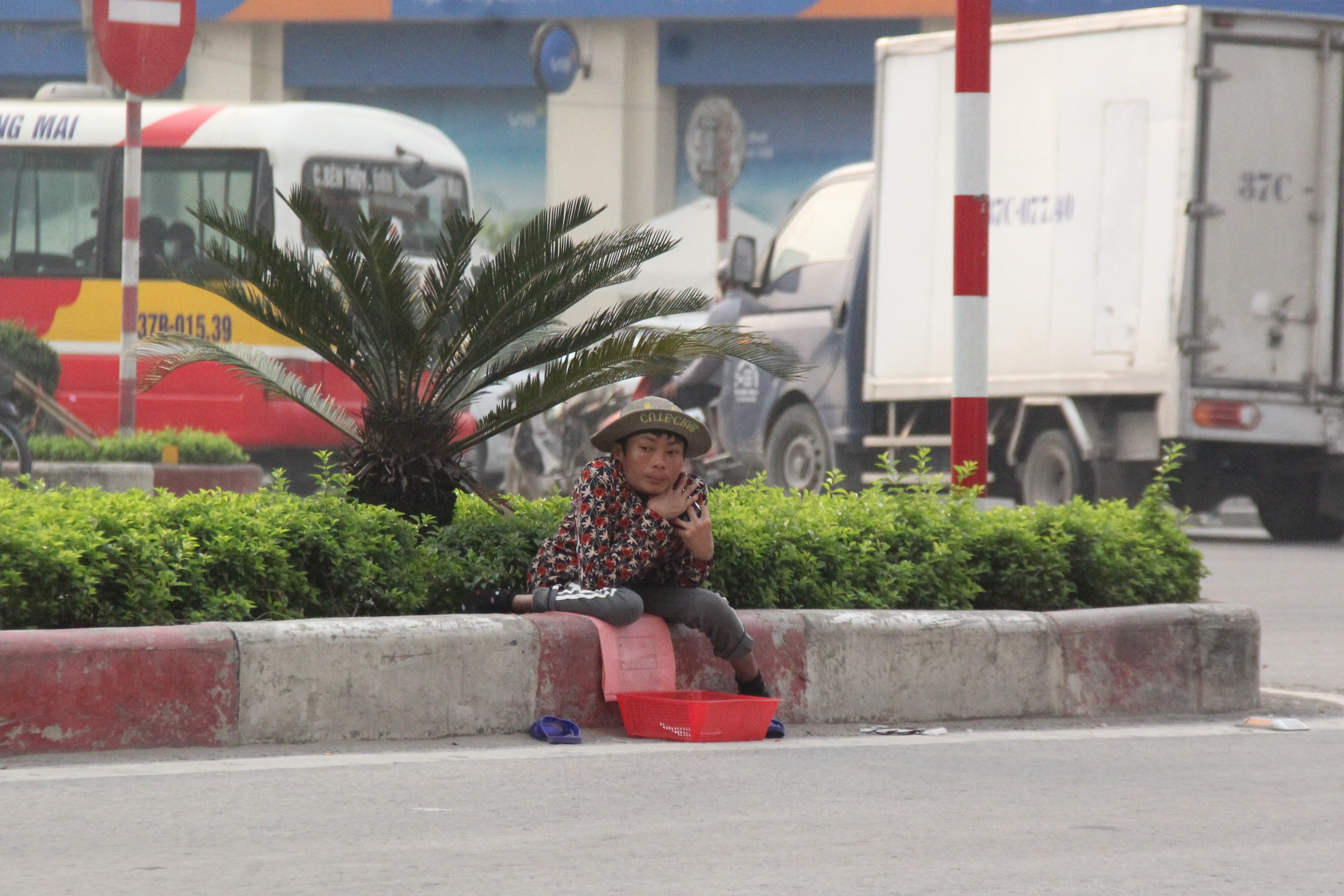 |
This woman has been begging on the streets of Vinh for many years. Photo: Tien Hung |
According to Mr. Duong, for cases where the place of residence cannot be determined or there are no longer any people obligated to care for them, the authorities will create a file and send them to social assistance centers. “We have sent quite a few people there already. But those centers are not responsible for supporting them for life; they only provide temporary care. After a short time, they are returned to their hometowns, and then they come back to Vinh City to beg. Others are sent there for a few days and then escape, returning to beg again,” Mr. Duong said.
On the afternoon of March 6th, we also worked with Mr. Tu Trong Hai, Chairman of the People's Committee of Hong Son Ward – the ward with the highest number of beggars, especially at Vinh Market and intersections. However, Mr. Hai asserted that there had been no begging in the ward for a long time. "If there were, we would go down and deal with it immediately," Mr. Hai said. Meanwhile, at the same time, we observed three beggars at the intersection in front of Vinh Market. Two of them were standing at the corner of Tran Phu Street, in Hong Son Ward. The third was begging at the corner of Quang Trung Street, in Quang Trung Ward.
More than 10 years ago, Vinh City had to send a delegation to Da Nang to study their model for dealing with beggars. In 2011, Vinh City issued a project titled "Addressing the problem of homeless beggars in the city," which included the construction of a "community house" to house beggars, with a total investment of 2.5 billion VND. The construction site was located within the grounds of a drug rehabilitation center. Both facilities even shared a common gate. The project was completed at the end of 2012. However, shortly after completion, the community house had to close because it failed to house any beggars or homeless people. Thus, Vinh City's project to address the problem of homeless beggars also "died prematurely."


