
What can we learn from the successful cycle of Vietnamese football?
(Baonghean.vn) - The past five years (2017-2022) are considered a successful period for Vietnamese football under the leadership of South Korean coach Park Hang-seo.
The new cycle under French coach Philippe Troussier began in 2023 with higher goals and greater ambition, building on the solid foundation of previous successes and seizing the new opportunity presented by the 48-team World Cup.
With that starting point, Vietnamese football is placed on a "launching pad" with a coach who has led many teams to the World Cup, has experience working with Vietnamese youth football, possesses concrete practical experience, and has ambitions for the future to begin a new cycle, a new vision. No one hides their goals, ambitions, and aspirations for the World Cup, not even the new coach, not even the U20 players who recently performed quite well in the continental tournament. A "model" for the Vietnamese national team aiming for the World Cup is being formed, consisting of 60% of the outstanding players from the previous "successful cycle" retained as the core, 20% of the current outstanding U23 and U20 players, and 20% selected from the V-League and First Division. The playing style will also be redefined compared to tradition.
 |
Vietnam U23 disappointed in their first tournament under coach Troussier. Photo: VFF |
The challenges that Park Hang-seo previously faced, such as the huge gap with top teams in the continent after the third round of World Cup qualifiers, and the inability to overcome Thailand in the region, will be addressed, starting with the U23 team at the upcoming SEA Games, and continuing with the campaigns of the Vietnamese national team.
However, it seems that right from the first steps in this "new cycle of success" with the new coach, Vietnamese football immediately encountered high mountains that are not easy to overcome. The re-application of the model where one coach manages both the U23 and the national team, a model that was successful with Park Hang-seo in Vietnam (but not with Polking in Thailand or Shin Tae-yong in Indonesia), has led to an unprecedented situation: the Vietnamese national team did not gather for training, friendly matches, or official games during this FIFA Day period, because the coach was busy leading the U23 team in friendly matches at the Doha Cup?
It's not fair to say that we need to focus more on the U23 team, closer to the SEA Games competition date, but...Vietnam national teamSince the first round of World Cup qualifiers doesn't start until the end of this year, is it really okay for national teams to not be training (and take a break from competition because the V-League is also temporarily suspended)? So, is it wasteful and unnecessary for all the national teams around the world to gather for friendly matches, including regional teams, and EURO qualifiers?
Sadly, while the dream of the World Cup burns brightly, Vietnamese football remains undefined, or rather, still struggling to find a playing style and philosophy depending on foreign coaches. This explains why national teams often have very long training camps, each time starting from scratch, rebuilding everything from the ground up for each player. Ironically, the captain of the Vietnamese national team, Hung Dung, recently admitted that "senior players don't have the advantage over junior players, who are like blank slates when they join the team under Coach Troussier." Another point that's never tired of discussing is that the U23 team's recent crushing defeat in the Doha Cup was due to players being new to the coach, not yet adapting, playing awkwardly, afraid of making mistakes, and afraid of being dropped. The coach, despite the loss, stubbornly maintains his direction, while the players are saddened by the defeat but playing according to their strengths and habits is impossible—it's suicidal.
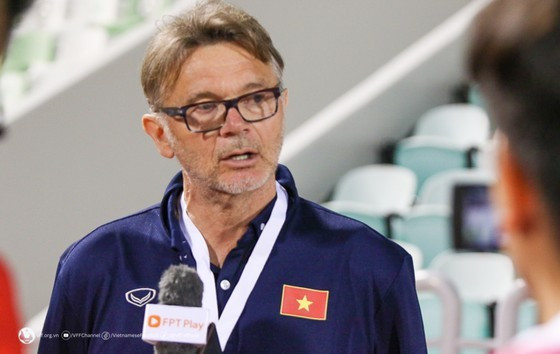 |
Coach Troussier will have a lot of work to do with the Vietnam U23 team if he wants to achieve the goal of reaching the SEA Games 32 final. Photo: VFF |
Of course, no coach will simply repeat another, or be a copy of someone else, but a team can't be a copy, a mechanical application of someone else's success. It's essential to have a "pillar," a unique system for each team, built upon individual talent and the collective strength of the entire team. Praising a new coach specifically and meticulously is one thing. But for him to dismantle and rebuild a team from scratch, it actually only brings more worry and disappointment. The lessons learned from the successful approaches of Coach Calistore, Coach Park Hang-seo, etc., clearly still hold value now and in the future, as they successively learned how to defeat and surpass the powerful Thai team.
In recent days, sports fans have been delighted by the progress in professional sports like volleyball, badminton, futsal, and basketball, attracting a large audience. However, alongside this, there have been regrettable setbacks, such as the failure to implement technology in the Ciputra Hanoi Badminton Tournament and the Hung Vuong Volleyball Cup, leading to unprofessional refereeing and causing widespread public outrage. Football, the king of sports, is also showing promising signs, but the disappointing results of the U23 team at the Doha Cup and the lack of focus from the Vietnamese national team are making things more worrying than ever.
Failure is failure; when you fail, get up and start again. Don't blame or excuse any objective or subjective reasons. No opponent will stand still or regress so that we can easily overtake them. It's no coincidence that concerns about Vietnamese football from Thailand, and even from Cambodia, are increasing every day.
After the resounding and unparalleled "cycle of success" under Park Hang-seo, whether a new "cycle" of success or failure will begin is unpredictable. The strong tests from the Doha Cup are immediately proving that point.


