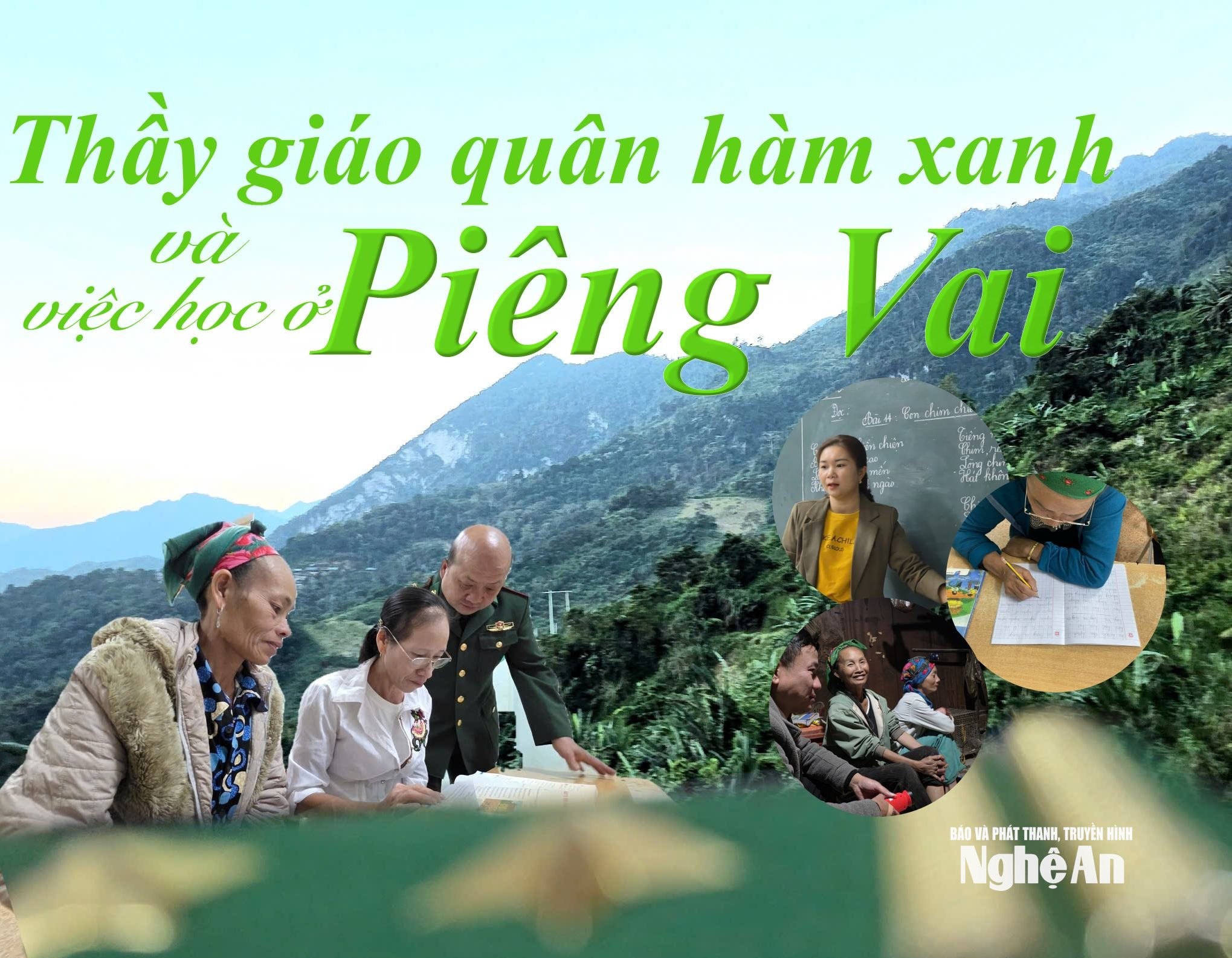
In the remote border region of western Nghe An province, as night falls and fog blankets the mountains and forests, the lights of a special classroom are lit. There, grandmothers and mothers, their hands calloused from working in the fields, learn to read and write under the guidance of border guards and teachers stationed in the village.
Content and technical design:Hoai Thu19/12/2025
In the remote border region of western Nghe An province, as night falls and fog blankets the mountains and forests, the lights of a special classroom are lit. There, grandmothers and mothers, their hands calloused from working in the fields, meticulously learn the alphabet night after night under the guidance of border guards and teachers stationed in the village.
Special students whereborder
From October 2025, literacy classes in Pieng Vai village (My Ly commune) will reopen after a two-month hiatus due to storms and floods. Many women in Pieng Vai village still cannot read or write the standard Vietnamese alphabet.
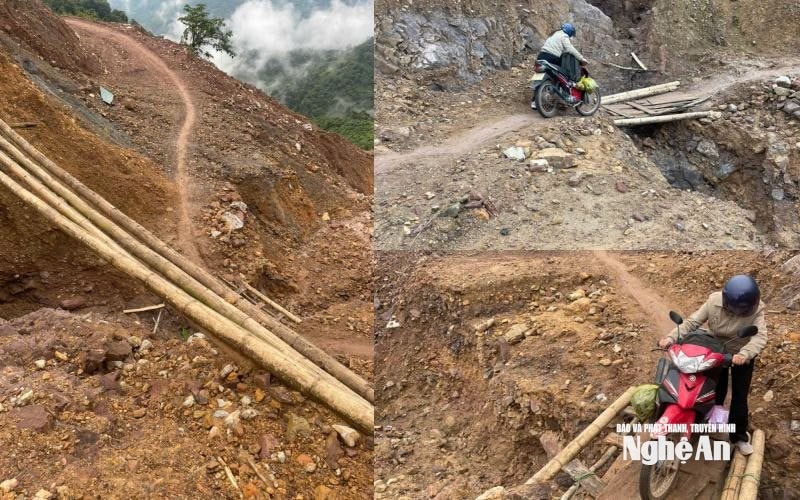
The road from the center of My Ly commune to Pieng Vai village is over 20 km long. In winter, the road is muddy, and fog blankets the slippery slopes. Yet, every evening, the students still carry flashlights and travel the long distance to class. The teachers and even the soldiers from the My Ly Border Guard Post travel the same distance to reach these special students. Vehicle breakdowns and falls due to the slippery road are commonplace. The small classroom is located at the Pieng Vai village school, perched precariously on the only road leading into the village. The teachers are the teachers from My Ly 1 Ethnic Minority Boarding Primary School and the officers and soldiers from the My Ly Border Guard Post. They patiently teach the students, who are "over forty," to write, do calculations, read newspapers, sign their names, and more.
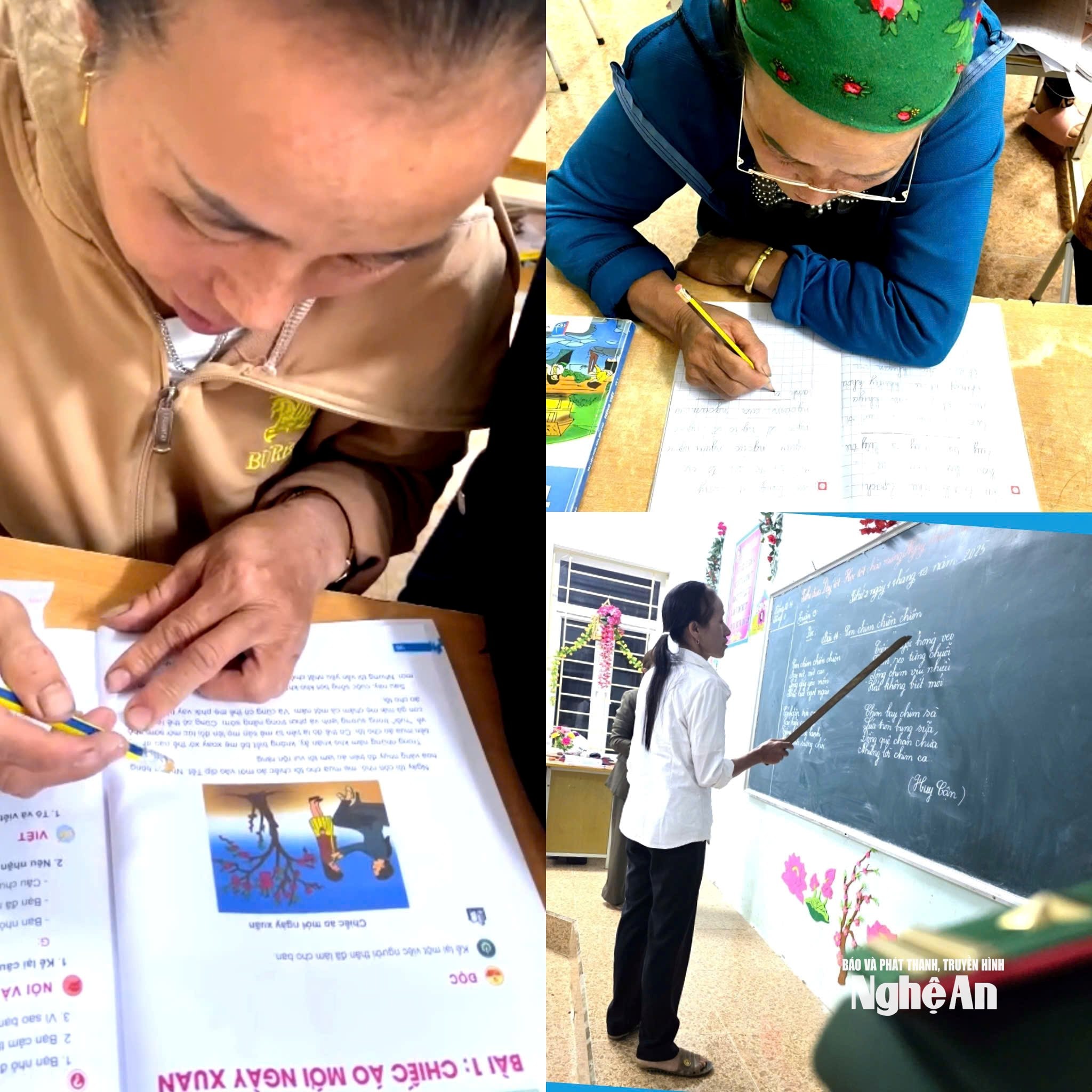
Although over 60 years old, this was the first time in her life that Mrs. Lau Y Xi knew how to spell, point to each letter, and read aloud clearly the poem "The New Dress for Spring." The sound of "student" Lau Y Xi's reading filled the entire class with joy. Outside, the night had thickened, and the biting cold enveloped the mountains and forests.
Grandmothers and mothers practice spelling, learning their first lessons in life. Photo: Hoai Thu
The class has no fixed schedule, where the lesson plan is not just about words, but also about patience, compassion, and the responsibility of soldiers towards their compatriots. What is most moving when entering this class is the diversity of ages and backgrounds of the students.
“Initially, the class had 11 students, but one student had to leave because her husband, after serving his prison sentence, came from Bac Ly to pick her up and take her back to their hometown. That absence left a void, but it also motivated the remaining 10 to persevere with their studies,” said teacher Cu Ba Po. Teacher Cu Ba Po is currently a Lieutenant Colonel and the Team Leader of the Community Mobilization Team at My Ly Border Guard Post.
Most of the students have unique circumstances. Some are single mothers, struggling to raise their children alone. Some are middle-aged women, unmarried, living alone in empty houses. Then there are grandmothers, who, despite their advanced age, remain the pillars of their families, as their children have grown up and gone to work far away in companies, leaving their grandchildren at home. The class is striking, showcasing the contrast between two generations sharing a common aspiration for knowledge. The oldest student in the class was born in 1967, making them 67 years old this year...
A lesson in Pieng Vai village. Video: Hoai Thu
Ms. Vu Y Xai, 48 years old, a resident of Pieng Vai village, holding an old notebook, smiled gently: “Before, writing was very difficult for me. Now that I can write my own name, I'm so happy. The Border Guard soldiers are like family; they gave us cows, saplings, and now they're teaching us to read and write. Everyone in the village loves them. The class started in May 2025. If it weren't for the floods, we would probably all know how to read and write by now.”
In contrast to her graying hair is the youthful face of the youngest student, Cu Y Va, born in 2008, who just turned 17 this year. Born into a poor family, as the eldest child, she had to put aside her dream of going to school from a young age to stay home and look after her younger siblings. Now that she is older, realizing the true value of literacy, she has voluntarily enrolled in school. "I don't want to fall behind, I want to rise up and take control of my own life. This is the reason that brought me to this class," Cu Y Va confided.
Bilingual lesson plans and the patience of the teachers.Instilling aspiration
Following the teachers to this special classroom, we truly understood the hardships and the silent dedication of the teachers involved in literacy education.
In the pitch-black night and biting cold, teachers, armed with flashlights, went from house to house, reminding and encouraging their "students" to attend class and not drop out. Ms. Vu Y Mo lives with her elderly parents in a small, precarious house about a 20-minute walk from the Piêng Vai village school. By the warm fire, she received nutritional supplements and other necessities that Teacher Cu Ba Po and the other teachers had brought when she had a fever. Moved by the teachers' care, she continued to try her best to attend class.
The road to the classroom in Piêng Vai. Photo: Hoài Thu
The students in the class are the main breadwinners in their families. During the day, they work tirelessly in the fields. Only after sunset do they return home to take care of cooking, bathing their children and grandchildren. They can only attend the literacy class around 8 PM. Initially, the class was scheduled for only three evenings a week. However, the eagerness to learn and the enthusiasm of the teachers erased that time barrier. The schedule was adjusted flexibly based on the needs and health of the students. Some nights, engrossed in studying, or when trying to explain things to a slow learner, the class would extend late into the night.
Teaching children to read and write is difficult enough, but teaching farmers, who are accustomed to farming year-round and who also face language barriers, is infinitely more challenging. The classes, which began in May 2025, were interrupted by floods before resuming in October 2025. This interruption only added to the difficulties of the literacy campaign. The biggest challenge for these military teachers is not just teaching the alphabet, but also overcoming the language barrier. The students are from the Hmong ethnic group and are not yet fluent in Kinh (Vietnamese).
"If students only read and copy, they will simply repeat what the teacher says without understanding the meaning, leading to immediate forgetting. With abstract phrases like 'wind blowing through the window' or 'tilting,' without a thorough explanation, they won't be able to visualize them. Therefore, the teachers become 'translators.' Teaching requires simultaneous analysis of both languages: Vietnamese and Hmong. When language fails, we have to resort to body language," a Border Guard teacher explained.
Lieutenant Colonel Cự Bá Pó and the teachers went to each house to encourage people to go to school. (Clip: Hoài Thu)
To explain the word "lean," the soldier didn't hesitate to lean his whole body to demonstrate the action, helping the students understand the lesson. This selfless dedication and willingness to overcome difficulties gradually broke down the language barrier, allowing the light of knowledge to penetrate the consciousness of the local people. This class, therefore, carries a dual mission: to eradicate illiteracy and to "eradicate linguistic illiteracy." The military teacher, Cự Bá Pó, is also a son of the Hmong people. That's why he can apply the "bilingual teaching method: standard Vietnamese and Hmong," Lieutenant Colonel Cự Bá Pó shared.
After months of effort, the class has achieved encouraging initial results. Currently, 8 out of 12 students can read and write. For students who learn slowly or forget easily, the teachers have to dedicate separate time during class to provide extra tutoring for each individual. They also take advantage of the time when students are not working in the fields to provide additional tutoring at home.
“
For each teaching session, the school assigns two teachers to go together to support each other. Teachers from the Border Guard, assigned by the My Ly Border Guard Post, also regularly participate. The class is expected to last one year, and students who complete it will receive a certificate as prescribed. The learning of the people and students in the highlands is further strengthened by the participation and support of the officers and soldiers of the Border Guard. They not only support the school and locality in teaching literacy, but also serve as a quick, dynamic, and steadfast force in all fields, especially in protecting the peace of the villages."
Thầy Nguyễn Thế Vĩnh - Hiệu trưởng Trường Phổ thông DTBT Tiểu Studying American Physics 1
Giữa bộn bề khó khăn của cuộc sống vùng cao, nhiều năm nay, các lớp học xóa mù chữ có sự tham gia của cán bộ, chiến sĩ Bộ đội Biên phòng vẫn sáng đèn. Những học viên vùng cao là đồng bào dân tộc thiểu số dù đôi tay còn lóng ngóng với cây bút, dù trí nhớ đã giảm sút nhiều do tuổi tác vẫn miệt mài để học thêm con chữ.
Chúng tôi gọi những thầy, cô giáo giảng dạy tại lớp xóa mù chữ ở Piêng Vai là "những người gieo khát vọng”. Họ là chiến sĩ Biên phòng, là giáo viên đứng lớp tranh thủ ngày nghỉ, bất kể mưa hay nắng, ngày hay đêm vẫn bám theo những đường núi cheo leo, hiểm trở đến với các lớp học xoá mù bằng tình yêu thương, cảm thông và cả sự thấu hiểu.
Lãnh đạo Trường Phổ thông DTBT Tiểu học Mỹ Lý 1 và Chỉ huy Đồn Biên phòng Mỹ Lý tặng quà động viên các học viên tham gia lớp học xóa mù chữ ở điểm trường bản Piêng Vai. Ảnh: Hoài Thu
“
Giữa bộn bề khó khăn của cuộc sống vùng cao, nhiều năm nay, các lớp học xóa mù chữ có sự tham gia của cán bộ, chiến sĩ Bộ đội Biên phòng vẫn sáng đèn như một biểu tượng của nghị lực và tình người.
Your comment has been submitted and will be displayed after being reviewed by the editorial team. The editorial board reserves the right to edit comments to comply with the newspaper's content guidelines.

.jpg)


