
How does the world of multiple-choice tests work?
While many universities in Canada use multiple-choice exams, some universities in Australia have abandoned this method due to concerns about unfair grading practices and ethical issues.
The multiple-choice test format originated from the research of psychologist Frederick Kelly and was first applied in intelligence tests by the US military during World War I.
According to the University of Waterloo, Canada, there are many advantages to using multiple-choice tests. One important advantage is that the questions are very easy to mark and grade by machine. This format is suitable for large test volumes. It greatly assists teachers who have to complete grading within a limited time. A well-designed multiple-choice test will include a wide range of knowledge and content, providing an objective measure of students' abilities.
Carnegie Mellon University in the US considers the objectives of the course and the test before deciding on the appropriate test format. For example, when students are asked to clarify or express their views on a controversial economic issue, multiple-choice questions are completely unsuitable because they don't require students to present any arguments. However, a well-designed set of multiple-choice questions can effectively assess students' ability to recognize a logical economic argument or distinguish it from illogical ones.
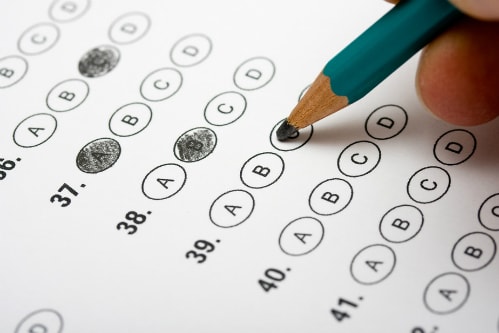 |
| It's difficult to determine whether the students know the answer or are just guessing. |
Central Queensland University in Australia, after carefully considering the advantages and disadvantages of multiple-choice tests, decided not to use this format in its exams from 2014 onwards for two reasons.
The first drawback relates to the scoring system. One correct answer to each question is awarded one point, while other answers are either not counted or have points deducted. However, choosing the correct answer can be the result of "knowing" or "guessing." Students only need to achieve a minimum of 50% to pass the test in most subjects at school.
To pass a 100-question test with 4 options (1 correct and 3 incorrect), test-takers only need to "know" the correct answers to 33 questions and "guess" the answers to the remaining 67 (the average correct guess rate is 25% of 67, or 17 questions). When one student passes with a 50% score and another fails with a 49% score, it's simply possible that the first student guessed at least one more question correctly than the second.
To mitigate some of these shortcomings, many schools have increased the minimum passing score and implemented a point deduction system. For example, requiring an 80% score and deducting points for each incorrect answer significantly reduces the problems arising from "guessing" correctly.
The second drawback is the ethical issue of including distracting options that contain partially correct information. Is it right for teachers to try to "lead students astray" by including these distracting options? While other forms of written exams encourage students to score points based on understanding rather than a single correct answer.
For these two reasons, Central Queensland University replaced multiple-choice tests with short-answer tests. Students simply write a word or short phrase on the answer sheet, and teachers grade accordingly. This format eliminates the drawbacks of multiple-choice answers while remaining effective in grading.
According to VNE


