
High-performance sports: Concerns and challenges
(Baonghean) - "Lack of long-term direction, failure to attract sports talents" - this is a familiar assessment in the annual reports of the Culture and Sports sector. To build a comprehensive and long-term strategy for developing high-performance sports, it is urgently necessary to have mechanisms to remove difficulties and obstacles...
In 2016, high-achieving athletes from Nghe An province won over 190 medals of all kinds, including 51 gold medals, 75 silver medals, and 169 bronze medals. Among these were 26 medals won at international, Asian, Southeast Asian, and open international competitions.
There are medals that have brought glory and honor to Nghe An province, demonstrating the efforts and spirit of dedication to the homeland's colors, the willingness to overcome difficulties and hardships of the athletes, coaches, and the leadership of the Nghe An Sports Training and Competition Center. Notable examples include the gold medal in women's triples sepak takraw won by athletes Tran Hong Nhung and Nguyen Thi My, and the bocce ball won by athlete Nguyen Van Quang at the Asian Beach Games; and the silver and bronze medals won by athlete Le Thi Tham at the Asian Weightlifting Championships...
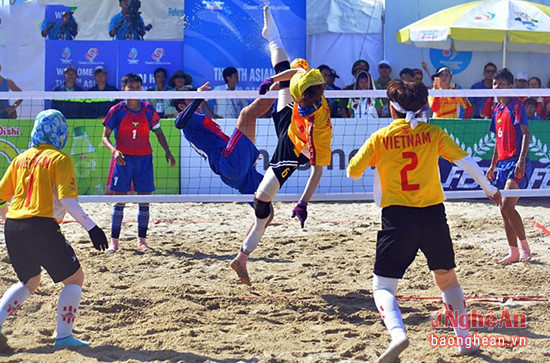 |
| Sepak Takraw athlete Tran Hong Nhung (number 2) from Nghe An province competes at the 2016 Asian Beach Games. |
2016 also witnessed progress in many sports in Nghe An province, such as sepak takraw (2 national championship gold medals), vovinam (2 national championship gold medals, 2 national youth championship gold medals), pencak silat (1 national championship gold medal, 4 national youth championship gold medals)...
Promising young talents have emerged, such as Phan Van Nghia (wushu), Vo Xuan Hai (traditional martial arts), Tran Anh Tuan (Vovinam)...
However, objectively speaking, in 2016, Nghe An's high-performance sports did not flourish as expected. Of nearly 300 medals of all kinds, only 91 were from international and national championships, while the remaining 204 medals were from club cups, age group competitions, and regional competitions – tournaments with low competitiveness and professional quality.
In addition, some sports have shown signs of stagnation, or even a decline in performance, such as karatedo, taekwondo, wrestling, etc. Some key athletes, who were highly anticipated, did not achieve the expected results last year, notably Le Cong Tai (sepak takraw), Pham Thanh Phong, Nguyen Thi Lanh, Lo Thi Lieu (petanque)...
It must be objectively acknowledged that the Provincial Sports Training and Coaching Center - responsible for Nghe An's high-level sports competitions at national and international levels - has made many efforts in discovering, training, and nurturing athletes.
However, like a shirt that's too tight, a new mechanism is urgently needed to break through and achieve higher results for Nghe An's high-performance sports, especially in terms of facilities and support for athletes.
Over the years, the province has paid attention to and invested in equipment and training tools for the sports sector, but it still does not meet the requirements for high-level training and competition. This can be easily seen when visiting the training facilities of various sports. For example, martial arts, which are always considered a strong sport of the province in domestic and international competitions, still lack many tools and equipment, especially standard training floors.
Apart from the taekwondo training facility funded by the Korea International Cooperation Agency (KOICA), in other martial arts, athletes still have to compete in cramped, hot steel-framed buildings that leak and get damp in the rainy season, or in the cramped functional rooms of Vinh Stadium with many old and dilapidated training equipment...
Furthermore, Nghe An currently has a very limited number of high-achieving athletes. The provincial target is 300 athletes, but currently only 238 athletes in the entire center receive benefits, spread across 18 sports, making it difficult to meet the professional requirements of the current period.
This has resulted in a lack of competitiveness for Nghe An teams participating in national championships, as there aren't enough athletes to compete in all the events of a tournament. Furthermore, the current remuneration for athletes is quite low.
Since 2014, the meal allowance for athletes has been increased to 150,000 VND, 120,000 VND, and 90,000 VND respectively for provincial team athletes, youth team athletes, and talented athletes. However, compared to many other provinces and cities, this amount is quite low.
Many coaches have shared that only those with a genuine passion pursue a career in sports. The inadequate support, diet, and training conditions discourage many athletes, leading them to consider quitting, thus preventing them from achieving high results.
It is time for the Department of Culture and Sports to promptly implement the provincial sports development plan for the period 2016-2025 and the orientation for 2030; to supplement funding and invest in upgrading sports facilities in districts, towns, and cities to create a foundation for the development of strong sports disciplines.
Furthermore, instead of relying solely on provincial budget investment, those involved in sports need to be proactive and promote social mobilization, especially for sports with high popularity such as table tennis, badminton, tennis, and swimming, in order to secure additional funding for key sports and strengths of Nghe An in high-performance sports competitions.
Minh Quan


