
The ultra-thin device helps pedestrians fully charge their phones.
With a thickness only 1/5000th that of a human hair, the new device can extract energy even when we move very gently and slowly.
Scientists at Vanderbilt University in the United States have created a microscopic energy-harvesting material that can extract energy from human movement.
The product can be placed inside clothing to charge as we move around daily. The electricity collected can be used to charge smartphones, tablets, or other personal electronic devices.
 |
| This new type of device harnesses excess energy from human movement. |
Cary Pint, a researcher on the project, said: "In the future, I hope that we will all be able to charge our personal devices ourselves by harvesting energy directly while on the go."
Previously, numerous studies have been conducted with the aim of harvesting readily available energy sources such as extracting energy from vibrations and deformations; drawing energy from temperature changes; or capturing energy from light, radio waves, and other forms of radiation...
However, a highly valuable energy source has been overlooked: the excess energy from human movement. Although some scientists have created certain materials, they can only function effectively at frequencies exceeding 100 times per second, a speed that most normal human movements cannot achieve.
With a thickness only 1/5000th that of a human hair, the new device can extract energy even when we move very gently and slowly.
"Compared to other materials, this material possesses two fundamental advantages: one is its thickness, and the other is its sensitivity," Pint said. "This material is so thin and small that it can be attached to layers of thread without affecting the feel of the fabric. Notably, it can harness energy from movements slower than 10 Hertz (10 times per second), which corresponds to human movement."
In the study, the scientists used graphene and two layers of black phosphorus – a material that has always been attractive to nanotechnologists because of its electro-optical and electrochemical properties.
The energy harvester is created by placing graphene (an electrolyte) between two identical black phosphorus electrodes. The electrodes are created through a chemical process when the black phosphorus layer interacts with the electrolyte.
Together, these 2D materials have the ability to bend and generate energy.
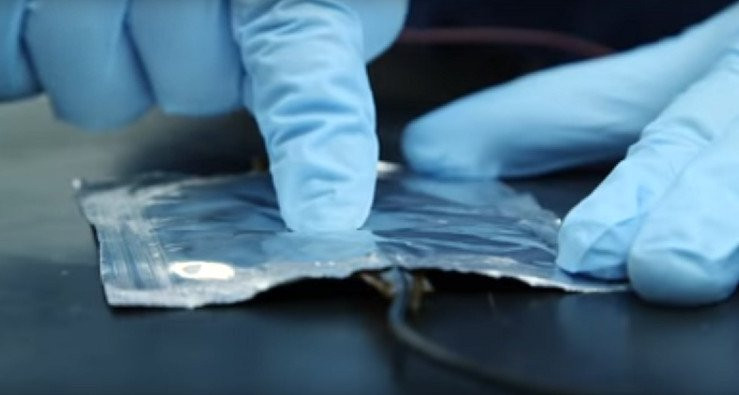 |
| Researchers are currently testing the prototype product. |
The team's prototype design can generate energy from movements below 10 Hertz (10 movements/second) and even as low as 0.01 Hertz (1 movement/100 seconds).
When asked about the safety of the materials, Pint confidently stated that users would never see this device short-circuit, leading to fires or explosions like many other electrical products.
Pint added: “Conventional batteries burn out when the positive and negative electrodes of the device are depleted; in this new material, because there are two identical electrodes, the depletion process only affects the ability to produce electricity.”
In the future, the team will continue to improve the device's ability to extract electricity, as currently, the new device obtains relatively low voltages, only in the millivolt (mV) range.
According to Khoahoc.tv
| RELATED NEWS |
|---|


