
Türkiye's presence on the 'big chessboard' of the Gulf region.
(Baonghean) - Following the 'shuttle diplomacy' activities of Germany, the UK, France, and the US to the Gulf region, the Turkish President is currently visiting three countries in the region: Qatar, Saudi Arabia, and Kuwait, in an effort to listen to the opinions of all parties involved in resolving the diplomatic crisis between the Gulf Arab states and Qatar.
Observers believe that, whether successful or not, this new diplomatic move shows that Türkiye wants to "make its presence felt" on the "big stage" in the Gulf region in order to increase its political and economic influence over the entire Middle East.
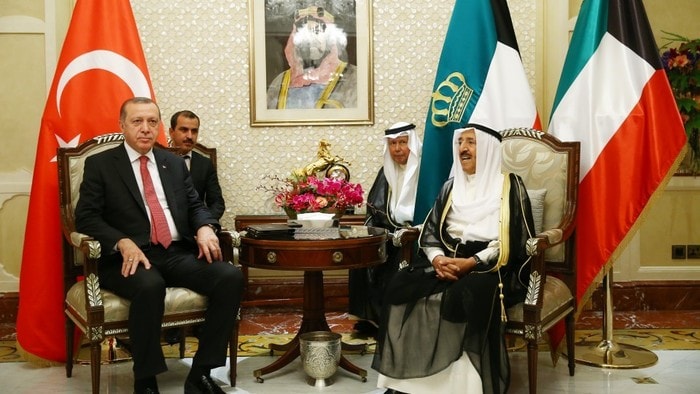 |
| President Recep Tayyip Erdogan (left) meets with Kuwaiti Emir Sheikh Sabah Al Ahmad Al Jaber Al Sabah in Kuwait on July 23. Photo: TRT |
Change your approach.
Turkish President Recep Tayyip Erdogan is the fifth foreign politician to visit the Gulf region to help resolve the crisis between Arab countries and Qatar, following diplomats from Britain, France, Germany, and the United States.
The visit has attracted considerable international attention, with expectations that Türkiye will play a special role in resolving the current tensions.
As a member of the Organization of Islamic Cooperation, Türkiye currently has close ties with Gulf states, particularly a close alliance with Qatar and a "friendship" with Iran.
From the very beginning of the Gulf crisis, Türkiye chose its stance in this diplomatic crisis: siding with Qatar.
From a diplomatic standpoint, the Ankara government has consistently opposed the severance of diplomatic ties between neighboring Arab countries and Qatar from the outset.
Economically, Türkiye immediately provided Qatar with food and water for Doha after Saudi Arabia intensified its efforts to isolate Qatar by closing borders and suspending flights.
On military matters, the Turkish Parliament on June 7th urgently passed a bill allowing the country's military to access a Turkish military base in Qatar.
Over a month and a half has passed, and alongside its efforts to wholeheartedly support its ally Qatar, Türkiye has gradually shifted its approach to the issue by proposing to mediate between the parties. Prime Minister Erdogan's visit to the three Gulf countries demonstrates this.
The Turkish leader's view is that prolonging the diplomatic crisis in the Gulf will not benefit anyone. He criticized the "enemies" who are seeking to "feverish tensions between brotherly nations" in the Gulf.
In this latest diplomatic move, President Erdogan has defined Türkiye's position as being on the side of "peace, stability, unity, and dialogue" in the Gulf crisis.
President Erdogan declared his support for Kuwait's mediation efforts, while acknowledging the important role of Saudi Arabia in resolving the current tensions between the four Gulf states and Qatar.
The Turkish president also did not forget to propose "doing everything possible" to resolve the issue between "brothers in the Gulf region".
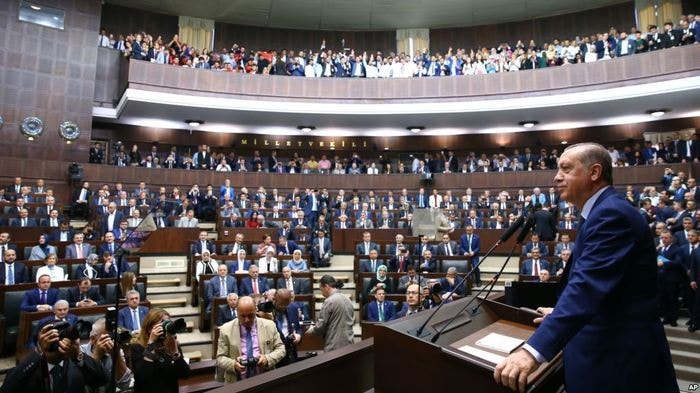 |
| President Tayyip Erdogan addressed the Turkish parliament on June 13, 2017, reiterating his support for Qatar. (AP photo) |
Opportunities to increase influence
The shift in Türkiye's approach and stance toward the Gulf diplomatic crisis, from outright support for Qatar to support dialogue between the parties, is not entirely difficult to understand for the following reasons:
Firstly, the current tensions in the Gulf are negatively impacting Türkiye's relations and interests in the region. One of the demands of the Arab countries on Qatar is that Doha close the Turkish military base in the country.
Turkish President Erdogan stated that the demands of the Gulf states constitute interference in the bilateral relations between Turkey and Qatar – “two countries that have the right to choose their partners, make friends, and form alliances.” Clearly, if tensions continue, Türkiye will be at a significant disadvantage in maintaining its strategic presence in the region.
Secondly, given the current strained relations between Türkiye and the European Union and the United States, Ankara must also be wary of the potential negative impact on its relationship with the regional power, Saudi Arabia.
Therefore, Erdogan's visit to the three Gulf countries this time was not only to "sound out" Saudi Arabia's stance on the Gulf crisis but also to appease the leading nation in isolating Qatar in order to avoid bilateral confrontations.
Furthermore, Türkiye also wants to build its image and role through engagement with all parties in the Gulf region. According to observers, the imbalance of power is still ongoing in the Middle East, with everyone trying to assert their influence in an open and confrontational competition.
In this context, Türkiye, a country considered prominent in the Islamic world, certainly does not want to remain "on the sidelines" and simply watch the political "chessboard" in the Gulf shift. Compared to Kuwait, Türkiye has more advantages if it wants to go further in mediating the Gulf crisis because of Ankara's connections with all parties involved.
Once a suitable solution to the current tensions is found, Türkiye will demonstrate a greater role in the region. However, it must also be acknowledged that President Erdogan will face more challenges than other NATO allies in securing a breakthrough in resolving this crisis.
Nevertheless, with these latest diplomatic moves, it is clear that Türkiye is trying to assert its role on the "big chessboard" in the Gulf region. Whether this mediating mission succeeds depends on the goodwill and concessions of all parties involved.
Thanh Huyen


