
Time - A resource for development
The story of a business that has been virtually inactive since 2013, and which may have to spend nearly 100 million VND to complete the dissolution process after more than 10 years, has been attracting public attention in recent days. This raises concerns about something bigger than just one business: what is lost when a day, a month, or a year of delay occurs? And ultimately, who pays the price for this delay?

Bui Chi Kien
(Central Committee for Strategic Policy)
*****************
The story of a business that has been virtually inactive since 2013, and which may have to spend nearly 100 million VND to complete the dissolution process after more than 10 years, has been attracting public attention in recent days. This raises concerns about something bigger than just one business: what is lost when a day, a month, or a year of delay occurs? And ultimately, who pays the price for this delay?
First and foremost, it's important to recognize that businesses participating in the market are responsible for their legal, tax, accounting, and registration obligations. Ceasing business operations does not automatically mean the legal entity ceases to exist. The rule of law must be upheld to ensure equality between compliant businesses and those that violate it.
However, from a national governance perspective, the story shouldn't stop at "who is at fault." The more important question is whether the system is capable of identifying, warning, and addressing a problem from its early stages. A business that has ceased operations for years without its obligations being definitively determined; a case left unresolved; data that already exists but citizens are still required to provide again; a matter within the jurisdiction that requires approval through multiple levels... each individual case may not seem significant, but thousands or tens of thousands of such cases combined create an "administrative debt" for the economy.
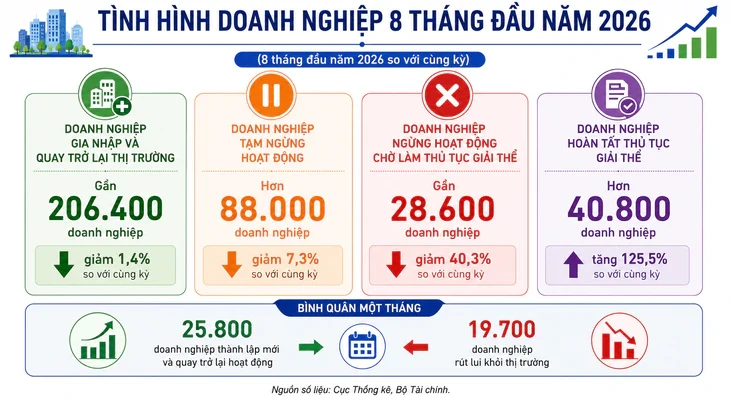
Notably, Tuoi Tre newspaper cited figures showing that nationwide, approximately 292,000 businesses have ceased operations but have not yet completed dissolution procedures, and over 325,000 businesses are no longer operating at their registered addresses. While these figures should be interpreted correctly according to statistical methods and do not necessarily mean that all of them are due to slow processing by state agencies, they still demonstrate the scale of the problem of businesses withdrawing from the market, which needs to be seriously considered. This is precisely the point that needs to be broadened from a specific case to a problem of service-oriented administration, demonstrating that the time of citizens and businesses is also a form of social resource.
At the National Conference on September 3, 2026, General Secretary and President To Lam emphasized: “Time is an irreplaceable resource for development. Delays in institutionalization, decisions, and removing bottlenecks increase costs and cause missed opportunities. What is clear must be done immediately; obstacles must be addressed early.” This is not just a message about speed, but a new requirement for governance thinking. If capital is considered a resource, it must be managed to prevent it from being idle; if land is a resource, it must be used efficiently; if data is a new resource, it must be ensured that it is connected and exploited. Therefore, society's time must also be protected as a resource for development.
A business having to wait an extra month to complete a procedure could lose a month of business opportunity. A project delayed in decision-making could lose an entire investment season. An investor having to travel multiple times might switch to another locality. An official having to spend days completing paperwork that the system already has data on is time that does not add value to public service. Therefore, administrative reform should not only be measured by the number of procedures reduced, but should shift strongly towards measuring the time society saves, the actual costs reduced, and the development opportunities opened up.

The country has made significant progress, such as the program to reduce and simplify administrative procedures related to production and business, aiming to cut processing time and compliance costs by 50% by 2026 compared to 2024. Simultaneously, it aims for businesses to only provide information and documents once, and for eligible procedures to be completed online throughout. By the end of 2025, 14 ministries and ministerial-level agencies had submitted plans to reduce and simplify 3,085 out of 4,888 administrative procedures related to production and business activities, equivalent to 63.1%; and simultaneously reduce 2,371 out of 6,974 business conditions, equivalent to 33.9%.
However, the government also frankly pointed out that the revision of documents to implement approved plans has been slow. This shows that the crucial issue is that reform is only complete when citizens and businesses truly receive faster, simpler, and less costly results. Modern administration needs to change the way it evaluates work. Instead of simply asking officials, "Has the file been received?", we must ask, "How far has the file been processed? What are the remaining obstacles? Who is responsible? And when will the final result be available?" An agency cannot be evaluated solely by the number of documents issued, but by the number of bottlenecks resolved, the number of days shortened, the number of costs reduced, and the actual level of satisfaction of citizens and businesses.
In other words, we need to shift from "process management" to "results management," a message that aligns with the requirements set by General Secretary and President To Lam at the National Conference on September 3rd: Work must have someone responsible; new and difficult tasks must be piloted under controlled conditions; data must be "accurate, complete, clean, and relevant"; officials must be evaluated based on results, and those who evade, shirk responsibility, or work half-heartedly must be screened out. From this, a very simple yet transformative standard can be formed: Do it right - do it quickly - do it thoroughly - take responsibility for the results. "Do it right" to avoid arbitrariness; "Do it quickly" to avoid wasting society's time and opportunities; "Do it thoroughly" to avoid passing on one's work to other agencies or to the people; "Take responsibility for the results" so that no one can complete a task simply by passing a file from one desk to another.
The most thought-provoking aspect of the business dissolution story isn't how to avoid a specific penalty, but rather how to prevent businesses from remaining inactive for over 10 years without any warning, guidance, or resolution mechanisms. A new process could be envisioned as follows: When a business ceases operations, the data system automatically identifies its status; the regulatory agency sends a warning about outstanding obligations; the business receives a one-time guidance on all necessary tasks; tax authorities, business registration agencies, and other relevant bodies share data; and a single point of contact is responsible for tracking the process until completion. This means that instead of allowing a small issue to accumulate into a large debt, the system will handle it early, remotely, and at a lower cost. This is also the direction the Government has requested to promote database connectivity, reduce paperwork, eliminate the need for businesses to re-provide information that the State already possesses, and complete business-related procedures online in a seamless and efficient manner.
In an era of rapid growth and fierce international competition, Vietnam cannot accept a fast-growing economy where some administrative processes still operate at an outdated pace. Double-digit growth requires not only more capital, technology, and infrastructure, but also reduced downtime, lower waiting times, and faster decision-making. Only then will administrative reform return time, costs, and development opportunities to the people, businesses, and the economy itself.


