
Announcement of the Conclusions of General Secretary To Lam at the Conference summarizing the work of the Central Steering Committee on Science, Technology, Innovation and Digital Transformation in 2025.
The Central Steering Committee on Science, Technology Development, Innovation and Digital Transformation has just issued Notice No. 17-TB/CQTTBCĐ, dated December 29, 2025, on the conclusions of General Secretary To Lam, Head of the Steering Committee, at the conference summarizing the work of 2025 and the key tasks and solutions for 2026 of the Central Steering Committee.
The content of Notice No. 17-TB/CQTTBCĐ is as follows:
On December 25, 2025, the Central Steering Committee on Science, Technology, Innovation and Digital Transformation (hereinafter referred to as the Steering Committee) held a conference to summarize its work in 2025 and outline key tasks and solutions for 2026. The conference was held in person at the Party Central Committee headquarters and online to 34 provinces and centrally-administered cities. The conference was chaired by General Secretary To Lam, Head of the Steering Committee, and attended by members of the Politburo, Secretaries of the Party Central Committee, members of the Party Central Committee, representatives of Party committees directly under the Central Committee, leaders of Party agencies at the central level, Ministers of ministries and ministerial-level agencies, government agencies, committees of the National Assembly, and Secretaries and Chairmen of provinces and centrally-administered cities; members of the Working Group and the National Advisory Council. You are representatives of the leadership of institutes, universities, and technology companies.
Based on the report of the Standing Agency of the Steering Committee, the remarks of the Prime Minister, Deputy Head of the Steering Committee, and the delegates attending the Conference, General Secretary To Lam, Head of the Steering Committee, basically agreed and directed as follows:
I-REGARDING THE EVALUATION OF RESULTS AFTER ONE YEAR OF IMPLEMENTING THE RESOLUTIONNUMBER57ButNQ/TW
The Steering Committee unanimously agreed with the assessment of the results of one year of implementing Resolution No. 57-NQ/TW as presented in the Report of the Standing Agency. It acknowledged and commended the serious and decisive work of the members of the Steering Committee, ministries, departments, localities, and the business community. After one year of implementation, the awareness and actions of the entire political system have shown positive changes, affirming that this is a correct and timely policy to remove bottlenecks and create opportunities for development.
Outstanding results include: (1) Basic institutions and policies have been streamlined with a large number of laws, decrees, and circulars issued synchronously, creating a solid legal framework. (2) Financial resources are prioritized, allocated, and ensured at 3% of the total state budget expenditure. (3) Digital transformation of the entire political system has made positive progress, especially when implementing Plan No. 02-KH/BCĐTW, Regulation No. 05-QĐ/BCĐTW, and the conclusions of the Steering Committee, along with the digital transformation programs and projects of the four government agencies. (4) Science, technology, and innovation have identified a systematic approach and the right direction, in line with the development trends of the world, with key areas of the 3-House Cooperation Model, high-tech zones, smart cities, innovation centers, and strategic technologies. The initial results achieved in implementing Resolution No. 57-NQ/TW in 2025 have contributed to the estimated contribution of science, technology, innovation, and digital transformation to GDP reaching over 16.4%.
Besides the positive results achieved, there are still many shortcomings, limitations, and bottlenecks that need to be addressed:(1)Although institutional and policy frameworks have been streamlined, some implementing guidelines have not been issued in a timely manner, leading to some policies and initiatives not being put into practice promptly.(2)Digital infrastructure and capacity at the grassroots level are weak; many communes and wards lack internet access, equipment, and dedicated IT personnel; software systems in ministries and agencies are fragmented and not interconnected, hindering the provision of comprehensive public services.(3)Progress in building national and specialized databases is slow, data is not standardized, and the value of data has not been fully realized.(4)The allocation and disbursement of funds and the arrangement of resources for some work items are still slow, directly affecting the speed of implementation of key tasks.(5)There is a shortage of high-quality human resources in key fields such as artificial intelligence, semiconductors, and cybersecurity.(6)The task of ensuring cybersecurity and data security still faces significant risks.
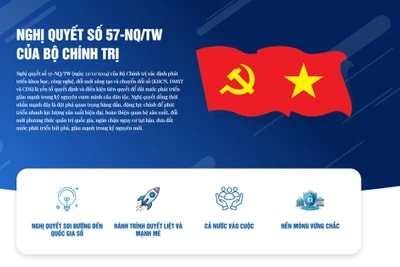
Resolution No. 57-NQ/TW of the Politburo
II- ABOUTTASKAGENCY AND WORK PLAN FOR 2026
The year 2026 holds special significance, marking the first year of implementing the Resolution of the 14th National Congress of the Communist Party of Vietnam. At the very beginning of this term, the Central Committee of the Communist Party of Vietnam will issue strategic resolutions on transforming the country's development model based on science and technology, and strategic solutions to mobilize resources for double-digit growth. This demonstrates the particularly important role – the fundamental and core – of science, technology, innovation, and digital transformation. This is no longer an option but a mandatory requirement for rapid and sustainable national development in the coming period.
The Steering Committee unanimously agreed with the Standing Agency's proposal on the key tasks and solutions for 2026 to implement Resolution No. 57-NQ/TW.(with attached appendix).Party committees, party organizations, and agencies at all levels are required to thoroughly understand and seriously implement the following seven orientations and guiding principles:
1.The agreed motto for 2026 is:"Breakthrough action, spreading results"The "startup" phase was completed in 2025, and in 2026, we must immediately shift to "acceleration," with the decisive factors being organizational capacity, discipline in action, and actual output results. Each ministry, sector, and locality must shift from a plan-based approach to a goal-oriented and product-driven approach; from progress reporting to effectiveness reporting; and from "doing it" to "doing it thoroughly."TheMinistries, departments, agencies, units, and localities must proactively propose their own tasks, not just wait for the Committee.CDirecting and assigning tasks; these must be clearly defined.task ofset,agency,my local areato organize and assign tasks for implementation;We propose that the Steering Committee, the National Assembly, the Government, and the Party and mass organizations at the central level provide guidance., consider and give opinions on issues beyond their authority;industriesIt is necessary to proactively coordinate in the implementation of related tasks..Prioritize the timely and adequate allocation of resources for infrastructure, data, strategic technologies, and high-quality human resources; and establish control mechanisms to ensure the effectiveness of investment implementation.
2.Enhancing the role of Party committees and leaders.Party committees and organizations at all levelsDtable,specialHeads of ministries, departments, localities, agencies, and units must clearly understand their responsibilities.personalProgress and results should be tracked, and performance results should be included in evaluation criteria, awards, and accountability measures for delays.
3Focus on directing key, core tasks to create a ripple effect. Specifically identify the key, core tasks that require focused direction and resource allocation, especially those related to concretizing the National Digital Master Architecture Framework and the National Data Architecture Framework; completing infrastructure, building platforms and databases, developing strategic technologies, and developing high-tech human resources, etc., with a specific roadmap for each task and appropriate resource allocation to focus on implementation.Three questions must be answered: (1) Ministries, departments, localities, and enterprises must formfacilityHow is our data? The complete database catalog must be finalized in Q1/2026; data must be regularly updated.aggregate, update, supplement to ensure correct, sufficient, clean, and living. (2) The strategic technology group needs to clearly identify which ministry is responsible.tResponsibilities for implementation, which ministries and agencies will coordinate, in 2026 and the period up to 2026.ButWhat requirements will be met by 2031? What is the implementation roadmap? (3) How should the entire population improve their digital transformation and innovation skills? How many high-quality graduates should be trained? How many engineers for strategic technology? What should the Ministry of Education and Training do? The Ministry of ScienceCWhat should the Ministry of Technology do? What should the two Academies of Sciences do? What should the Union of Scientific Associations do?... All of these issues need to be defined very specifically, along with a roadmap for implementation.
4.Promote the development of specific applications and products serving socio-economic development and the needs of the people. All policies, platforms, services, and utilities must meet the requirements of serving the people and businesses; the satisfaction of the people and businesses is the measure of performance; work must be substantive, not formalistic, and bring about practical results. Strengthen digital transformation associated with administrative reform and streamlining the apparatus, effectively operating the two-tiered local government, reducing administrative procedures, and promoting the provision of online public services; promote innovation in the public sector through decentralization, standardization of processes, comprehensive digitalization, and creating conditions for ministries, sectors, and localities to proactively exploit data and effectively operate shared digital platforms.
5.Focus resources on strategic technologies and product commercialization; promote science and technology and innovation based on close linkages between the State, universities, and businesses, forming the core of an innovation ecosystem. Prioritize the development of high-tech zones, innovation centers, and smart cities as spaces for testing, application, and dissemination. Concentrate investment and deployment on strategic technologies to create long-term competitiveness, mobilizing social resources to make science, technology, innovation, and digital transformation key drivers of double-digit growth.
The State must play a facilitating role, removing barriers and acting as the first "customers" ordering products, services, and solutions related to science, technology, innovation, and digital transformation. This creates a starting market for research results, inventions, and new technology applications, and provides impetus for businesses, research institutes, and universities. Large enterprises need to think big, do big things, lead and pave the way, creating jobs and space for other businesses to participate in the value chain; small and medium-sized enterprises should focus on doing things that match their capabilities, thereby enhancing their position and contributing to national development.
6.Ensuring information security, cybersecurity, and digital sovereignty.This is a prerequisite for sustainable development. It requires agencies, units, and localities to thoroughly understand and implement the Party Central Committee's Directive and the Steering Committee's overall plan on ensuring cybersecurity, information security, and data security within the political system.
7.We must resolutely combat waste. It is necessary to identify and prevent the risk of waste right from the investment planning stage. Large investments must go hand in hand with high efficiency; we must resolutely prevent any waste of finance, resources, and development opportunities.
The Central Party Office is tasked with leading and coordinating with relevant agencies to develop the Steering Committee's 2026 work program, clarifying breakthrough areas for the development of science, technology, innovation, and digital transformation across sectors and fields, creating a foundation for promoting double-digit economic growth. The Government will focus on strongly promoting comprehensive digital transformation across all sectors: digital government, digital economy, and digital society. Priority will be given to digital transformation in the business sector, especially in key economic and industrial sectors such as: energy industry, food processing industry, textile and garment industry, leather and footwear industry, chemical-fertilizer-rubber industry, construction materials industry, mechanical and electronic industry, cosmetics, furniture, smart agriculture, and e-commerce. The 2026 work programs and plans of central and local agencies must be completed.before the 10th1/2026.
Develop evaluation indicators and ranking mechanisms, and periodically publicize the implementation results of agencies and localities in implementing Resolution No. 57-NQ/TW, ensuring objective, transparent, and verifiable data. All progress and results must be measured and monitored using real-time data on the System for Monitoring and Evaluating Resolution No. 57-NQ/TW, while also publicly disclosing some information for social oversight, citizens, and businesses.
Resolution No. 57-NQ/TW has ushered in a new era for the country, placing science, technology, innovation, and digital transformation at the center of the development strategy. 2025 has established a solid foundation; 2026 must be a year of breakthrough action, shifting from foundation to results, from policy to product, from ideas to tangible value for the people and businesses. The Steering Committee requests that the entire political system act immediately; every official, every agency, and every locality must clearly define their responsibilities, mobilize resources, and implement decisively to turn the goals into reality, contributing to the rapid and sustainable development of the country.
The Central Party Office - the Standing Agency of the Steering Committee - hereby informs the members of the Steering Committee and relevant agencies to be aware of and implement this.


