
Where does the average income of people in Nghe An stand on the national income map?
The results of the 2025 survey on living standards, recently published by the General Statistics Office (Ministry of Finance), clearly outline Nghe An's position in the national income landscape; at the same time, it suggests the need to improve the quality of growth in the coming period.
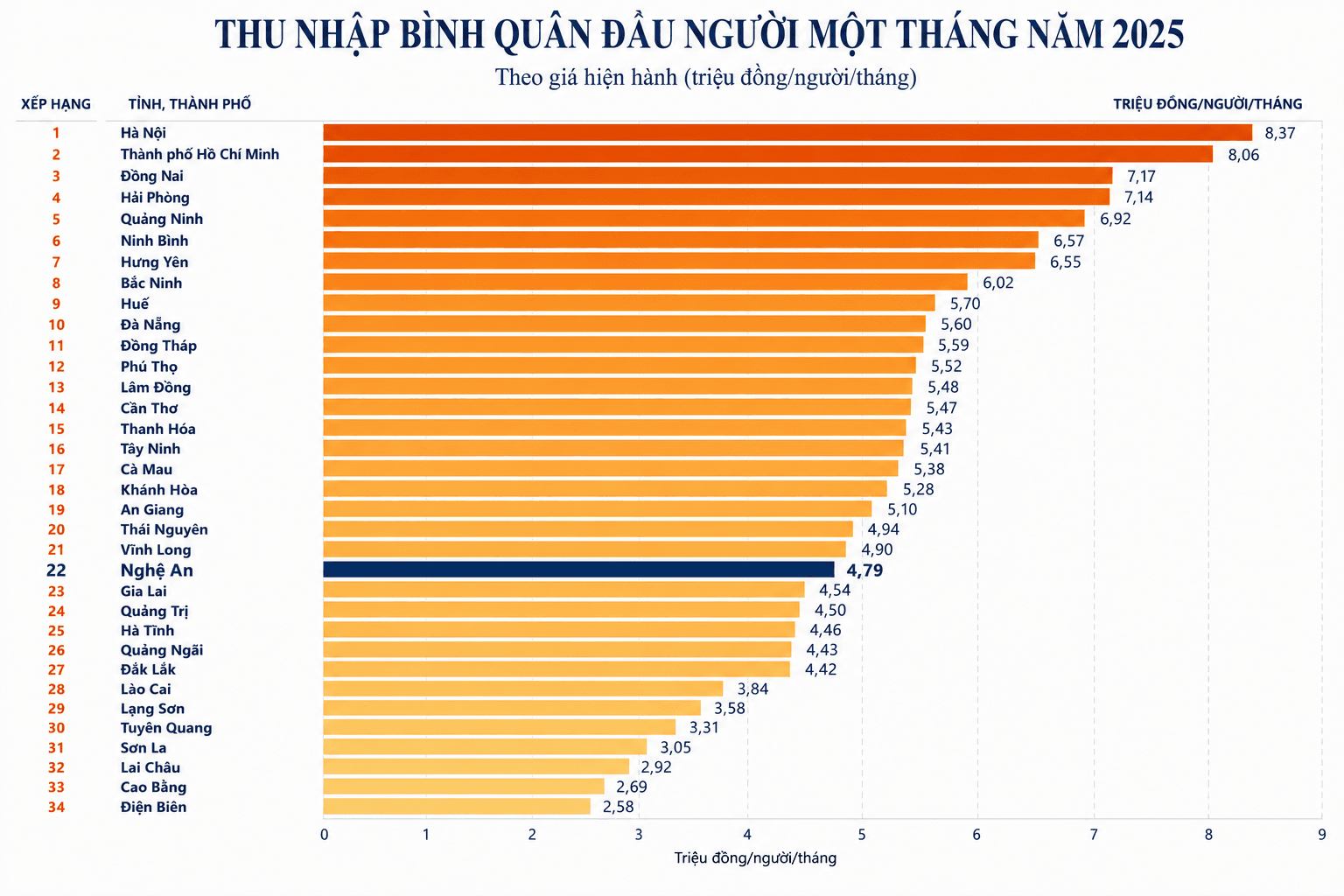
According to the survey results, the average monthly per capita income at current prices nationwide in 2025 will reach over 6 million VND, an increase of 10.9% compared to 2024.
Within that overall picture, the average income of people in Nghe An reached 4.79 million VND/person/month, ranking 22nd out of 34 provinces and cities. Compared to the national average, the income of people in Nghe An is about 1.21 million VND/person/month lower, equivalent to 20.2%.
In the North Central region, the average income in Nghe An is about 227,000 VND/person/month lower than the regional average, equivalent to 4.5%.
Within this region, Nghe An ranks third in per capita income, after Hue with 5.697 million VND/person/month and Thanh Hoa with 5.43 million VND; higher than Quang Tri (4.502 million VND) and Ha Tinh (4.457 million VND).
On the positive side, the income of people in Nghe An has continuously improved in recent years. In 2021, the average income reached 3.095 million VND/person/month; in 2022 it increased to 3.629 million VND; in 2023 it reached over 4.05 million VND; in 2024 it reached 4.42 million VND and by 2025 it will reach 4.79 million VND. After 5 years, the average income increased by more than 1.69 million VND/person/month.
This upward trend demonstrates the effectiveness of economic development. However, the gap compared to the national average remains quite large, reflecting that the process of translating economic growth into workers' income requires more time.
In recent years, Nghe An has maintained a relatively high growth rate, its economy has continuously expanded, and its investment environment has steadily improved.
Nevertheless, the proportion of the workforce in agriculture remains large, while many manufacturing sectors employ a significant number of unskilled laborers, resulting in income levels not keeping pace with the GRDP growth rate.
One positive sign is that the employment structure is shifting towards higher value-added jobs. Many industrial parks are being invested in, and projects in electronics, high technology, precision mechanics, and new materials are successively coming into operation, creating more jobs with higher productivity and wages.
In addition, strategic infrastructure systems such as highways, seaports, logistics, and the expansion of the Southeast Economic Zone are creating a foundation for attracting large-scale projects.
When these projects become effective, the labor market will have more quality jobs, contributing to improved incomes for the people.
The service sector is also expanding its growth potential thanks to the stronger development of tourism, e-commerce, logistics, finance, and the digital economy. This is a group of industries with high added value and a large demand for skilled labor.
Nghe An's development orientation in the coming period focuses on increasing the proportion of processing, manufacturing, and high-quality service industries; prioritizing attracting projects that apply modern technology and employ a large number of skilled workers. This strategy is expected to contribute to raising the wage level and improving average income.
Alongside attracting investment, improving the quality of human resources plays a crucial role. Vocational training linked to the needs of businesses in the fields of electronics, precision mechanics, automation, information technology, logistics, and modern services will help workers access more job opportunities with higher incomes.
In rural areas, the restructuring of agriculture towards large-scale commodity production, the application of high technology, the development of processing industries and value chains is expected to increase labor productivity and raise people's incomes.
The development of the private sector, along with investment in education, healthcare, digital transformation, and social infrastructure, will also create further impetus for improving job quality and raising living standards.
Per capita GRDP reflects the scale of value created by the economy, while average income reflects the portion of value that people actually receive. A gap always exists between these two indicators, but the narrower that gap, the higher the quality of growth.
Therefore, the road ahead will be measured by both the scale and quality of growth. The value of each percentage point of GRDP becomes even more meaningful when it translates into better jobs, higher incomes for the people, and an increasingly improved standard of living.


