
The Prime Minister answers questions regarding the Ho Chi Minh Highway Project.
The Prime Minister has just issued a document responding to questions from National Assembly representatives from Tay Ninh province regarding the Ho Chi Minh Highway project.
Previously, the Prime Minister received a question from National Assembly Representative Trinh Ngoc Phuong, from the Tay Ninh Provincial National Assembly Delegation: “The reduction of over 14 trillion VND, approximately 23%, in the Ho Chi Minh Highway project is a breakthrough in saving costs in basic construction. Please explain the solutions that led to this breakthrough? As far as I know, besides the actual prices and calculations in the bidding process, the unit prices, norms, investment rates, as well as technical design standards and regulations issued by ministries and agencies are difficult to change and adjust. Please explain the legal basis for the 5% savings in the aforementioned project. Furthermore, I propose that if the breakthrough in the transportation sector through the above project has a solid legal basis, the Government should direct ministries and agencies to research and review the system of unit prices, investment rates, and technical standards and regulations issued recently, in order to ensure that construction projects are carried out effectively.” "We need to establish the fundamentals based on their true value; otherwise, we are wasting a great deal of resources on this work."
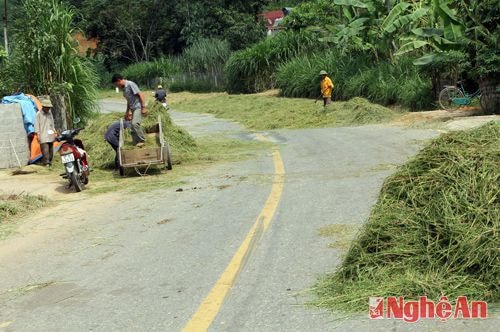 |
| Along the Ho Chi Minh Highway, in the sections passing through Lang Son commune (Anh Son district), Nghia Hanh commune (Tan Ky district), etc., many people are drying straw, posing a very high risk of accidents. |
In response to the questions, the Prime Minister stated that, in implementing Resolution No. 13-NQ/TW dated January 16, 2012, of the 4th Conference of the Central Committee of the 11th Party Congress on building a synchronous infrastructure system to basically transform Vietnam into a modern industrialized country by 2020; and Resolution No. 31/2012/QH13 dated November 8, 2012, of the National Assembly on socio-economic development in 2013; the Government issued Resolution No. 83/NQ-CP dated December 7, 2012, assigning the Ministry of Transport to preside over and coordinate with relevant ministries, sectors, and localities to mobilize resources to implement projects to renovate and expand National Highway 1 and the Ho Chi Minh Highway section through the Central Highlands.
To date, all projects have been well-controlled in terms of progress and quality. The project to upgrade and expand National Highway 1 from Hanoi to Can Tho was basically completed entirely in 2015; the Ho Chi Minh Highway projects through the Central Highlands were completed entirely in July 2015, shortening the construction time by 1.5 years compared to the plan.
Currently, the projects to renovate and upgrade National Highway 1 from Hanoi to Can Tho and the Ho Chi Minh Highway section through the Central Highlands still have remaining government bond funds of 14,259 billion VND.
The reasons for the surplus capital are: the difference between the total capital allocated to projects according to Resolution No. 65/2013/QH13 and the approved total investment; accelerated land clearance and construction progress, thus saving on contingency costs for price fluctuations and interest costs for BOT projects; review and adjustment of designs for suitability; reasonable construction organization methods; and a 5% saving in the estimated budget due to the implementation of direct contracting (the Ministry of Transport has already provided a detailed explanation in Document No. 14383/BGTVT-KHĐT dated October 28, 2015, during the National Assembly's group discussion on the allocation plan for the remaining government bond capital of the projects to renovate and upgrade National Highway 1 and the Ho Chi Minh Highway section through the Central Highlands).
Regarding the application of a 5% cost savings rate due to the direct contracting method, the Prime Minister stated that during the implementation of the projects to renovate and upgrade National Highway 1 from Hanoi to Can Tho and the Ho Chi Minh Highway through the Central Highlands, the Government and the Prime Minister instructed the Ministry of Transport to direct the investors to prepare, appraise, and approve cost estimates in strict compliance with current regulations on construction investment cost management. At the same time, to ensure objectivity, the cost estimate verification was assigned to the Institute of Construction Economics - Ministry of Construction.
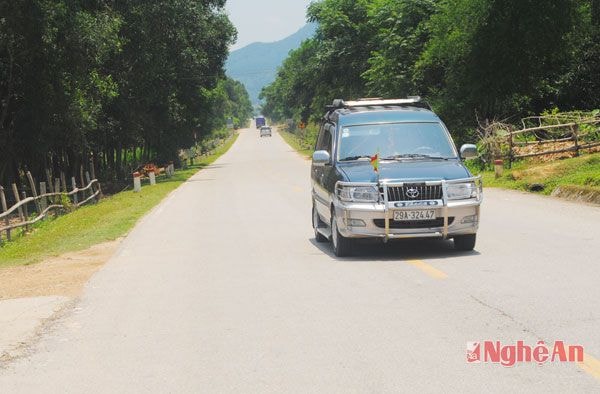 |
| Since the Ho Chi Minh Highway was built through the area, it has created favorable conditions for the local socio-economic development. |
According to current cost management regulations, when preparing cost estimates, a profit margin for the construction company (pre-taxable income) is projected. When participating in bidding, companies, based on their capacity and experience, have the right to develop appropriate construction organization methods to ensure quality, progress, efficiency, and profitability. According to summary data on bidding for transportation infrastructure construction projects in the recent past, the savings rate through bidding ranges from 3% to 5%.
In the past, when implementing projects of particular importance to socio-economic development and people's lives, the Government has applied the direct contracting mechanism with a savings rate to accelerate project implementation progress, such as: Power projects have applied the direct contracting mechanism with a savings rate of 5% according to mechanism 797-400 (Government Document No. 797/CP-CN dated June 17, 2003); hydropower projects have also applied the direct contracting mechanism with a savings rate of 5% according to mechanism 797-400 (Government Document No. 400/CP-CN dated March 26, 2004). The Ho Chi Minh City - Trung Luong Expressway Project and the Vinh Tuy Bridge Construction Project applied the direct contracting mechanism, resulting in a 5% cost saving (Notice No. 170/TB-VPCP dated September 12, 2005, from the Government Office). Using this mechanism shortened the implementation time and allowed for the projects to be put into operation sooner, meeting the requirements for socio-economic development and serving the people's lives.
Therefore, in order to expedite the completion and synchronous commissioning of the projects to renovate and upgrade National Highway 1 from Hanoi to Can Tho and the Ho Chi Minh Highway section through the Central Highlands, the Government has continued to allow the application of the direct contracting mechanism with a savings rate of 5% compared to the approved budget as stated in Notice No. 55/TB-VPCP dated February 21, 2012.
To date, the projects to renovate and upgrade National Highway 1 from Hanoi to Can Tho and the Ho Chi Minh Highway through the Central Highlands have been basically completed and put into operation, achieving great effectiveness in developing infrastructure in particular, and contributing to promoting the socio-economic development of the country in general. Thus, it can be affirmed that the Government's directive on applying the direct contracting mechanism with a 5% savings rate on the estimated budget is appropriate to practice, contributing to the efficient use of state investment capital, while ensuring the harmonious development of enterprises.
According to VNA
| RELATED NEWS |
|---|


