
The Prime Minister chaired the conference on addressing the consequences of Typhoon No. 3.
On the morning of September 8th, at the Government headquarters, Prime Minister Pham Minh Chinh chaired a conference to assess the response efforts, the extent of damage, and the implementation of urgent measures to mitigate the consequences of Typhoon No. 3.
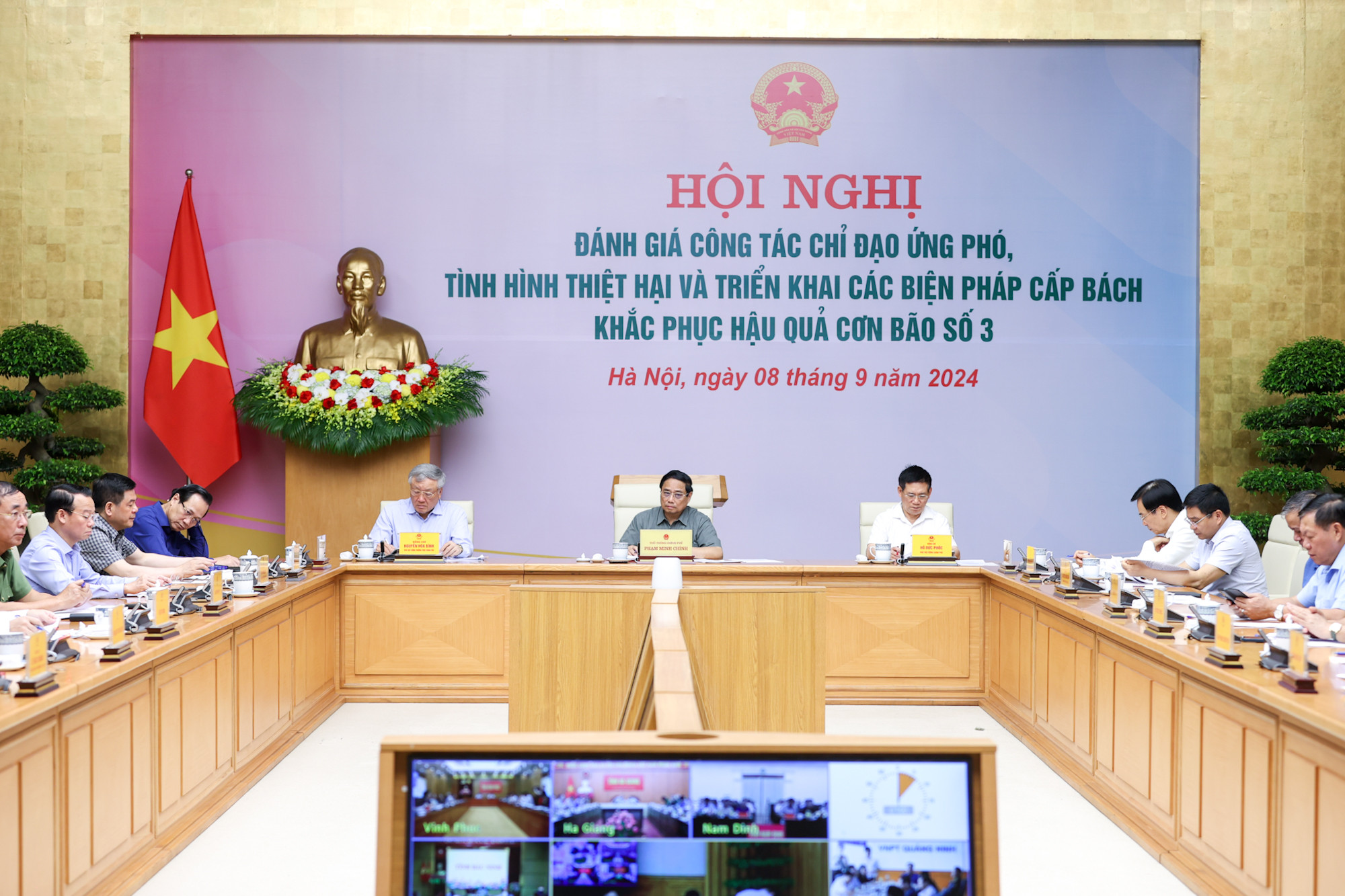
The conference was held online, connecting the Government headquarters to 26 localities from Thanh Hoa northward. Attending the conference were Deputy Prime Minister Nguyen Hoa Binh, Deputy Prime Minister Ho Duc Phoc, leaders of ministries and central agencies; and the Secretaries and Chairmen of the People's Committees of the 26 provinces and cities northward.
In his opening remarks at the conference, Prime Minister Pham Minh Chinh emphasized that Typhoon No. 3 had raged on land for more than a day, causing serious consequences. The storm's remnants will continue to cause rain and floods, especially in the northern mountainous provinces.
This conference aims to assess the situation, forecasting, public awareness campaigns, information dissemination to the people, implementation of the "four on-the-spot" principle; response efforts at both the central and local levels; assessment of consequences, analysis, and sharing of lessons learned; measures to mitigate consequences in the shortest possible time and long-term, strategic measures.
The Prime Minister requested an immediate review and support for the affected localities and families who lost loved ones. He emphasized that while people are suffering losses, discussions must be conducted with urgency; efforts to mitigate the consequences of the storm must be continued immediately; and issues related to people's lives, production, business, and landslide and subsidence response must be addressed promptly.
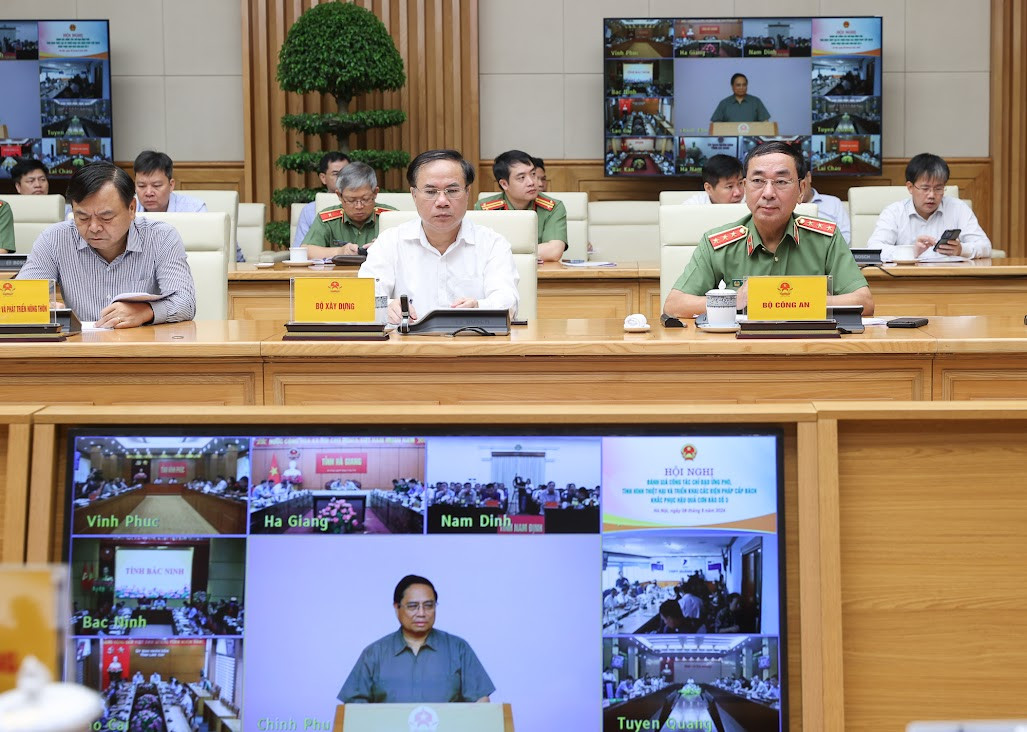
The storm also impacted the power and telecommunications systems. The Prime Minister instructed telecommunications providers to coordinate and share network connections to ensure telecommunications coverage for command and control operations and disaster relief efforts.
According to a report by the Ministry of Agriculture and Rural Development, Typhoon No. 3 (international name Yagi) was a very unusual storm, forming east of the Philippines but strengthening into a super typhoon in the South China Sea, and was the strongest typhoon in the South China Sea in the past 30 years. The strongest winds near the center of the storm reached level 16, with gusts exceeding level 17; upon landfall in Quang Ninh and Hai Phong, the strongest winds reached levels 13-14, with gusts of levels 16-17.
Typhoon No. 3 and its aftermath had a wide impact across the Northern region to Thanh Hoa (26 provinces and cities); the typhoon caused heavy rain in the Northern region, especially in the northern mountainous areas which suffered very heavy losses due to successive floods, flash floods, and landslides in July-August 2024.

In response, the Prime Minister paid special attention and issued three urgent dispatches to direct ministries, agencies, and localities to promptly and intensively implement measures to respond to the storm.
Local authorities and forces have thoroughly understood and strictly implemented the three directives from the Prime Minister, completing a huge amount of work before the storm hit.
Specifically, 51,319 fishing vessels/219,913 people were counted and guided to safe shelters. 52,979 people were evacuated from fish farms, aquaculture watchtowers, and weak houses to safe locations (Quang Ninh: 3,460 people; Hai Phong: 23,581 people; Thai Binh: 21,510 people; Nam Dinh: 1,743 people; Ninh Binh: 2,685 people).
438,275 people and 6,642 vehicles of all types were mobilized to respond to the storm, with forces assigned to be on standby at critical locations.

Regarding initial damage (updated as of 7:00 AM on September 8, 2024), due to darkness, high waves, strong winds, and power outages and communication disruptions, local authorities have not yet been able to compile accurate statistics.
Preliminary reports indicate initial damage includes 5 deaths (3 in Quang Ninh, 1 in Hai Phong, and 1 in Hai Duong); 186 injuries (157 in Quang Ninh, 13 in Hai Phong, 5 in Hai Duong, and 10 in Hanoi); 25 small cement and timber vessels sunk at their anchorages in Quang Ninh; and widespread power outages and communication disruptions in Quang Ninh, Hai Phong, Thai Binh, Hai Duong, and Hanoi.
Due to the prolonged duration of the storm and the sustained intensity of the storm, very strong gusts of wind damaged 3,279 houses; 401 power poles were broken; many shops, offices, and schools had their roofs blown off or were damaged; numerous advertising signs and telecommunication poles were broken; and urban trees were uprooted or broken.
In agriculture, 121,500 hectares of rice and other crops were flooded and damaged (concentrated in Thai Binh: 76,345 ha; Hai Phong: 6,750 ha; Hai Duong: 11,200 ha; Bac Ninh: 11,009 ha; Hanoi: 6,218 ha; Nam Dinh: 2,800 ha; Hung Yen: 11,923 ha; Ha Nam: 7,418 ha...); 5,027 hectares of fruit trees were damaged (concentrated in Hai Phong: 1,000 ha; Thai Binh: 1,385 ha, Hung Yen: 1,818 ha,...); over 1,000 aquaculture cages were damaged or swept away (mainly in Quang Ninh).
At approximately 00:05 on September 8th, a landslide occurred in Xóm Chầm hamlet, Tân Minh commune, Đà Bắc district, Hòa Bình province, affecting a household and killing four people and injuring one.

The remnants of Typhoon No. 3 will cause heavy rain.
Regarding the characteristics of Typhoon No. 3, the Ministry of Natural Resources and Environment assessed it as a typhoon with rapidly increasing intensity (intensity increased by 8 levels in 24 hours) and maintaining super typhoon status for an extended period. Upon making landfall on the eastern side of Hainan Island (China), it still retained super typhoon intensity. It was the strongest typhoon in the South China Sea in the past 30 years.
The rate of weakening along its path did not follow the usual pattern. Normally, when passing over Hainan Island (China) into the Gulf of Tonkin, typhoons tend to weaken quickly, but with typhoon number 3, its intensity did not decrease rapidly; when approaching the coast of Quang Ninh - Hai Phong, it still maintained an intensity of level 12-13.
The storm lasted for an extended period over land (12 hours). At 4 am this morning (September 8th), Typhoon No. 3 weakened into a tropical depression over the Northwest region. It is forecast that within the next 12-24 hours, the tropical depression will further weaken into a low-pressure area and gradually dissipate.
The National Center for Hydro-Meteorological Forecasting's forecast regarding the intensity and direction of Typhoon No. 3 closely matches the actual direction and intensity of the typhoon in the Gulf of Tonkin and upon landfall, and is consistent with forecasts from international agencies.

The National Center for Hydro-Meteorological Forecasting predicts that from September 8-9, 2024, the remnants of Typhoon No. 3 will cause heavy rain in the northern plains, midlands, and mountainous regions, with an average 24-hour rainfall of 100-150 mm, and in some places even over 200 mm.
There is a high risk of flooding on rivers and streams, as well as flash floods and landslides in some localities, with particular attention to the following:
(1) Small rivers in Quang Ninh, Lang Son, Cao Bang, and Hoa Binh may experience floods at alarm level 2 to alarm level 3.
(2) High risk of flooding in urban areas, cities and provinces in the Northern Delta due to heavy rain, especially in the provinces of: Quang Ninh, Hai Phong, Lang Son, Thai Nguyen, Cao Bang, Ha Giang, Yen Bai, Bac Kan, Nam Dinh, Thai Binh, Ha Nam, Hanoi.
(3) High risk of flash floods, landslides in the following provinces: Quang Ninh (12 districts/towns), Lang Son (11 districts), Bac Kan (6 districts), Thai Nguyen (9 districts), Bac Giang (8 districts), Vinh Phuc (5 districts), Hoa Binh (11 districts), Phu Tho (9 districts), Tuyen Quang (6 districts), Yen Bai (9 districts), Son La (8 districts), Lai Chau (3 districts), Lao Cai (4 districts), Thanh Hoa (10 districts).
The National Center for Hydro-Meteorological Forecasting and forecasting units in provinces and centrally-administered cities will continue to closely monitor the developments of rain and floods in the aforementioned areas and provide detailed and timely information to central and local disaster prevention and control agencies to enable timely and effective guidance, management, and response measures.
In his directive speech, the Prime Minister outlined five upcoming goals, including:
Firstly, the focus should be on rescuing people, searching for missing persons; providing medical treatment to the injured, especially those seriously injured; and arranging funerals for those who have passed away.
Secondly, we must ensure that no one lacks food, clothing, shelter, or a place to live; that no student lacks classrooms or schools; and that no sick person is left without access to medical care.
Thirdly, it involves resolving issues related to electricity, water, telecommunications, and other areas to support leadership, management, production, business, and people's lives.
Fourth, accurate and objective damage statistics are needed to develop appropriate, effective, and timely remedial solutions.
Fifth, responding to the consequences of storm circulation such as flash floods, landslides, subsidence, etc.
Regarding solutions,The Prime Minister requested that Party committees, governments at all levels, and relevant ministries and agencies proactively and actively implement measures to overcome the consequences of the storm according to their assigned functions, duties, and powers; the Ministries of Industry and Trade, Information and Communications, Transport, Agriculture and Rural Development, Natural Resources and Environment, and Labor, Invalids and Social Affairs strictly carry out their state management tasks within their authority (regarding guidance, regulations, standards, etc.), and if exceeding their authority, report to the competent authority for consideration and decision.
The Ministry of National Defence, the Ministry of Public Security, and rescue forces remain on standby to promptly respond to and mitigate the consequences of natural disasters. Relevant agencies continue to maintain forecasting and communication efforts, paying particular attention to providing information and guidance on disaster response skills.
Local authorities and relevant ministries and agencies, within their jurisdiction, shall utilize reserves for disaster prevention and control (in terms of finance, equipment, supplies, etc.) to restore normal operations.
Local authorities are to release reserves to address urgent issues related to people's food, clothing, housing, education, and healthcare, and to propose support from the central government from the contingency budget. The Prime Minister has assigned Deputy Prime Minister Ho Duc Phoc to preside over the handling and decision-making process. This needs to be done immediately, completed before 6 PM today, and further supplemented if necessary.
"In particular, localities must immediately compile statistics and release reserve rice as needed. The important thing is to have accurate and transparent statistics to avoid corruption," the Prime Minister emphasized. Along with that, focus should be placed on repairing schools and classrooms.
In particular, the Prime Minister called on people, businesses, agencies, and localities that were not affected to support those who were affected, "contributing what little they have, contributing what much they have, contributing what they have, contributing what they have, contributing their labor, helping those in need, and upholding the tradition of mutual support and compassion of our nation."
The Prime Minister pointed out several important lessons: Leaders and directors, especially local Party secretaries and chairmen, must closely monitor the situation, act decisively and resolutely, and focus on key areas; ministries, sectors, localities, agencies, and units, based on their functions, tasks, and powers, must strictly comply with the directives of competent authorities, be proactive, positive, and creative in disaster prevention and mitigation; thoroughly mobilize the "four on-the-spot" principles, conduct regular drills closely aligned with the situation, and prepare adequate reserves; and do a good job of communication and promptly commend, reward, discipline, and handle violations.


