
The Prime Minister raised five major questions about exports.
On the morning of April 23, in his opening remarks at the National Conference on Comprehensive Solutions to Promote Exports, Prime Minister Nguyen Xuan Phuc urged delegates to speak frankly and clearly explain the reasons behind the limitations and inability of certain industries to export.
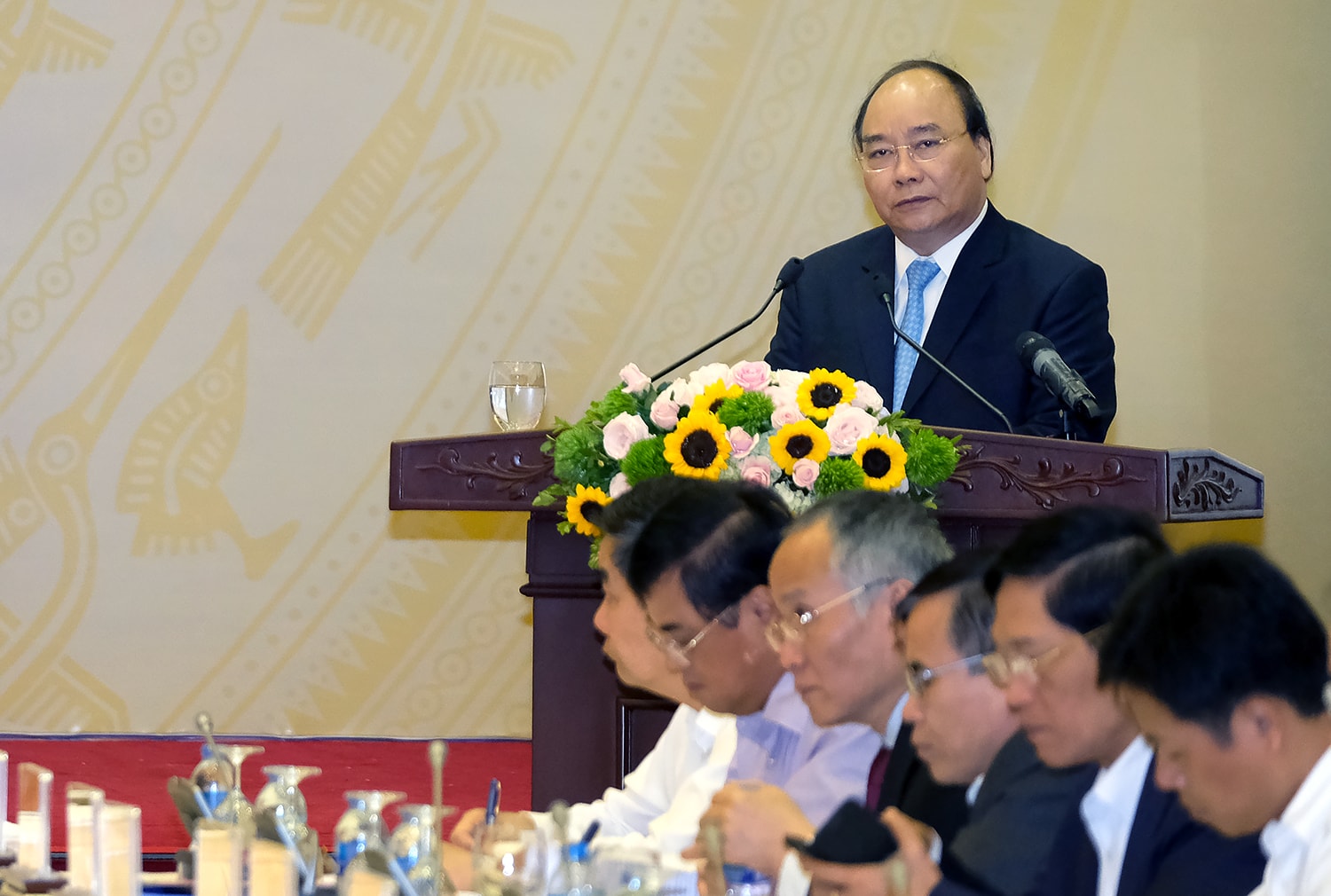 |
| Prime Minister Nguyen Xuan Phuc speaks at the conference. Photo: VGP/Quang Hieu |
Welcoming the participants directly involved in exports to the conference, the Prime Minister emphasized that no country in the world can industrialize and become a high-income country without succeeding in exports. Successful countries and businesses all view the entire world as a market to reach out to, thereby seeking ways to enhance their competitiveness to capture international markets.
Senior leaders also go to market Vietnamese products.
"Capturing the market is also the path for Vietnam's economy to take off," the Prime Minister said. While acknowledging the immense importance of the domestic market with nearly 100 million people, the Prime Minister emphasized that the most crucial factor for growth and sustainable development is looking at the global market.
The Prime Minister stated that a country that fails to balance its exports and imports, or has a high trade deficit, is also a source of high inflation, and high inflation leads to an unstable economy and difficult living conditions for the people. Therefore, balancing trade is a crucial issue in governance.
Therefore, at the conference, the Prime Minister expressed his desire for delegates to address the most crucial issues of current exports in order to resolve them: “I request that delegates speak frankly, explaining why some of our industries are hindering exports. Some industries are developing very rapidly, but others are still struggling, fluctuating between highs and lows. Of course, this is due to the global market, but also to our organizational and management methods,” the Prime Minister emphasized, and requested: “Before producing any product domestically, we need to consider where it will be consumed. You should produce what society needs, not what you have.”
The Prime Minister stated that last year, for the first time, Vietnam exported over $200 billion, including major export sectors such as electronics, manufacturing, agriculture, and other products for which we have found successful approaches. According to the Prime Minister, we have almost completed opening up access to new markets with 12 Free Trade Agreements (FTAs) already signed and under negotiation, as well as the conclusion of negotiations on several others. This is crucial to prevent Vietnam from becoming dependent on a few trading partners or sectors, contributing to increased economic self-reliance. Many Vietnamese leaders, including ministers, chairmen of provincial People's Committees, and even high-ranking Party and State leaders, are actively promoting Vietnamese products and seeking new markets.
|
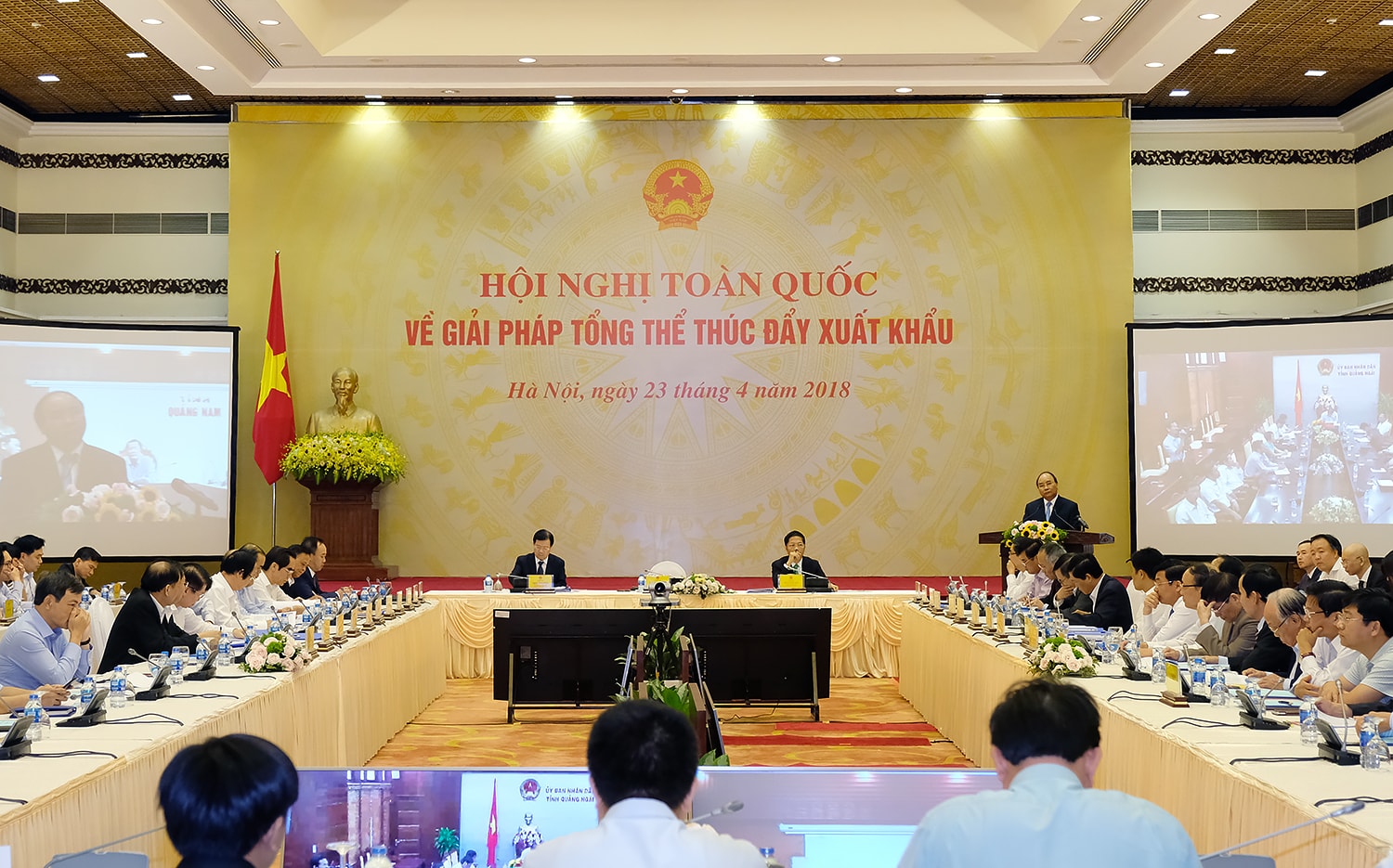
| The conference scene. Photo: VGP/Quang Hieu |
Big questions need answers.
The Prime Minister stated that today's conference is not about achievements or victories, but rather about identifying existing shortcomings and inadequacies in order to address them, given that the economy's openness is 190% of GDP, and imports and exports significantly impact economic growth.
Furthermore, according to the Prime Minister, difficulties in global trade this year and in the coming years are ever-present due to tensions in many countries and regions, including the risk of a trade war. The trend of increasing protectionism, especially in the first months of 2018, needs to be addressed to diversify exports. Countries are raising standards, especially for agricultural products and food, including increasingly stringent regulations on legal fishing, traceability, antibiotic residues, and plant protection products. "Without good management of these input stages to ensure clean agriculture, it will be difficult to export," the Prime Minister noted. On the other hand, competition for export goods is increasingly fierce. Meanwhile, some people and businesses are not yet closely linked to the market. Quality is inconsistent. Some products are initially good but later deteriorate, and some even damage Vietnam's reputation. Accordingly, should the conference "strongly condemn production facilities and individuals who act recklessly and carelessly for short-term gain without considering Vietnam's long-term reputation?" - the Prime Minister raised the issue.
Regarding administrative procedures in this area, the Prime Minister acknowledged significant progress, but the public's complaints remain strong. Therefore, the Prime Minister expressed his desire to listen to the heartfelt opinions of localities and industry associations, to hear about obstacles related to mechanisms, policies, market access, and solutions to enhance the competitiveness of export products.
In particular, the Prime Minister raised five major questions for the delegates to focus on clarifying.
Firstly, how can we increase the added value of Vietnam's exports? How can Vietnamese businesses participate strongly and move up the global value chain, instead of just focusing on frozen shrimp, fish fillets, etc., and not just on raw processing?
Secondly, what initiatives are there to identify and eliminate major bottlenecks in exports, "how many barriers are your industries facing?" If, "today, you cannot fully express your views, or sometimes at the conference you may be too sensitive, then write a letter to the Minister or the Prime Minister to present your initiatives to resolve these issues," the Prime Minister expressed.
Thirdly, how can Vietnamese businesses access market information, legal regulations abroad, opportunities and risks, and market orientations for production and export? What should foreign trade and diplomatic agencies do? How can the Trade Promotion Department operate effectively? What is the role of the Vietnam Chamber of Commerce and Industry? How should businesses, associations, and industries be informed and guided on implementing regulations, quality requirements, and traceability management? What should the National Competition Authority do to be more proactive in the current context?
Fourth, regarding further market development and creating demand for goods, "are you familiar with the agreements and tax incentives related to domestic production? What information do you need?"
Fifth, which is Vietnam's weakest link in exports today: foreign language skills, legal compliance, quality, or all three? Delegates can also propose comprehensive strategies for our country to boost exports, focusing on a systematic approach rather than a fragmented one, constantly addressing problems elsewhere. How should the broader picture of exports be approached?
The Prime Minister hopes that scientists, strategists, and experienced individuals from both within the country and internationally will contribute their opinions.
Stating that the conference was about discussing solutions to overcome obstacles, not just a formality, because each locality is involved in exports, the Prime Minister emphasized that the vision of the local chairman and the vision of the minister must both be geared towards exports so that the nation can achieve good growth, as exports are an indicator contributing to sustainable growth.
Based on the opinions expressed, the Prime Minister will issue a Directive on a number of solutions to develop production and promote exports.


