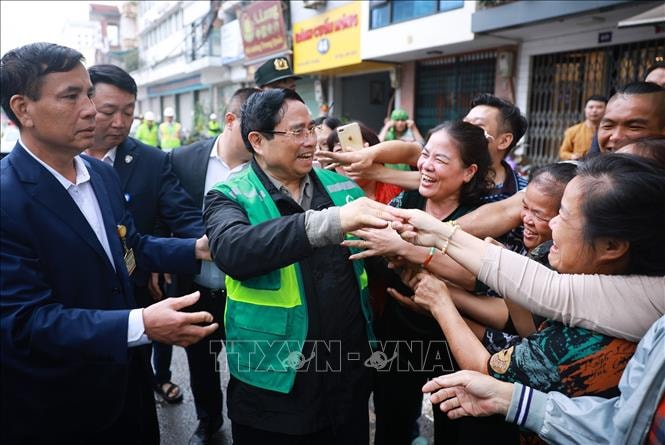
Prime Minister Pham Minh Chinh: Planning the development of the railway industry with a vision of over 100 years.
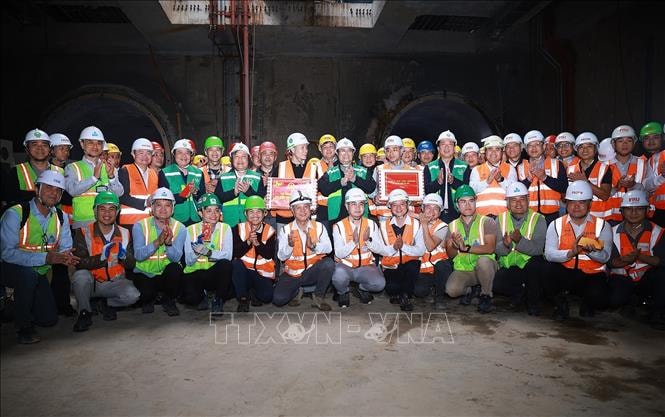
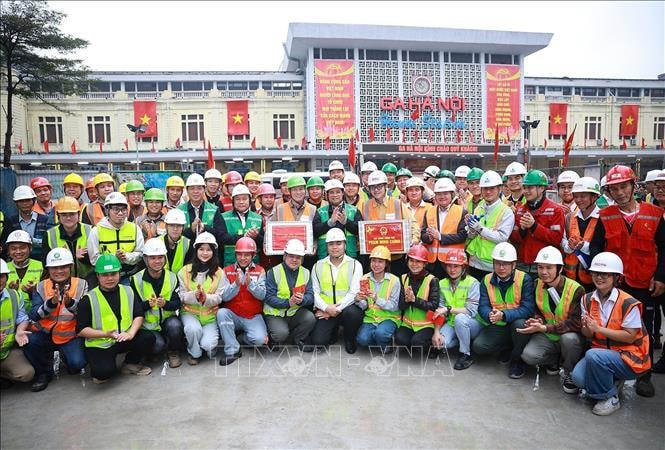
On the morning of February 22nd (the 6th day of the Lunar New Year, Year of the Horse 2026), Prime Minister Pham Minh Chinh inspected and encouraged the construction forces and directed the acceleration of the Hanoi urban railway project.
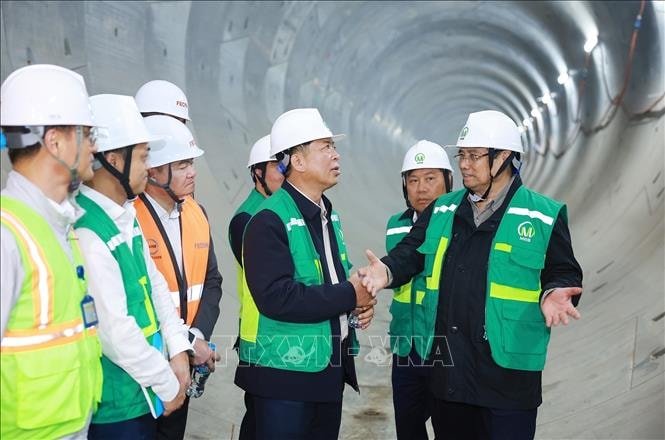
Accompanying him were Minister of Construction Tran Hong Minh; leaders of several ministries, central agencies, and the city of Hanoi.
Address the issue of prolonged implementation time.
The Hanoi City Pilot Urban Railway Project, Nhon - Hanoi Station section, has a total main line length of 12.5 km, of which 8.5 km is elevated and approximately 4.0 km is underground. This urban railway line is a double-track railway with a 1,435mm gauge, meeting European standards, with 8 elevated stations and 4 underground stations. The transport vehicles on the line are medium-sized locomotives and carriages, with trains consisting of 4-5 carriages. The project has a total investment of VND 34,826 billion, using ODA loan funds and counterpart funds from the Hanoi City budget. The project implementation period is from 2009 to 2027.
To date, the elevated section from Nhon to Cau Giay has been completed and put into operation since August 8, 2024, according to the adjusted schedule; ensuring quality and safety, and has been positively received by the people. The underground section is being simultaneously constructed, reaching 76.3% of the construction volume, basically meeting the progress schedule.
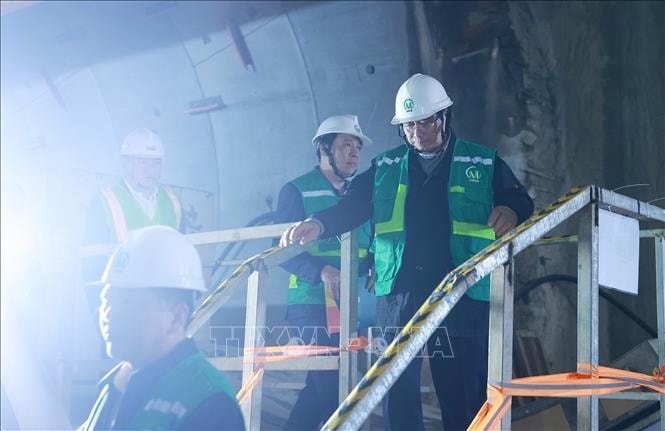
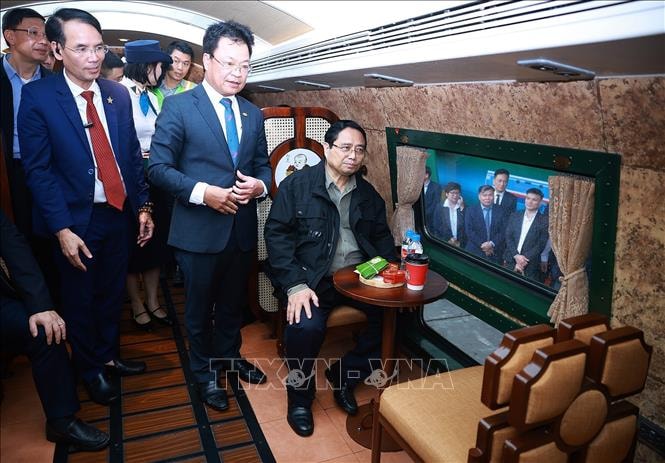
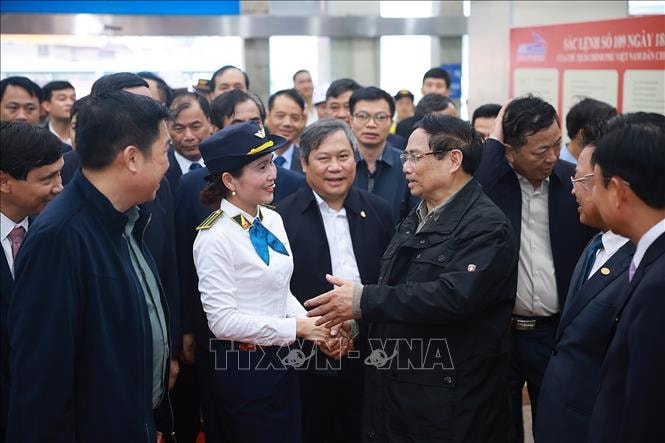
In the joyful atmosphere of the early days of the Lunar New Year 2026, Prime Minister Pham Minh Chinh traveled by trolley from tunnel B3, S9 (Kim Ma) urban railway station to tunnel B2, S11 (Van Mieu) and S12 (Tran Hung Dao) stations of the Nhon - Hanoi Railway line to visit and extend New Year greetings to the forces working on the construction site.
The Prime Minister expressed his pleasure, acknowledged, and commended the efforts of Hanoi city, ministries, and agencies working day and night on the construction site, especially the officials, engineers, and workers who sacrificed their personal time during the Tet holiday to stay on the construction site to accelerate the project's progress, bringing the urban railway lines into operation and exploitation as soon as possible, in a synchronized and efficient manner, keeping pace with the development requirements of the Capital.
According to Prime Minister Pham Minh Chinh, the Hanoi urban railway project from Nhon to Hanoi Station has a long implementation period, therefore a change in mindset, methods, and approach is necessary to accelerate progress, improve quality, maintain safety, and ensure technical, aesthetic, and environmental standards.
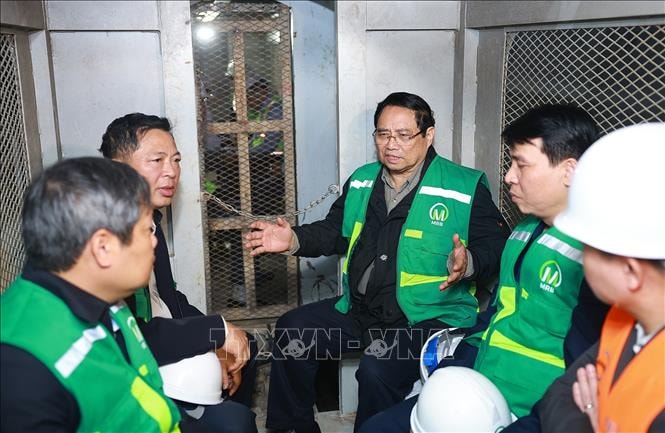
Visiting and inquiring about the lives, incomes, and work of engineers and workers on the construction site, the Prime Minister expressed his hope that, in addition to their patriotic spirit and dedication to working throughout the Tet holiday and other holidays, "working day and night, working extra days off," "working three shifts, four teams," "eating quickly, sleeping urgently," and "only discussing work, not retreating," they would continue to innovate their thinking, improve their working methods, enhance their skills, and raise their intelligence to help the country progress rapidly and sustainably.
Speaking with the people in the project area, the Prime Minister expressed his gratitude to the people of Hanoi for their companionship, sharing, and support throughout the project's implementation; and hoped that the people would continue to support and create favorable conditions for the project to be implemented smoothly, on schedule, and with the highest quality. The sooner the project is completed, the sooner trade, investment, and tourism will develop, thereby creating momentum for economic growth in the locality and the Hanoi region.
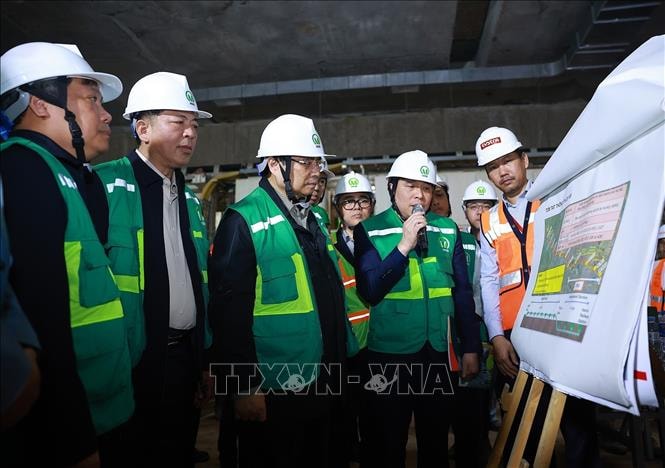
After inspecting the project's implementation site and encouraging the forces working on the construction, Prime Minister Pham Minh Chinh held a working session with ministries, central agencies, the city of Hanoi, the investor, and the design and construction contractors to resolve difficulties and accelerate the project.
At the meeting, delegates assessed that, despite positive results, the project faced several difficulties and obstacles related to urban railway network planning; the interoperability of technical standards; the lack of diversity in funding sources, forms, and investment methods; slow progress in compensation, resettlement support, and relocation of technical infrastructure for construction, especially in tunnels and underground stations; inadequate institutional and policy frameworks; and delays in negotiations with foreign contractors regarding the supply of equipment packages to complete the remaining underground sections.
Concluding the meeting, Prime Minister Pham Minh Chinh welcomed and highly appreciated the encouraging results in the project's implementation; stating that, overall, the pilot urban railway project in Hanoi, the Nhon - Hanoi Station section, has been implemented vigorously and with guaranteed quality.
This includes promptly handling unforeseen situations during construction; putting the elevated section from Nhon to Cau Giay into operation; accelerating construction activities for the remaining sections across all sites; and completing many items, aiming for the entire route to be put into operation in 2027.
Based on the practical experience of this project, and considering that Hanoi has only built 21 km of urban railway in 17 years, while the goal is to have over 600 km of urban railway by 2045, requiring a pace dozens of times faster, the Prime Minister emphasized the need to change mindsets, methodologies, approaches, methods, and organizational approaches. He stressed the importance of surpassing one's own limitations to develop the railway sector in particular, and the country in general, rapidly and sustainably, transforming it into a wealthy, civilized, prosperous, and happy nation, steadily advancing towards socialism.
Diversify sources of capital and forms of investment.
Based on field inspections and listening to reports and proposals, in order to ensure the project's smooth implementation, meet the set requirements, and contribute to the development of Hanoi's railway and urban railway sectors, the Prime Minister has directed and assigned specific tasks to ministries, agencies, and the city of Hanoi to resolve difficulties and obstacles, promote the Hanoi urban railway project, and guide the development of Vietnam's railway sector.
The Prime Minister requested the early completion and promulgation of procedures, standards, and regulations for the urban railway technical standards system. He urged the expedited completion of the railway sector development plan, including urban railways, with a vision spanning over 100 years. The guiding principle should be to "look far ahead, think deeply, and act on a grand scale," "go deep into the earth, soar high into the sky, and reach far into the ocean," avoiding wasted time, effort, capital, and land, while maintaining a bright, green, clean, and beautiful environment.
The Prime Minister emphasized the need to develop the railway industry with unified, shared, modern technology, optimizing investment and linking it with technology transfer. In addition, the supporting industries and the railway industry ecosystem must be developed as quickly as possible to meet practical requirements; and the training of railway human resources in all aspects, from consulting, design, construction, management, and operation, must be promoted, striving for 90% of the workforce in this field to be Vietnamese.
At the same time, the Prime Minister noted the need to diversify sources of funding for railway development, mobilizing public investment, public-private partnerships, bond issuance, loans, and capital raised from the public. He also emphasized the need to build a railway operating system based on localization, with the participation of Vietnamese technology corporations and enterprises. The management system must be modern and intelligent, moving towards digitalization, greening, and Vietnamization, drawing on the experiences of other countries while adapting them to Vietnam's conditions.
Requiring central ministries and agencies to cooperate effectively and closely with the Hanoi People's Committee in implementing projects, the Prime Minister directed the railway sector to focus on preparing for the 145th anniversary of the Vietnam Railway industry. This includes drawing lessons from the development and construction of railways and urban railways with a vision of over 100 years, relying on internal resources as a strategic, long-term, and decisive factor; external resources as important and breakthroughs; reducing costs, improving the environment, lowering service prices, and increasing the competitiveness of railway services so that people can enjoy the fruits of their labor.
The Prime Minister requested the implementation of the project based on the principles of "1 objective," "2 guarantees," "3 yes's," "4 no's," "5 transformations," and "6 clear outcomes." Specifically: "1 overarching objective" is independence, freedom, prosperity, and happiness. "2 guarantees" are ensuring development for stability, stability to promote development; and ensuring security, safety, and people's well-being. "3 yes's" are the participation of the State; the participation of the people; and the participation of businesses. "4 no's" are not wasting a single day; not delaying a single week; not missing opportunities for a single month; and not being passive for a single year. "5 transformations" are digitalization; greening; optimizing efficiency; smartening governance; and harmonizing the interests of the State, the people, and businesses. "6 clear outcomes" are clarity of personnel, tasks, timelines, responsibilities, authority, and expected results.