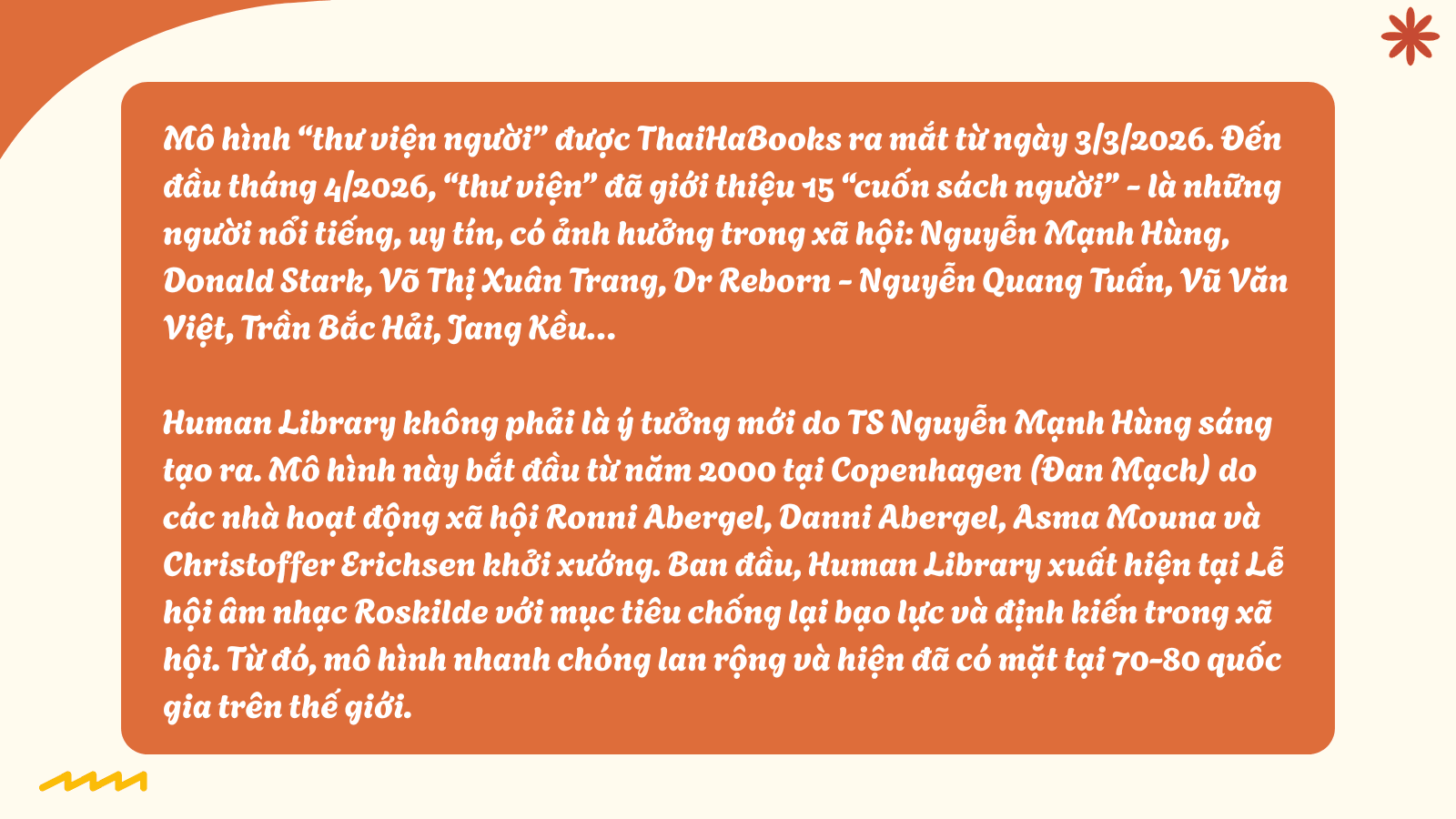
'Human Library': When each life becomes a book
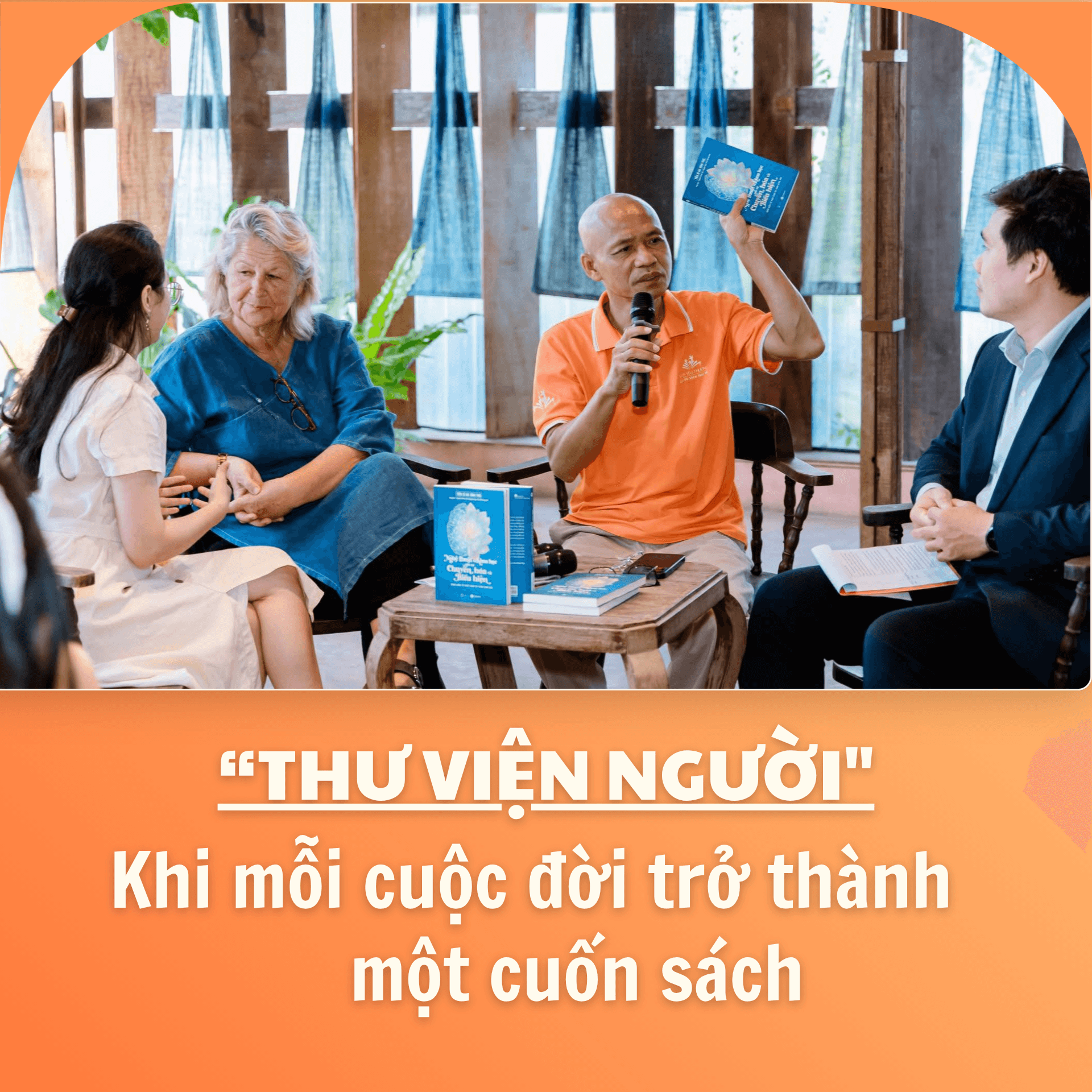
Dr. Nguyen Manh Hung - Chairman of the Board of Directors of ThaiHaBooks Company - had an in-depth dialogue with Nghe An Newspaper and Radio and Television about the story of "books for people".
Perform:Phuong Chi• April 6, 2026
*****
In an age where knowledge is easily accessible with just a few taps on a screen, humanity seems to be facing another void – the void of listening and understanding. The emergence of the Human Library model in Vietnam, implemented by ThaiHaBooks since March 2026, is not simply an experiment in a new reading culture, but raises a fundamental question: when reading is no longer confined to the pages of a book, what are we truly seeking – knowledge or connection between people?
Dr. Nguyen Manh Hung - Chairman of the Board of Directors of ThaiHaBooks Company - had an in-depth dialogue with Nghe An Newspaper and Radio and Television about the story of "books for people".
"Human libraries" help us open our hearts and cultivate empathy.
PV: TYes For a long time, we believed that reading was a spiritual act.hQuiet, private. That way.nlibrary "person" puts people in a state of confrontation.dialoguedirectly. In your opinion, what does this shift reflect in today's spiritual life?
PhDNguyen Manh Hung:I believe that the emergence of the "human library" model is not a replacement for reading, but rather a thought-provoking sign of today's spiritual life. If we have to answer the question "are we lacking knowledge or listening skills?", then in my opinion, perhaps we are not lacking knowledge, but rather the ability to receive knowledge in a vibrant and humane way.
Because, nowadays, information and knowledge are practically abundant. With just a phone, we can access a wealth of knowledge. But knowledge doesn't equate to understanding. What people lack, in my opinion, is deep listening and genuine connection. We read a lot, but rarely engage in "dialogue," with others and even with ourselves.
The "human library" emerged to fill that gap. It transforms knowledge from a "static" state to a "living" one: not just information, but experience. Not just knowledge, but life stories. Not just reading, but dialogue and empathy.
I believe this shift reflects a very human need: the need to be heard and understood.
In an increasingly digitized, fast-paced, and complex world, people are tending to return to very basic values such as meeting in person, listening to each other's stories, and understanding each other through emotions, not just data.
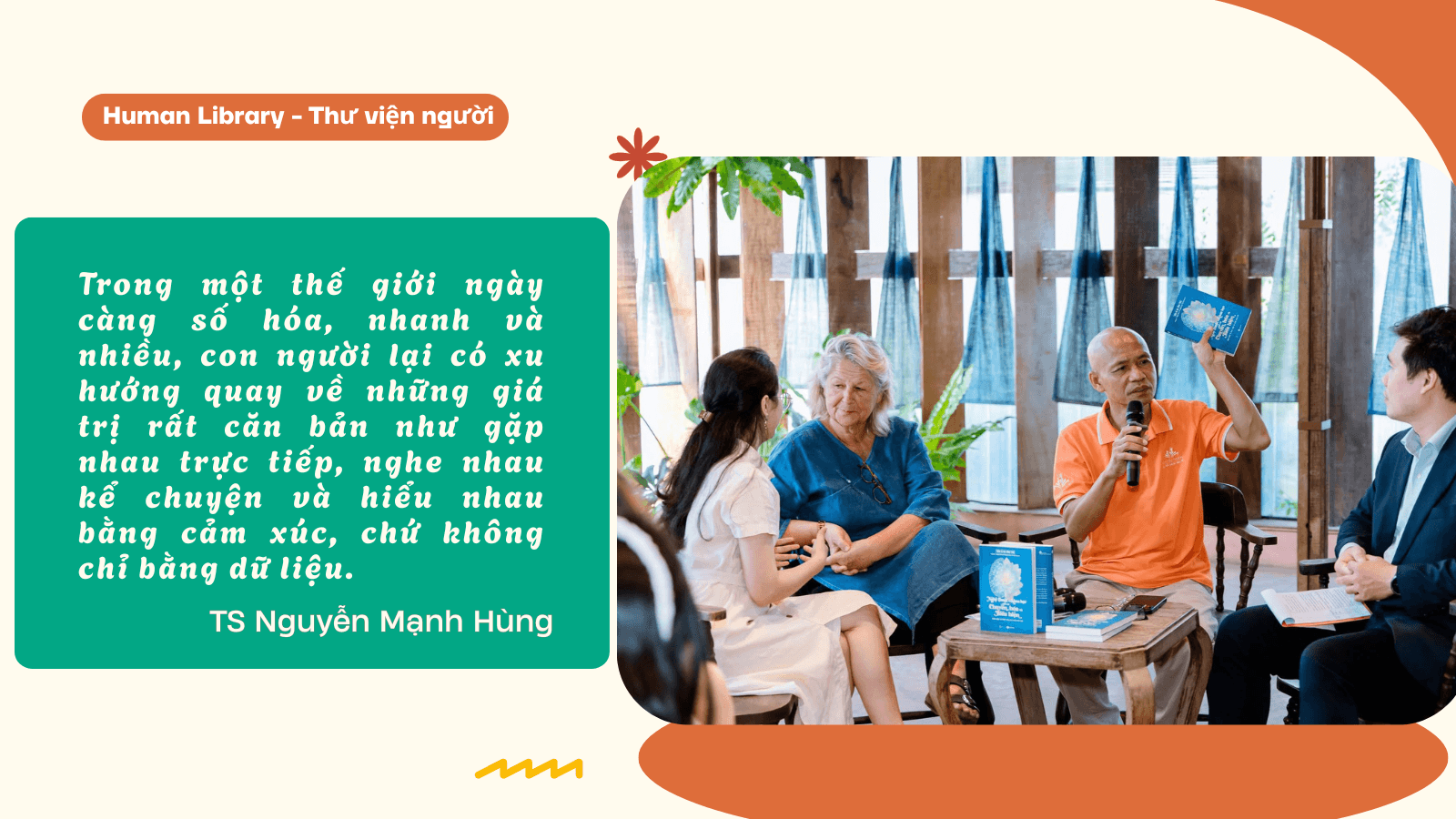
However, I also want to emphasize that "books" and "human libraries" are not opposed, but complement each other. Books help us to delve deeper, reflect, and accumulate knowledge sustainably, while "human libraries" help us open our hearts, engage in dialogue, and cultivate empathy.
A developed society is not one with the most information, but one where people listen to each other more deeply. And if a "human library" helps us get closer to that, it is a very encouraging sign for today's spiritual life.
PV: A book can be read many times, each time revealing a new layer of meaning., nBut a person cannot be "turned around" in that way.Especially since the time to "read" each "book of humanity" is only about 20 minutes. But 30 minutes.How does he view the depth of the "reading" experience?People"LHow can we ensure it doesn't just remain a brief encounter?smellEmotionally rich, yet truly leaves a lasting impression?
PhDNguyen Manh Hung:It's true that a book can be read many times, but a person cannot be "reread" in that way. However, I think that this very "non-repetition" is what makes "the book of humanity" so special.
Regarding the depth of experience, I see it this way: Books give us depth of thought, while "human books" give us the touch of emotions and life experiences. 20-30 minutes may seem short, but if the conversation is sincere and genuine enough, it can create a very powerful "point of awareness," sometimes a single moment can change how we view an entire issue.
However, simply having an emotionally charged encounter is not enough.
In my opinion, to achieve lasting depth in "reading other people's books," three things are necessary.
First, the quality of the "human book." Not everyone can become a "book." The chosen one needs to have sufficiently deep experiences, storytelling ability, and the capacity for reflection—that is, the ability to transform experience into knowledge.
Secondly, the quality of the listener is crucial. Participants shouldn't just listen for the sake of listening; they need to know how to ask questions, how to listen deeply, and most importantly, how to relate it to themselves. Without this proactive approach, the experience can easily fade away like a touching story that is quickly forgotten.
Third, there needs to be "follow-up after the meeting." This is crucial. This could involve suggesting further reading of related books, taking notes, reflecting on the experience, or creating a community for continued exchange. In this way, the "human book" becomes a gateway to a longer learning journey, rather than a closed-off experience.
I often think this way: "Human books" aren't meant to replace reading, but to awaken the need to read and the need for deeper understanding. It's like a spark. If it just flashes and then goes out, it's just an emotion, but if nurtured, it becomes awareness. Therefore, the depth of a "human book" doesn't lie in its duration of 20 or 30 minutes, but in whether, after those 30 minutes, the participants change their way of thinking and seeing. And if done well, I believe that even a short encounter can leave a very long-lasting impact on each person's journey of development.
.png)
PV: In the Human Library model around the world, the biggest goal is to break down stereotypes. However...However,In a still somewhat reserved East Asian society like Vietnam, is it really appropriate to open one's life to others?"read”Are we one step ahead of the community's readiness?
PhDNguyen Manh Hung:I believe that saying "taking a step ahead" is partly true, but it's a necessary step, not a hasty one. In East Asian societies like Vietnam, we have very distinct characteristics: discretion, privacy, a reluctance to reveal imperfections, and sometimes a fear of judgment. Therefore, for someone to "open up their life" for others to "read" is certainly not easy, and we cannot expect the majority to be ready immediately.
However, I think we need to look at it from a different perspective. Precisely because society still has many prejudices and hesitations, models like the Human Library are all the more meaningful. It creates a safe space for people to speak truthfully about themselves. It helps personal stories – which are often kept secret – to be listened to with respect. And from there, it gradually softens social prejudices.
.png)
However, in order for this model not to "move too quickly" compared to the community, I believe three principles are necessary.
First, voluntariness and respect for personal boundaries are essential. Not everyone needs to tell their entire story. Participants should have the right to choose how much they want to share. Second, professional guidance is crucial. Organizers need to create a safe and trustworthy environment, avoiding turning sharing into curiosity, exploitation, or even harm. Third, a step-by-step approach that aligns with the culture is necessary. It's possible to start with more accessible and relatable topics, gradually expanding to deeper and more sensitive stories. I believe this isn't about whether the community is ready or not, but about creating decent spaces where the community can gradually become ready.
During this April – “Reading Month” – I believe that a mature society is not one without hesitation, but one where people feel safe enough to gradually speak the truth about themselves. If Human Library contributes to creating that, then even if it's a step ahead, it's still a step in the right direction.
A bridge between emotion and knowledge
PV: As someone with years of experience in the book industry, he surely understands the value of verification and depth of knowledge. So, when he shifts to "reading people,"Butwhere personal experiences can be highly subjective.Butdo thatanyHow can we prevent knowledge from being replaced by emotionally charged but unsubstantiated stories?
PhDNguyen Manh Hung:This is a very important question, because if we're not careful, "reading people" can easily slip from intellectual understanding to purely emotional judgment. I think we need to clearly see that personal experience is not complete knowledge, but it is a very valuable raw material for forming knowledge. The question is how we process that raw material.
To prevent knowledge from being replaced by stories that only evoke emotion, I believe several principles are necessary. First, clearly distinguish between "story" and "knowledge." A story may be very good and touching, but that doesn't mean it's true for everyone. Listeners need to be reminded that this is a personal experience, not a universal truth.
.png)
Secondly, there needs to be "soft validation." This doesn't mean rigid, academic validation, but rather that the storyteller should place their narrative within a broader context, relating it to established knowledge, research, or practices. This allows the personal experience to "take root" within a shared knowledge base.
Thirdly, the role of the organizer and facilitator is crucial. This is very important. The facilitator needs to know how to prompt the right questions, maintain a balance between emotion and reason, and avoid letting the sharing session become merely "storytelling" without deep reflection.
Fourth, reconnect with books and foundational knowledge. After each "reading session," suggest related books or guide the listener back to deeper reading. In this way, "reading sessions" become a starting point, not an end point.
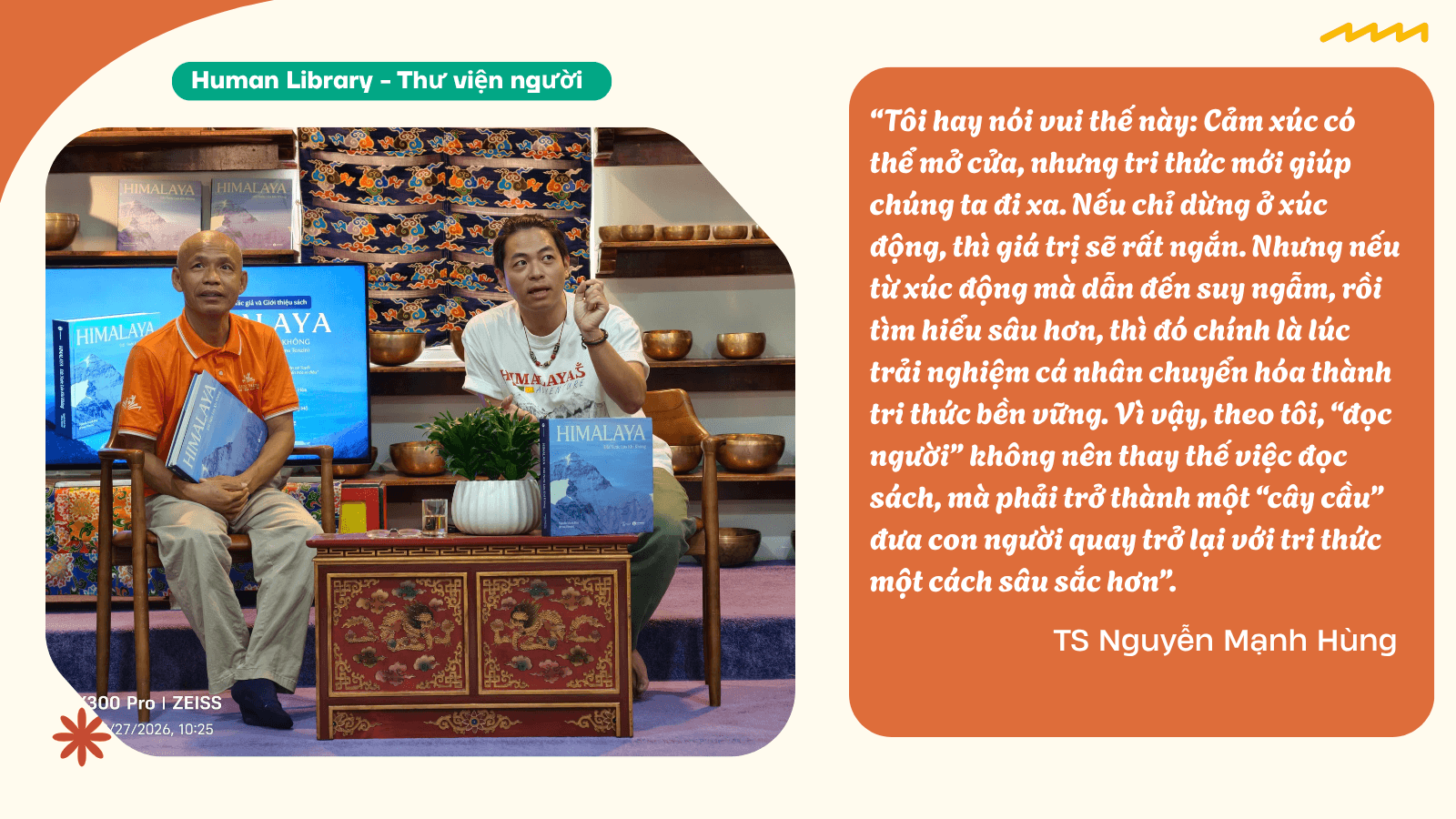
I often jokingly say this: Emotions can open doors, but knowledge is what takes us further. If we only stop at feeling emotion, the value will be short-lived. But if emotion leads to reflection, then deeper understanding, that's when personal experience transforms into lasting knowledge.
Therefore, in my opinion, "reading people" should not replace reading books, but should become a "bridge" that leads people back to knowledge in a deeper way.
PV: There is a paradox.currentlyThe more connected we become onlinericeThe more lonely they become in real life, the more he hopes that the "human library" will be a space for healing. He hopes that the "human library" will be a healing space.,Or perhaps he sees it as a test, to see if people today still have the patience to sit down together?
PhDNguyen Manh Hung:I think the "human library" is both a healing space and a very interesting test for people today.
First, let's talk about healing. In a world where we're constantly connected but lack genuine connection, having a space to sit down, listen, and be listened to is incredibly valuable. Often, people don't lack advice, but rather someone willing to sit and listen to their whole story. From that perspective, a "human library" can create very genuine moments where people connect with each other sincerely, and that has a healing element.
But I also see it as a test. A test to see if we still have the patience to listen to a story longer than a few minutes. A test to see if we can be fully present without being distracted by phones or social media. And a test to see if we are still open to understanding someone else, someone different from ourselves. If we can't sit down together for 20-30 minutes, then the problem isn't with our "human library," but with the way we are living.
Therefore, in my opinion, the greatest value of a "human library" is not just healing, but reminding us of a very fundamental capacity: the capacity to be human, which is to listen and be present.
I can say right now, in this particular month of April, that in an age of so much virtual connection, any space that allows people to sit down and connect with each other in person is precious, whether for healing or to ask ourselves: Do we still have the capacity for genuine connection?
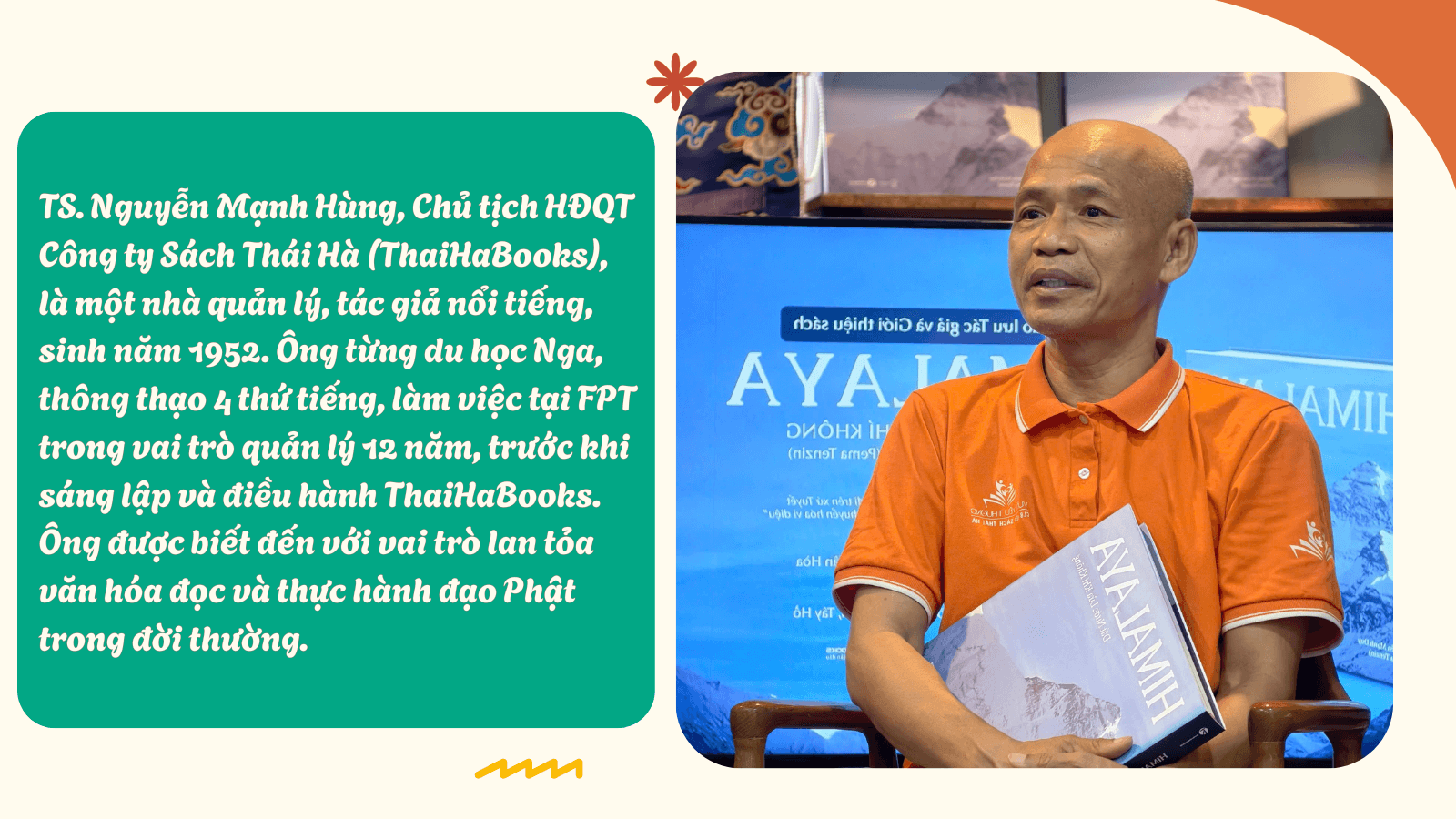
PV: WithgrandfatherThe journey of bookmaking seems to always be linked to a belief in enlightenment.If we were to delve into the very essence of his philosophy on promoting reading, what does he believe has the most profound power to change people?mA good book, or a timely dialogue with a "book"living"And where does the 'human library' fit into that journey?"
PhDNguyen Manh Hung:If forced to choose, I think it's not a good book or a timely conversation, but rather the right encounter between knowledge and experience. Because a good book can profoundly change a person. It gives us a system of thinking, helping us understand the world sustainably, but a timely conversation can create a turning point. It touches emotions, awakening something dormant within each person.
Books can help us understand, but people can awaken us. And often, the most profound change occurs when we have read something somewhere, but only when we hear a real person recount it do we truly "realize" it. Therefore, in my opinion, the "human library" is not outside the realm of promoting reading, but occupies a very special position: it is a bridge. A bridge connecting knowledge and life, a bridge connecting reading and understanding, and sometimes a bridge connecting understanding and change.
If there are only books without dialogue, knowledge can become detached. If there are only stories without a foundation, emotions can become superficial. But when these two things meet, people not only know, but also understand and live differently.
I would like to conclude with this idea: At the end of the journey of promoting reading, what we seek is not to read more books, but to enlightened individuals, and a "human library" is a very humane way to achieve that.
PV: Thank you very much, Dr. Nguyen Manh Hung, for the insightful conversation!