
China's J-35 stealth fighter faces engine challenges on the Fujian aircraft carrier.
Reports indicate that the new generation J-35 carrier-based fighter jet faces limitations in operational time and engine performance when operating in conjunction with the electromagnetic catapult system on the Type 003 carrier.
According to a report from the South Korean newspaper Chosun Ilbo, China's J-35 stealth fighter jet, expected to be deployed on the aircraft carrier Fujian (Type 003), is facing serious technical hurdles related to engine performance. These limitations are believed to directly impact the sustained combat capability and operational range of the Chinese Navy's newest carrier strike group.
Questions arise from factual data and media images.
The analysis stems from footage broadcast by China's state-run CCTV earlier this year. While the footage's initial purpose was to showcase the power of the Fujian aircraft carrier, military observers quickly noticed signs of power deficiencies in the J-35's jet engine system.
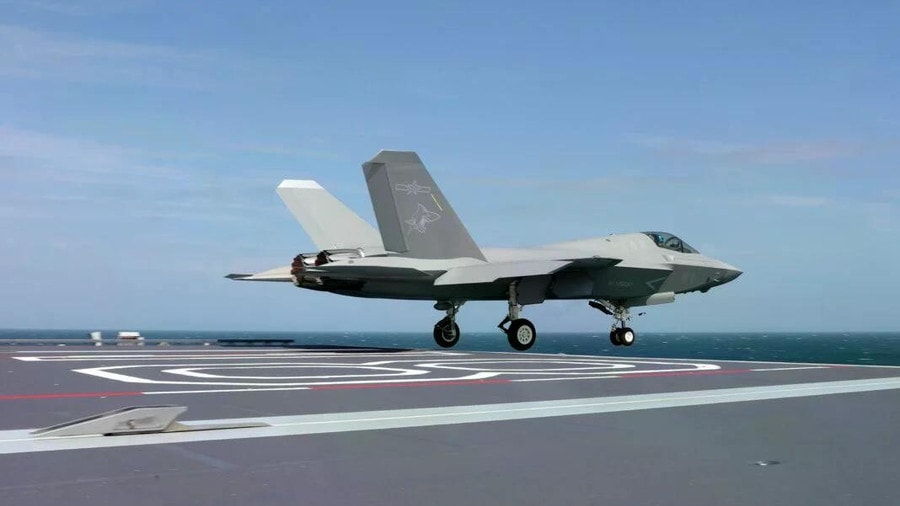
The Fujian is China's third aircraft carrier and the first to be equipped with an electromagnetic catapult system (EMALS). This technology allows the launch of fighter jets weighing tens of tons at speeds exceeding 200 km/h in just seconds. However, the aircraft's performance depends not only on the thrust from the catapult but also on the self-power of its engines to maintain speed and payload after leaving the ship's deck.
WS-19 engine technology bottleneck
Although observers had predicted that the J-35 would be equipped with the new-generation WS-19 engine – an engine developed since 2017 to optimize performance for carrier-based fighters – the reality is that this aircraft is still using the older WS-21 engine. This is an improved version, but it still hasn't achieved the ideal performance expected for a fifth-generation fighter.
This issue is often referred to by the Chinese military as "heart disease," alluding to the relative backwardness of propulsion technology compared to advancements in airframe and electronics. To address this bottleneck, China established the Aviation Engine Corporation of China (AECC) in 2009 and invested over $40 billion in research and development between 2010 and 2020. However, translating research results into practical application on the high-intensity operational demands of aircraft carriers remains a significant challenge.
Limitations in combat capability and flight range.
Based on current technical specifications, military expert Haixian Xianfeng believes that the engine's performance is below standard, causing the J-35 to struggle with sustained flight time. Specifically, it is estimated that this fighter jet can only maintain operation for about 7 minutes when operating at a distance of 900 km from an aircraft carrier.
The limitations in circling time and continuous operation capabilities make it difficult for the J-35 to fully fulfill its role of establishing an air defense umbrella for the fleet or conducting long-range attack missions. This creates a paradox: the Fujian aircraft carrier possesses a modern catapult system comparable to the US Ford-class carriers, yet its primary combat aircraft, the J-35, has not been able to fully utilize that advantage.
The strategic role of the Fujian-J-35 duo.
The Fujian aircraft carrier plays a central role in China's naval modernization strategy. Unlike its two predecessors, the Liaoning and Shandong, which use ski-jump type runways, the Fujian allows aircraft to take off with larger payloads of weapons and fuel thanks to its electromagnetic catapults.
The Chinese Navy aims to use the J-35 as a counterweight to the US Navy's F-35C in controlling airspace and projecting power in distant seas. However, until the engine issue is fully resolved, the combat readiness of carrier strike groups using the Type 003 will remain a major question mark for international analysts.


