
Standards to become a Vietnamese naval commando.
To become a Vietnamese naval commando, in addition to requiring exceptional physical fitness and health, the soldiers must also possess extremely good vestibular nerve function.
Strict standards
In addition to the aforementioned standards for becoming a naval commando, naval commandos must be able to swim at least 12 km at sea and dive for 3 minutes. It is known that 98% of the units' personnel are recruited from coastal provinces according to special requirements, significantly higher than other branches of the military.
Health is the most important factor in the recruitment process. To become a combatant in the naval special forces, the selection process is as rigorous as that for pilots or submarine crews.
Not only is the selection process rigorous, but even the food standards for this force are unique, with four different regimes for infantry, naval commandos - counter-terrorism, frogmen, and naval fleets.
The specific nature of that mission requires a very rigorous selection process for frogmen. Frogmen must meet the following requirements: height must be no less than 1.65 m; body weight no less than 52 kg; minimum grip strength no less than 35 kg; pulling force no less than 200% of body weight…
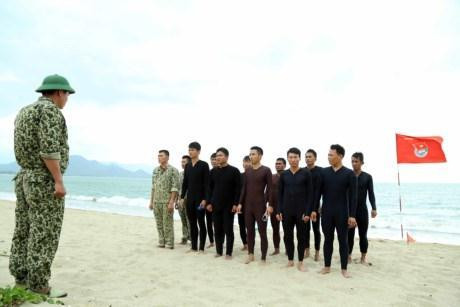 |
| Vietnamese naval commandos before training. |
In addition, to become a frogman, candidates must also meet physiological functional standards regarding the cardiovascular system, respiratory system, eyes, digestive system, etc.
Naval commandos are special, and maritime commandos are even more special because, in addition to the training and drills of naval commandos, they also have to undergo specific exercises.
The dangers faced by naval commandos are extremely high, especially when confronting dangerous marine creatures. To successfully complete their missions, frogmen commandos must be exceptionally brave; possess exceptionally skillful tactics and techniques; have exceptional physical endurance; and be particularly resourceful, intelligent, and flexible.
Naval commandos are few in number, valuable, and especially necessary, but their careers are short. Typically, the optimal age for a naval commando to be in good health and complete missions is no more than 35 years old, or at most 40.
The process of rigorous training
To become a true naval commando, training takes two years. The skills required of these commando frogmen include: swimming silently and continuously for a minimum of 10km, diving to a maximum depth of 1,000m, and exceptional wave tolerance to enable deep diving and travel by aircraft or submarine.
Vietnamese naval commandos must also be proficient in using heavy weapons to attack foreign invaders in Vietnamese territorial waters, and in the most difficult situations, they must be able to camouflage themselves in just 1-2 minutes. For soldiers to be able to swim continuously for 12-15km at sea, they must invest a great deal of effort in both physical and mental training.
Officers at all levels regularly monitor, train, dive, and swim alongside the soldiers; they organize day and night practical training in techniques for navigating currents, dodging marine life, and even methods for handling scratches to prevent bleeding that would attract dangerous animals.
All of these skills must be mastered by a naval commando, enabling them to act independently to ensure safety and complete missions accurately, efficiently, and in the shortest possible time.
The most grueling part of the training course is "compressed air." Soldiers are placed in a chamber where the pressure is increased and decreased, adjusting to match the seawater pressure at the corresponding depth.
This process is strictly followed to train the endurance of the soldiers when diving at different depths. This is also the most difficult stage in selecting frogmen who meet the mission requirements.
Inside the pressurized and decompressed chamber, the pressure makes the chest feel like it's about to burst, causing extreme difficulty breathing and discomfort. But for any frogman, this is a necessary step to be able to dive to depths of tens of meters; otherwise, they could die at any moment while performing their duties at sea.
According to Baodatviet
| RELATED NEWS |
|---|


