
Draining floodwaters in flood-prone areas is a topic that's been discussed endlessly.
(Baonghean) - Nghe An currently has over 20,000 hectares dedicated to vegetable and crop production, playing a crucial role in the province's agricultural output. However, for various reasons, the irrigation system for these crop-growing areas has not received adequate investment and still has many shortcomings.
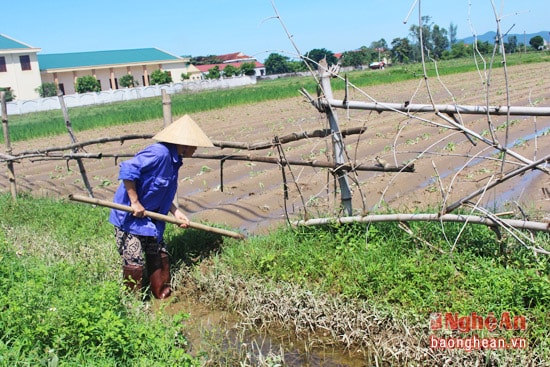 |
| Ms. Tran Thi Phuong, from Hamlet 17, Nghi Thuan Commune, Nghi Loc District, is draining water to replant corn that died on two plots of arable land. |
After several days of rain from September 13th to 14th, two plots of corn, sown nearly a month ago, belonging to Ms. Le Thi Phuong's family in Hamlet 17, Nghi Trung Commune (Nghi Loc District) were completely destroyed. While using a hoe to clear the drainage channels, Ms. Phuong said: “Before the rain, the corn was growing well and had six leaves. But after being flooded for three days, by the afternoon of September 14th, when the water receded, the corn had all withered and died. We need to clear the drainage channels and wait for the sun to come out so the soil can dry before we can replant…”
Mr. Tran Hai Duong, Vice Chairman of the People's Committee of the commune, said: The main drainage canal in the commune is the Rao Truong canal, running from Vinh Airport, through Nghi Lien, Nghi An, and Nghi Long communes, to Nghi Xa and then down to the Nghi Quang wharf to drain into the sea. Although it is a main and important canal, currently only more than 1 km of this drainage canal has been concreted at both ends in Nghi Trung commune, while the middle section is still an earthen canal. In the past few days of rain, the commune had to rent machinery costing tens of millions of dong to remove water hyacinths that had flowed in from other communes, causing blockages in the canal's flow.
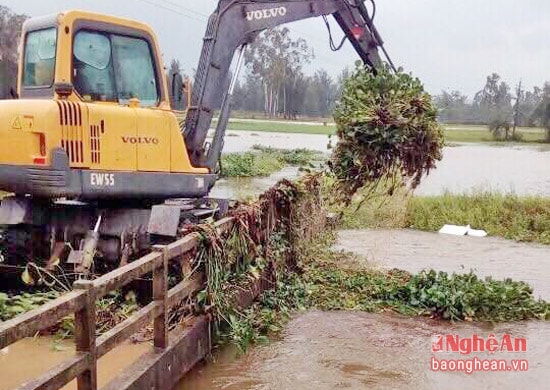 |
| Excavators are clearing water hyacinths that have clogged the main drainage canal, which runs through several communes in Nghi Loc district and Vinh City, due to flooding. |
Nghi Loc is one of the localities with a large area of arable land in the province, with over 4,000 hectares, including nearly 3,000 hectares of peanuts and over 1,000 hectares of various vegetables. According to Mr. Nguyen Xuan Quang - Head of the District's Agriculture Department, only a few communes in the district have high-lying arable land with good drainage, while almost all the communes with concentrated arable land in the district, located east of National Highway 1A such as Nghi Long, Nghi Trung, Nghi Thuan... face many difficulties in drainage, not only in winter crop production but also in spring crop production.
After 2000, as part of the province's drainage project for agricultural areas, all major canals in these areas, such as the Nha Bien canal, Nha Na canal, East Nghi Phong canal, West Nghi Phong canal, etc., were basically widened. However, only about 10% of the length in critical locations has been concreted, while the rest remain earthen canals.
Heavy rains and strong currents are heavily dependent on the Nghi Quang and Nghi Thach irrigation systems. There are times when drainage is needed, but the tide rises. Meanwhile, the water flowing into Nghi Loc for drainage into the sea serves not only the local area but also Vinh City. “In many years, just a light rain of 100-150 mm during the early summer months can cause significant damage to 50-70% of the peanut crop, even when the tubers are ripe. As for winter crop production, farmers are hesitant to cultivate or change the crop structure in their fields for fear of damage from flooding.”
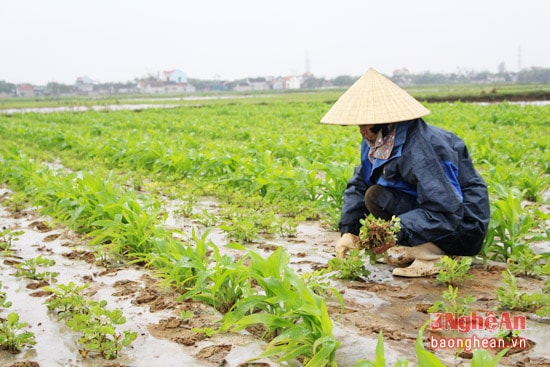 |
| People in Dien Thanh commune (Dien Chau district) are uprooting peanut plants that died due to flooding in order to replant them. |
In Dien Chau district, there are 55 km of main drainage canals serving the district's agricultural areas. To date, thanks to funding from various projects, apart from the branch canals which are mostly still earthen, approximately 40% of the length has been concreted, only in important sections. The rest only involves the construction of bridges and culverts over the canals and dredging.
The province currently has 800 km of drainage canals serving agricultural areas, of which only 200 km (mainly main canals) have been reinforced, while the rest are earthen canals within the fields. Due to untimely disbursement of funds, the irrigation and drainage projects in agricultural areas are behind schedule, have low drainage capacity, and the lack of uniformity in the drainage canal system limits effective water drainage.
According to Mr. Nguyen Ngoc Van, Deputy Head of the Provincial Irrigation Department, to address the shortcomings in irrigation for vegetable and crop production in the long term, it is necessary to plan and build more small-scale irrigation works, especially in areas with large model fields and concentrated production zones. At the same time, local authorities need to get involved, promoting and encouraging people to actively participate in the campaign to improve irrigation systems in the fields more effectively.
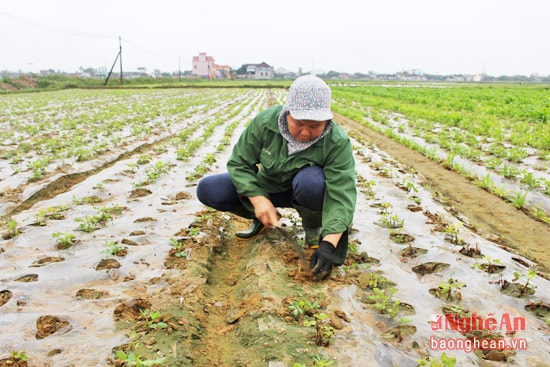 |
| For many years, the peanut fields in Dien Thinh commune (Dien Chau district) suffered damage due to flooding. |
However, while the drainage system for all crops remains challenging and requires substantial funding, technical solutions need to be prioritized. Some agricultural experts recommend that, to improve crop production efficiency in areas with poor drainage, some localities should advance their planting schedules.
For alluvial or hilly areas in Quynh Luu, Thanh Chuong, and Do Luong districts, planting should be started in August and as early as possible because the rains mainly come after September 2nd, when the crops are able to withstand floods. For areas along the Lam River, depending on the specific terrain, planting should be delayed in deep floodplains, and in low-lying areas like Anh Son and Tan Ky, it may be necessary to wait until after the floods, until October, to minimize damage.
Phu Huong


