
President Ho Chi Minh's affection for his homeland is expressed through his letters.
(Baonghean) - Throughout President Ho Chi Minh's life, his homeland always held a significant place. Although he did not spend much time in Nghe An, his love and concern for his homeland always stayed with him.
After the August Revolution of 1945, besides two visits to his hometown in 1957 and 1961, Uncle Ho also sent dozens of letters to his homeland during his time leading the country from the revolution until his death; in these letters, he gave advice to his homeland on many important issues that remain relevant to this day.
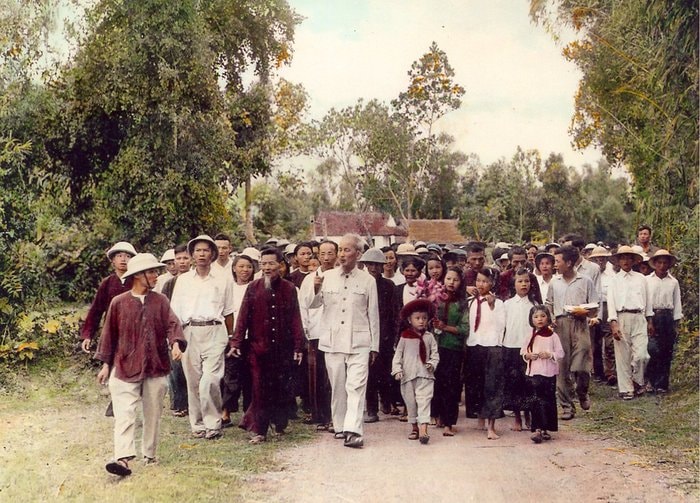 |
| President Ho Chi Minh visited Kim Lien - Nam Dan in 1957. (Archival photo) |
On September 2, 1945, at Ba Dinh Square, President Ho Chi Minh read the Declaration of Independence, giving birth to the Democratic Republic of Vietnam. Exactly half a month later, on September 17, 1945, he sent his first letter to Nghe An. From then until the end of his life, Uncle Ho sent 25 letters and 2 telegrams to his hometown. In addition to the letters sent to Nghe An, he also gave many speeches, wrote articles in newspapers, and sent general letters to the military and people of Military Region IV and North Central Vietnam...; in which he mentioned the military and people of Nghe An.
In most of his letters, Uncle Ho expressed deep affection for the people of his homeland. However, his concerns and encouragement for his homeland also evolved in accordance with the changing circumstances of the resistance and national reconstruction efforts.
The letters revolved around important issues such as urging the people and soldiers of Nghe An to intensify the movement to fight the enemy and increase production; sharing experiences in various activities; rectifying the revolutionary spirit and ethics of cadres; and praising and encouraging the people in the resistance and national construction movements. Uncle Ho often concluded the letters with the phrase "With affection and determination to win."
During the resistance war against the French, Uncle Ho sent nine letters and telegrams to Nghe An, primarily analyzing the situation, reminding and encouraging the Party committee, people, army, and people of the province in building up forces, participating in the resistance war, and fighting against hunger and illiteracy. Between his two visits to his hometown from 1957 to 1961, Uncle Ho sent two letters to Nghe An praising the elderly association of Nam Lien commune and encouraging the people of Vinh town who had just experienced a fire.
And, the time when Uncle Ho was most concerned about the situation in his hometown was when the destructive war waged by the American imperialists escalated. In the four years from 1965 to 1968, Uncle Ho sent 12 letters home. These letters mainly praised and reminded the people and soldiers of Nghe An of their vigilance and their great achievements in the resistance war. Among them, seven letters praised the achievements of the people and soldiers of his hometown in shooting down American planes.
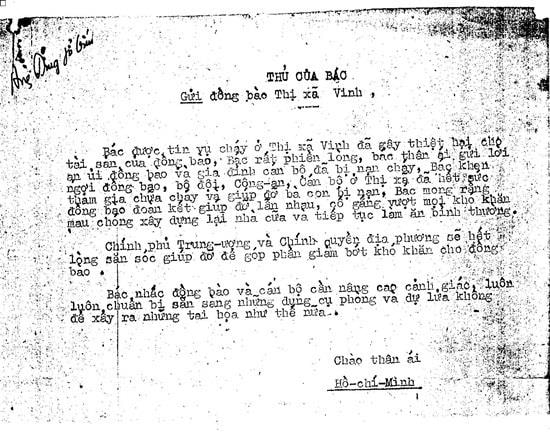 |
| A letter from President Ho Chi Minh to the people of Vinh town in 1961. (Archival photo) |
The recipients of Uncle Ho's letters were quite diverse. Some letters were sent to individuals (such as Mr. Ha Van Quan); some to a commune (Nam Lien) or to the elderly association and students in the commune; some to district-level officials, such as to the people of Vinh town or Que Phong district; and some to the provincial Party committee; and some to all the people of Nghe An province...
Uncle Ho showed concern for almost everyone, from the elderly to children, from Party members, soldiers, railway workers, farmers, young volunteers building roads to ensure traffic for vehicles going to the battlefield, nurses working in hospitals, or patients in hospitals...
Furthermore, Uncle Ho did not narrow the content of his letters based on the recipients, but always placed everyone within the common struggle, the common goal of resistance and national reconstruction. Whether inquiring about, praising, or encouraging someone, Uncle Ho always connected them and their work to the common cause of the entire nation.
In his letters to provincial leaders, Uncle Ho provided more detailed analyses, while in his letters to workers and farmers, he tried to write concisely and clearly, yet still comprehensively. He always cared about everything from small things like how the people were producing rice and potatoes, their yields, and how much fertilizer they were using, to larger issues concerning the entire province and the country, such as the struggle for national liberation and nation-building.
In his letters, President Ho Chi Minh also showed concern for the Catholic community in Nghe An. Besides a general letter to all Catholics, he also sent a separate telegram to the Catholic people of Xa Doai to share in their grief and loss when their parishioners were bombed by American planes in August 1968.
As a leader who consistently upheld the principle of sacrificing personal matters for national affairs, Uncle Ho wrote many letters to his hometown but rarely spoke of personal feelings. Besides two visits to his hometown, he only sent one letter and one telegram to his relatives and loved ones. These were "Letter to Mr. Hoang Phan Kinh and Mr. Tran Le Huu, Nam Lien commune, Nam Dan district" (1949) and a telegram to the Nguyen Sinh family (1950).
In his letter to his uncle, Uncle Ho only mentioned a few personal matters; the rest was about the country's situation and everyone's duties in the resistance war. Only in the telegram sent in 1950, when his eldest brother Nguyen Sinh Khiem passed away, did Uncle Ho speak of personal feelings as "a son who sacrificed family affection for the sake of national affairs."
Rectifying morality, improving capabilities, and combating the degeneration of Party members were among the issues that President Ho Chi Minh paid the most attention to. In his very first letter, "To the comrades in my home province," dated September 17, 1945, he wrote: "In this letter, I am not writing in the capacity of the Chairman of the Government, but only in the capacity of an old comrade to share some experience with you..." The letter clearly analyzed the reasons for the victory of the August Revolution of 1945, the situation of the country after the revolution, and the tasks of everyone.
In particular, Uncle Ho emphasized the enormous shortcomings in the localities to remind Party members to avoid and combat narrow-mindedness and excuses; to avoid the abuse of punishment, arbitrary arrests, unreasonable confiscation, and intolerance; lax discipline; and susceptibility to corruption.
Uncle Ho also kindly instructed his comrades in his home province, saying, "If you encounter any difficult problems in your work, please write to me to discuss them. I am very willing to offer my opinions." In his last letter home on July 21, 1969, Uncle Ho also instructed the cadres of the Nghe An Provincial Party Committee to focus on four urgent tasks at that time:
1. Actively promote democracy with the people even more, ensuring that everyone participates in providing feedback and acting as a monitor of the implementation process in all matters.
2. Restoring and developing the economy from agriculture, forestry, fisheries, and industry and handicrafts, contributing more significantly to serving the resistance war.
3. Pay utmost attention to the people's well-being, ensuring they do not become weary or discouraged by the protracted resistance war against the US.
4. Always remain vigilant and ready to fight until the resistance movement achieves victory.
In this letter, Uncle Ho also conveyed a simple wish: "Nghe An is a large province with abundant resources, a hardworking and revolutionary people. I sincerely hope that the people and comrades of the province will strive to make Nghe An one of the most prosperous provinces in the North."
Nearly half a century has passed since President Ho Chi Minh "returned to the world of the righteous," and the same amount of time has passed since his last letter was received in his hometown. The people of Nghe An have continuously strived to improve, contributing to the resistance war against the US to achieve the final victory as President Ho Chi Minh wished.
Looking back now, Nghe An has undergone many changes. The province's socio-economic and cultural life has developed far beyond what it once was. Infrastructure has been built, cities are large, houses are spacious, and roads are clean... The people are more prosperous and have more resources. This is a practical manifestation of the respect that the officials and people of the homeland have for Uncle Ho.
Sy Hao
| RELATED NEWS |
|---|


