
President Ho Chi Minh's affection for the elderly in Vietnam.
(Baonghean.vn) - During his lifetime, President Ho Chi Minh always showed special affection for the elderly. He held the "veteran generation" of the nation in high regard and held them in deep respect and trust. This is because this generation plays a crucial role in preserving, promoting, and connecting traditional cultural and humanistic values; they are the "keepers of the nation's soul."
"Respecting elders and yielding to juniors," and "Respecting the elderly brings longevity" are long-standing traditions and beautiful cultural traits of the Vietnamese people. Within families, clans, and villages, the older generation is always respected and listened to; they play a crucial role in connecting traditional values and have made significant contributions to the national liberation movement and the country's renewal and development. Therefore, during his lifetime, President Ho Chi Minh always paid deep attention to and affirmed the important role and position of the elderly.
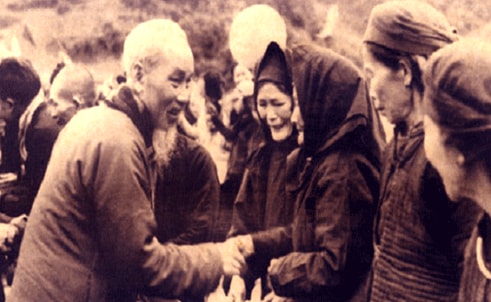 |
| Uncle Ho shook hands with the elderly during his visit to Pac Bo, in the spring of 1961 (Year of the Ox). |
In June 1941, Uncle Ho wrote a letter in Chinese characters titled: "Nguyen Ai Quoc's Letter to the Elderly" (Nguyen Ai Quoc - Letter to the Elderly People of the Whole Country). The letter began with: "The responsibility of us elders towards the nation's mission is truly immense. The nation prospers because of the elders' efforts, and its survival is due to their support. When the nation is lost, the elders save it. When the nation declines, the elders support it. Whether the nation prospers, declines, survives, or perishes, the elders bear a very heavy responsibility..."
Uncle Ho highly valued the role of all strata of the people in building and protecting the nation's independence, including the potential role of the elderly. According to him, in order for the elderly in society to fulfill their role, the prerequisite is to bring them into the activities of a specific organization, and that is how the "Elderly National Salvation Association" was born.
The speaker said: “We, as elders, must first demonstrate unity to set an example for our children and grandchildren. Therefore, I hope that the elders in Hanoi will volunteer to organize the “Elders' National Salvation Association” so that elders nationwide can emulate them and contribute to safeguarding the independence of our country.”
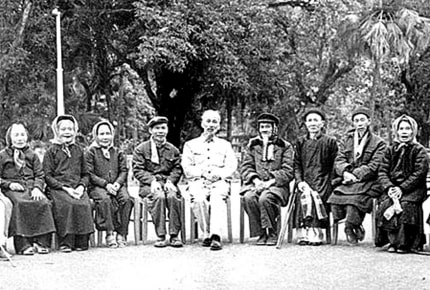 |
| President Ho Chi Minh poses for a commemorative photo with elderly delegates from Hanoi. |
He pointed out: For the elderly, although their health may not be as good as when they were young, they possess fundamental strengths, namely: a fervent and profound patriotism; the older they get, the stronger their resolve becomes; they have accumulated a wealth of knowledge, experience, and skills; and they enjoy high levels of trust. It can be seen that the core of President Ho Chi Minh's progressive and comprehensive thinking and perspective on the elderly is his deep respect and belief that "the elderly are an invaluable treasure of the nation and the State."
President Ho Chi Minh's respect for the elderly was not only evident in his thoughts and views, but also in his writings, speeches, and in all his actions, gestures, and behavior.
With affection and respect for the elderly, Uncle Ho reminded everyone to show reverence to the elderly. Within the Party, he instructed: “The elderly comrades are very valuable; they are exemplary figures of persistent struggle, guiding, nurturing, and training younger comrades. The elderly must help the young comrades progress. This requires the elderly to have a tolerant attitude and guide the young comrades. This is also a standard of communist morality.”
As President of the State and Chairman of the Party, despite his countless responsibilities, President Ho Chi Minh always showed special affection, timely encouragement, and respect for the elderly. Whenever he received news of meaningful deeds and achievements in the resistance war and production by the elderly, President Ho Chi Minh would promptly send letters of encouragement, greetings, congratulations, and present them with badges and silk gifts.
President Ho Chi Minh frequently reminded, encouraged, and motivated the elderly to educate themselves, raise their intellectual level, actively participate in social life, in the struggle for national liberation as well as in building the country, becoming shining examples for future generations to follow, because "The work is increasingly numerous and new, so elderly Party members must strive to learn," so that "they not only serve as role models and diligently work for their descendants but also demonstrate the mighty will of the Vietnamese nation."
 |
| Uncle Ho visits and inquires about the well-being of the elderly. |
During the resistance war, those who couldn't wield guns or swords to kill the enemy, or who were too old to do heavy work, would lead the way with their canes, encouraging the youth and sharing their experiences with them, setting an example for their descendants…
Besides encouraging and praising, he also criticized the notion that old age means the end of one's abilities and that the elderly should remain idle. He advocated "mobilizing all the strength of every citizen, leaving no one behind, to form a nationwide force," in which the elderly play a particularly important role.
During the resistance war against the French, he wrote simple, vernacular yet spirited poems, "To the elderly guerrillas of Cao Bang," in recognition of their contributions in halting the enemy's advance. He also stated: "Party committees and fronts at all levels in the localities should strive to help the elderly organize, consolidate, and develop the 'White-Haired Army' units. This is also a considerable force in the struggle against the Americans to save the country."
For the first time, when speaking about his own old age, Uncle Ho wrote the poem "Untitled" in 1949, when he was 59 years old:
"Because of the country, I haven't thought about home yet."
"Fifty-nine years old is still not old..."
When he turned 60 in 1950, Uncle Ho optimistically wrote these verses:
"At sixty, one still has plenty of youthful energy."
Compared to Mr. Peng, he's still just a teenager..."
Following that were poems written about his sixties, sixty-threes, and in 1964, at the age of 74, a "rare age in history," in his closing speech at the first session of the Third National Assembly, he still optimistically said: "...For the Fatherland, for the people, we will always strive to fulfill our responsibilities, determined not to betray the trust of our compatriots and the National Assembly. As for me: 'At seventy-four, I am still not old / I will strive to fulfill my duties...'"
On May 20, 1968, at the age of 78, amidst the whirlwind of the Tet Offensive, Uncle Ho was inspired to write a poem about his age with an optimistic and enthusiastic spirit:
"Seventy-eight years old, not too old yet."
Still fulfilling two roles related to national affairs.
Our people's resistance is winning big.
"Let's move forward! We and our children."
Uncle Ho's stirring verses have shown us a shining example of old age that "refuses to sit idle," "the older one gets, the more vigorous and heroic one becomes," a revolutionary optimism, a love of life, and tireless dedication to the people, the country, and the revolutionary cause, forgetting old age and even oneself. "Even if one must leave this world," there is nothing to regret, "only regretting not being able to serve longer and more"... That is why, during his revolutionary activities and until his passing, on various occasions, Uncle Ho often said: "The older one gets, the higher one's spirit becomes; in the fight against America and for national salvation, no old person is inferior to anyone"; "Old age but not old in spirit / Contributing to building a prosperous nation."
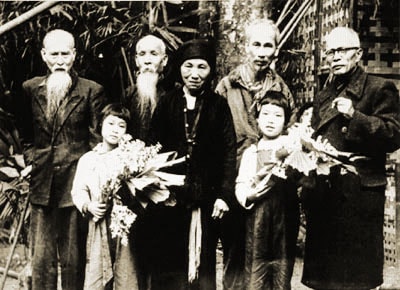 |
| President Ho Chi Minh with representatives of the elderly and children attending the Viet Minh - Lien Viet unification congress, March 1951. |
In President Ho Chi Minh's thoughts and views on the elderly, he affirmed that the elderly are the core force in the revolutionary cause, a factor contributing to strengthening the power of national unity, building and defending the Fatherland. Whether in the family or in the village and society, in times of war or peace, learning from and following the moral example of Uncle Ho, "the elderly are shining examples," the elderly are respected elders who always set an example, persistently guiding and encouraging their descendants to strictly abide by the Party's guidelines and policies, and the State's laws, continuing to contribute to socio-economic development, maintaining political security, and social order.
Therefore, the power of the calls to action and the pioneering spirit of the elders in the revolutionary struggle, in building and developing the country, has a tremendous influence on the spirit of national unity. This spirit of unity can "gather wind to create a storm, condense vapor to form clouds. The people of the whole country are holding their heads high, looking to the elders," who serve as shining examples for future generations to follow.
Peace(Synthetic)


