
Streamlining the system: Ending avoidance and fear of responsibility.
With a spirit of working "day and night," the Government successfully implemented the historic decision to restructure the apparatus and reorganize the "country," leaving many profound imprints.
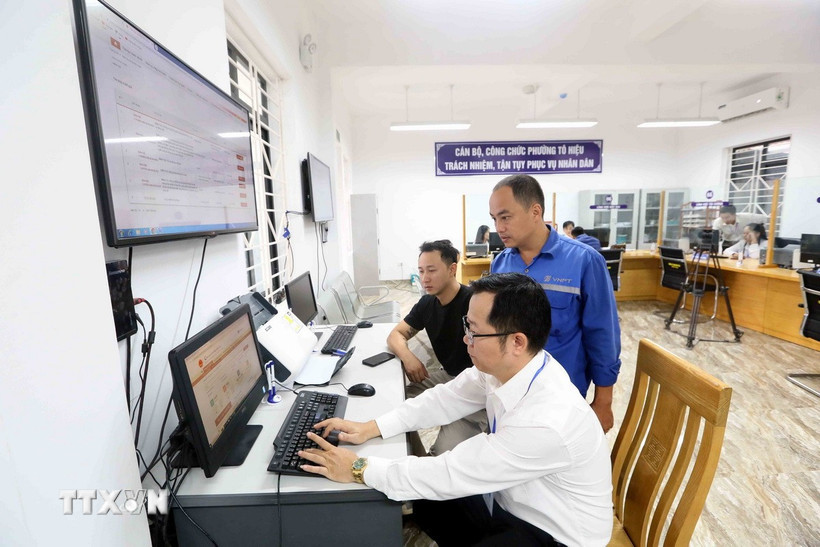
Speaking at the recent conference summarizing the work of the Government and local authorities in 2025 and outlining the work for 2026, General Secretary To Lam emphasized that the reform of the organizational structure and the two-tiered model of local government, coupled with decentralization and delegation of power, has been accelerated, creating a significant shift in governance methods towards empowering individuals while holding them accountable, fostering a spirit of initiative and creativity, making the apparatus more streamlined, local administration more proactive, and gradually reducing compliance costs.
In 2025, with a mindset of "looking far ahead, thinking deeply, and doing big things," and with a spirit of working "day and night," the Government successfully implemented the historic decision to restructure the apparatus and reorganize the "country," leaving many profound imprints.
This is not just an adjustment in administrative boundaries, but also a strategic step to restructure the national governance model, reduce intermediate layers, and increase interconnectedness, synchronization, effectiveness, and efficiency in administration.
The government has implemented a comprehensive set of solutions to ensure the smooth operation of the new apparatus, without disrupting state management activities, closely linked to promoting decentralization and delegation of power, shifting from a management-oriented administration to a development-oriented administration that serves the people.
Close to the people, close to the grassroots.
According to Chairman of the Hanoi People's Committee Vu Dai Thang, in 2025, the city has focused intensely on completing tasks and objectives, removing bottlenecks in the socio-economic development of the capital, and building a two-tiered local government according to the new model.
Notably, the city's average GDP growth reached 8.16%, significantly higher than the average of previous years. The size of the economy reached approximately US$64 billion. 2025 is also expected to see a dramatic increase in foreign investment in Hanoi, with a growth rate exceeding 70% compared to 2024, reaching approximately US$4.4 billion.
According to the Chairman of the People's Committee of Ho Chi Minh City, Nguyen Van Duoc, 2025 will be a "trial by fire" year for the city as it simultaneously consolidates and implements strategic tasks to accelerate development.
With close guidance from the Central Government, close coordination among ministries and agencies, the unity of the entire political system, and especially the consensus and solidarity of the people and businesses, the city has achieved encouraging results. The reorganization of the administrative apparatus and public service units has been seriously implemented, and the two-tiered local government model is gradually operating stably and smoothly.
The annual GRDP increased by 8.03%. GRDP per capita reached US$8,755. The investment environment improved.
The year 2025 marks a significant milestone as, along with the rest of the country, Quang Ngai province completes the reorganization of its administrative apparatus and units, operating a two-tiered local government system. Many citizens have noted the positive changes in administrative services.
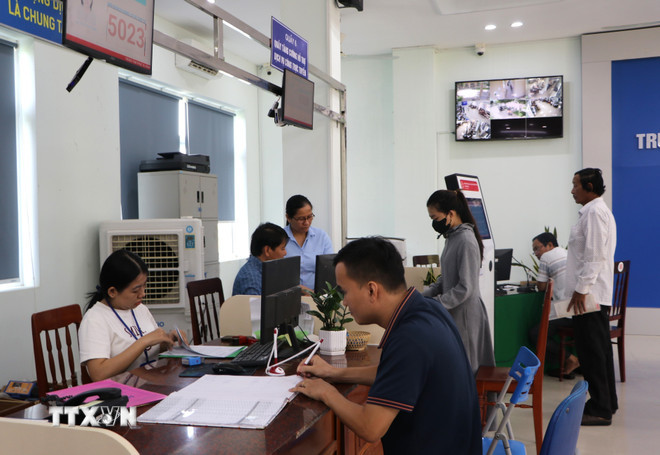
Ms. Y Thuy, a resident of Dak To commune, said that whenever she comes to the Public Administrative Service Center to complete procedures, she is always warmly welcomed and wholeheartedly assisted by the staff. If her documents are incomplete, the staff provide thorough and prompt guidance, making her clearly feel the improvement in the service style of the civil servants.
With the motto "Whatever benefits the people must be done to the utmost, whatever harms the people must be avoided to the utmost," every official and Party member throughout Quang Ngai province considers being close to the people and grassroots levels as a regular practice, and has received positive feedback from the people. At the same time, they are resolutely implementing integrity in public service and completely eliminating the "request-and-grant" mechanism.
From July 1st, 2025 to the present, 96 communes, wards, and special zones in Quang Ngai province have received more than 252,000 applications, with a nearly 99% rate of timely and on-schedule resolution; the satisfaction level of people and businesses is over 94%, demonstrating the effectiveness of the new administrative apparatus.
Along with the reorganization of the government and local administrations, in 2025, the reorganization of the organizational structures of mass organizations at all levels, as assigned by the Party and the State, will also be carried out synchronously and uniformly.
The associations have proactively adjusted and reduced internal organizational structures, streamlined the organizational structure and personnel of their affiliated units, and issued decisions on merging, dissolving, and transforming the operating models of their affiliated units.
To date, 20 out of 30 mass organizations assigned by the Party and State have implemented the restructuring and streamlining of their internal structures; the number of organizations has decreased from 160 to 91, a reduction of 43%.
Enhancing the accountability of leaders
In reality, the process of reorganizing and streamlining the administrative apparatus and implementing the two-tiered local government model still faces some "bottlenecks."
General Secretary To Lam pointed out that some areas are still confused, lacking coordination, and experiencing delays in administration, causing difficulties for people and businesses. Decentralization and delegation of power have not gone hand in hand with resource allocation and capacity building for officials, creating a gap between assigned authority and the ability to implement it in practice.
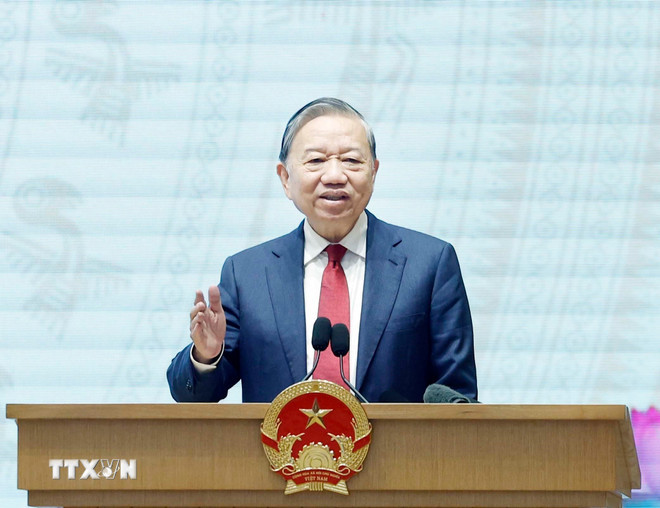
In 2026, the General Secretary requested an improvement in the implementation capacity of the apparatus under conditions of strong decentralization and delegation of power; a review to reduce procedures, creating more space for decision-making and greater accountability for officials and civil servants, while reducing compliance time and costs for citizens and businesses. He also called for the development of high-quality human resources and raising the skill level of the entire society.
According to the General Secretary, it is necessary to closely link authority with resources and accountability, ensuring smooth operation from the central to the grassroots level. Continue to streamline the organizational structure to be lean, efficient, effective, and efficient; enhance the responsibility of leaders, tighten administrative discipline, and put an end to the avoidance and fear of responsibility; improve the mechanism for evaluating and replacing cadres, and prioritize the recruitment of capable cadres.
Strictly implement Conclusion 226 of the Party Central Committee on rectifying working methods and improving the effectiveness of the political system; at the same time, remove obstacles in the operation of the two-tiered local government, focusing on improving the capacity of cadres and Party members at the grassroots level, especially at the commune, ward, and special zone levels; 2026 should be designated as the "year of improving the quality of grassroots cadres."
There are solutions to exploit public assets that are being wasted, and to handle surplus public offices after restructuring, thereby enhancing the proactiveness, autonomy, and governance efficiency of the state apparatus.
To further streamline the internal organizational structure of associations, the Politburo and the Secretariat have just issued Conclusion No. 230-KL/TW on the plan for restructuring and streamlining mass associations assigned tasks by the Party and the State, and the plan for evaluating the operational model of the Vietnam Cooperative Alliance and the Vietnam Federation of Commerce and Industry.
Accordingly, a unified list of 29 mass organizations assigned tasks by the Party and State at the central level has been established. The Vietnam Cooperative Alliance and the Vietnam Federation of Commerce and Industry are professional social organizations assigned tasks by the Party and State, and do not have state management functions.
The Prime Minister assigned tasks to these two organizations at the request of the Central Committee of the Vietnam Fatherland Front.
The Politburo and the Secretariat of the Central Committee have assigned the Party Committee of the Vietnam Fatherland Front and the Central mass organizations to lead and direct the continued research and review to streamline the internal organizational structure of the associations; review, reorganize, and streamline the affiliated organizations and legal entities, retaining only those with appropriate, necessary functions, operating effectively and in accordance with the principles and objectives of the associations; and resolve issues related to land, finance, and assets of the associations to ensure practical, effective, and efficient operation in accordance with the objectives (to be completed in the second quarter of 2026). The associations operate on the principles of voluntarism, self-governance, and self-financing, not for profit.


