
Cybercrime - The invisible traps in cyberspace:Part 3: One click can cost you your entire fortune.
No complicated schemes are needed; just one wrong click at the wrong time, and your account is empty, your savings of many years disappearing. The reality is that despite repeated warnings about this scam, many people still fall for it without stopping to verify the information.
Content: Dang Cuong - Tien Dong - Thanh Luong
Present:Hong Toai• April 27, 2026
*****
No complicated schemes are needed; just one wrong click at the wrong time, and your account is empty, your savings of many years disappearing. The reality is that despite repeated warnings about this scam, many people still fall for it without stopping to verify the information.
.png)
Still reeling from the shock of being scammed out of 2.4 billion VND, Ms. Nguyen Thi Lan, residing in the former Yen Thanh district, recounted the elaborate scheme: "I met a man online who called himself Nguyen Trung Thang, introduced himself as an engineer at a game company, cultivated an image of being polite, successful, and single. For about four months, he regularly messaged me every day, asking things like 'Did you sleep well last night?', 'It's cold, remember to wear an extra coat when you go out'... which gradually made me trust him."
Later, he claimed to be on a business trip, frequently recording videos from the airport to his workplace and meetings with clients, creating a very realistic impression. One evening, he reported a problem, saying a client had reacted negatively to him for leaking company information, that he was having to write a self-criticism report, and that his computer had been "sealed off." He then asked for my help checking a game accessed via a suspicious link. I thought it was just a small favor, so I clicked on it. Unexpectedly, it was a fake website that had been pre-programmed.
Initially, this person gained my trust by showing profits from their account, then created a separate account for me and "shared" 100 million VND. I even managed to withdraw 6 million VND to my real account, so I believed it was real money. I started depositing money, starting with a few hundred million VND, gradually increasing the amount each day, hoping "money would make more money." By the time I realized something was wrong, it was too late. In just a few days, all 2.4 billion VND of my money disappeared. I couldn't withdraw the money, and I could no longer contact that person…”

While in the story above, the trap was set using emotions and trust built over months, in another scenario, the criminals only needed a few short calls to directly target daily habits.
Ms. Tran Thi Thuan, residing in the former Hoang Mai town, was also a victim of the scam impersonating a delivery driver. "The scammers obtained my order information, called to inform me about the delivery when I wasn't home, and then requested a bank transfer. About 30 minutes later, I received a second call with alarming information: I had mistakenly transferred money to the 'goods insurance account,' meaning I was enrolled in an insurance package costing 4.8 million VND per month. To cancel, I was forced to follow their instructions."
A link was sent to a fake fan page. There, someone posing as a customer service representative asked me to open my banking app, enter a series of numbers into the money transfer section, and hold down the button to confirm to "complete the procedure." In reality, these were money transfer orders that I had made myself.
In a state of confusion and under constant pressure with the excuse of "breaking the procedure," I repeated the actions multiple times. As a result, nearly 300 million VND was withdrawn from my account. Not stopping there, the perpetrators continued to lure me into borrowing money through the app to steal it. In less than a week, the money I had saved for many years disappeared… I didn't have time to stop and think; everything happened too quickly, as if I was being led step by step,” Ms. Thuan shared.
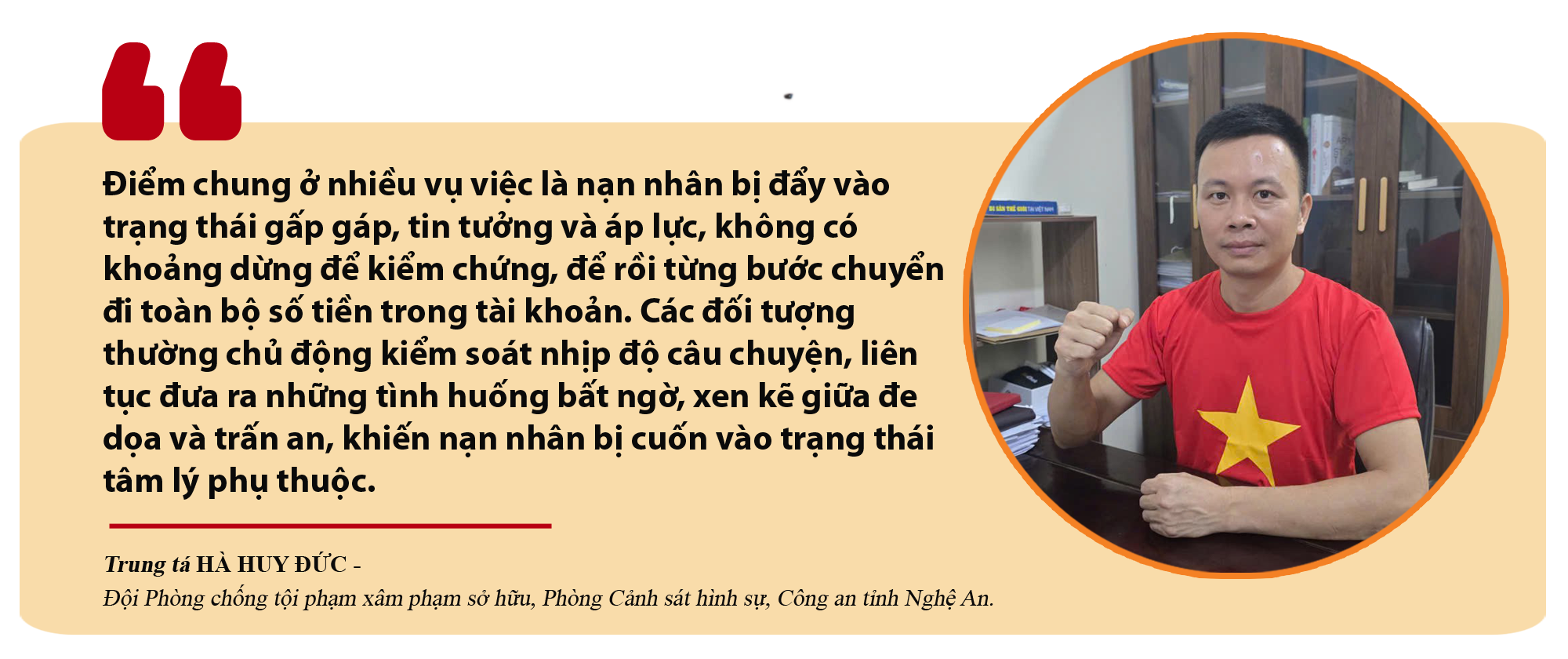
Through handling fraud cases, Lieutenant Colonel Ha Huy Duc - Head of the Property Crime Prevention Team, Criminal Police Department, Nghe An Provincial Police, stated: "The common point in many cases is that victims are pushed into a state of urgency, trust, and pressure, without a pause to verify, and then gradually transfer all the money in their accounts. The perpetrators often proactively control the pace of the conversation, constantly creating unexpected situations, alternating between threats and reassurance, causing victims to become psychologically dependent."
Once initial trust or confusion is established, they exploit the time factor to exert pressure, not giving the victim a chance to discuss the matter with family or verify the information. In many cases, even with initial suspicions, victims, due to constant pressure, still follow instructions reflexively, leading them to perform money transfers without fully understanding the risks.
In reality, a short pause to verify information through official channels or seek advice from others could prevent many incidents. However, this information isolation and high-pressure situation has caused many people to lose their judgment, making them easy targets for scammers.
The consequences extend beyond just the lost money. Many victims experience psychological crises, prolonged insomnia, and feelings of confusion and self-blame. “The financial pressure makes everything unbearable. It’s not just about the economic burden, but also the suspicious glances from loved ones…,” one victim shared.
A single click, therefore, is not simply a technological operation, but can be the thin line between safety and total loss, where the price to pay is the entirety of years' savings, or even the peace of an entire family. But such scenarios are not random. Behind each incident is an organized system, with fraudulent "factories" operating in a chain reaction.
.png)
Recent crackdowns have shown that high-tech crime is no longer carried out by isolated, fragmented groups. This is a "non-traditional" type of crime, without borders or geographical limitations, and with constantly evolving methods and tactics.

Colonel Nguyen Hong Quan, Deputy Director of the Cyber Security and High-Tech Crime Prevention Department, stated: "For fraudulent activities, perpetrators target people's perceptions and psychological vulnerability. Therefore, the Ministry of Public Security has intensified its propaganda activities, most recently the 'Don't Be Alone' campaign, which has contributed to spreading information to the public, helping people become aware of online fraud activities, thereby raising awareness and reducing the number of online criminals defrauding people."

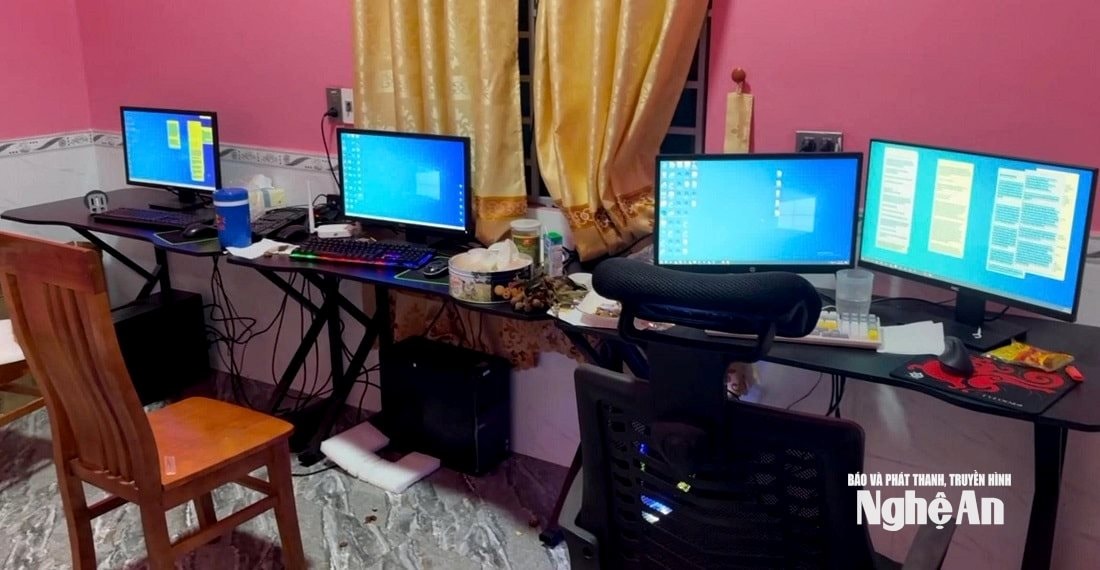
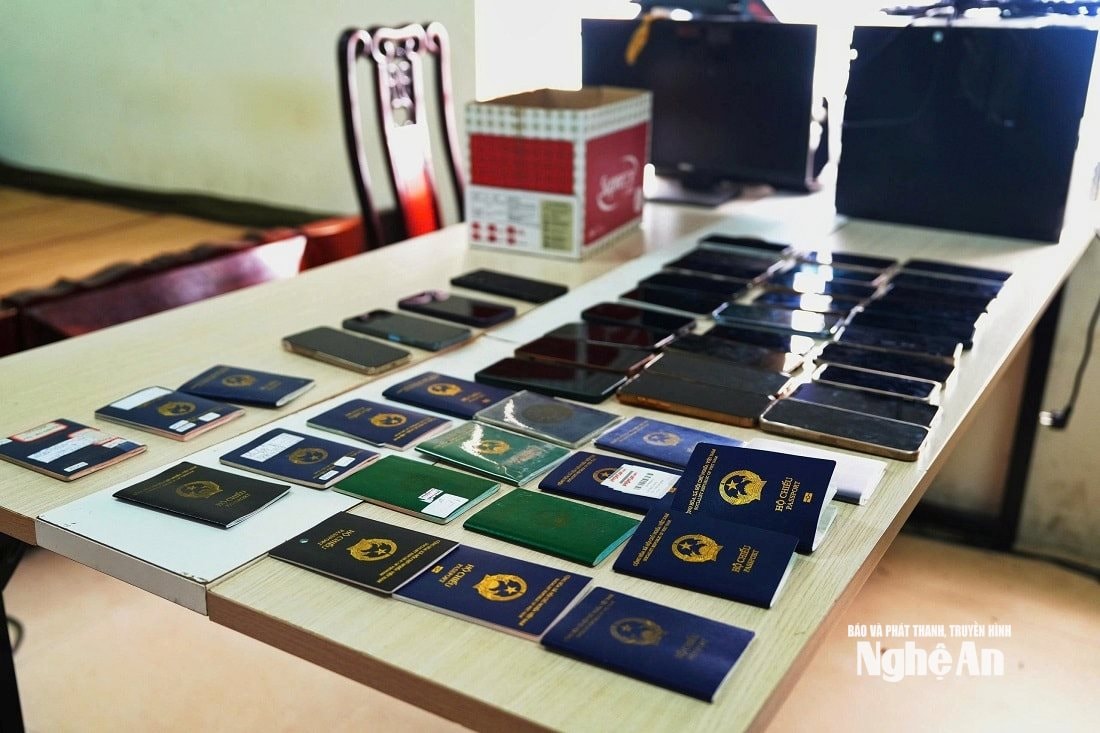
These individuals not only possess knowledge of information technology but also understand psychology, constantly changing their scenarios to evade detection by law enforcement. The case of dismantling two high-tech crime gangs linked to overseas operations is clear evidence of this. Since July 2023, through intelligence gathering, law enforcement discovered many individuals in Nghe An working for "companies" based in Cambodia – which were actually centers for defrauding Vietnamese citizens nationwide.
.jpg)
According to Lieutenant Colonel Ha Huy Duc, of the Property Crime Prevention Team, Criminal Police Department, Nghe An Provincial Police, these networks operate like a real business, on a large scale and with a tightly structured hierarchy. The fraudulent system is divided into many clearly defined operational lines, with each "department" playing a specific role in the overall scheme.
At the frontline (D1), the perpetrators act as "scouts," impersonating telecommunications employees or officials, making calls based on a pre-existing list of data. Notifications such as "Your SIM card will be blocked in the next 2 hours," or "Your account is being frozen due to its connection to a case," are used to create initial psychological shock.
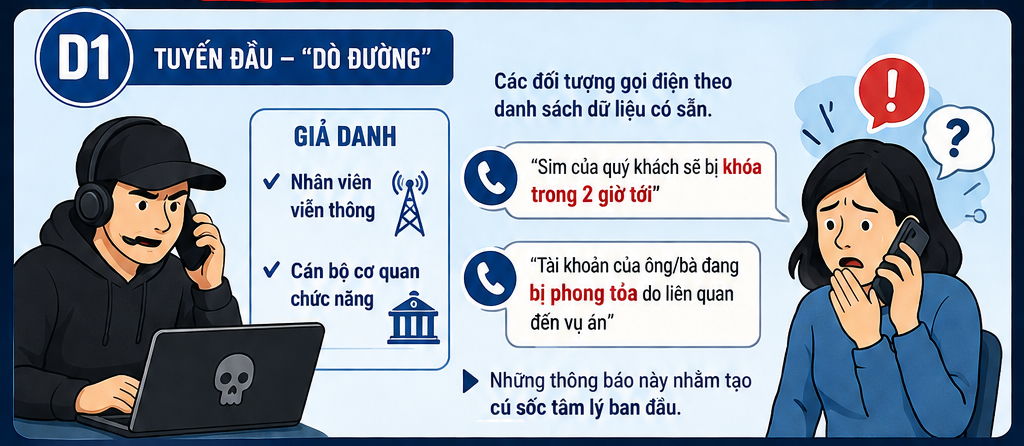
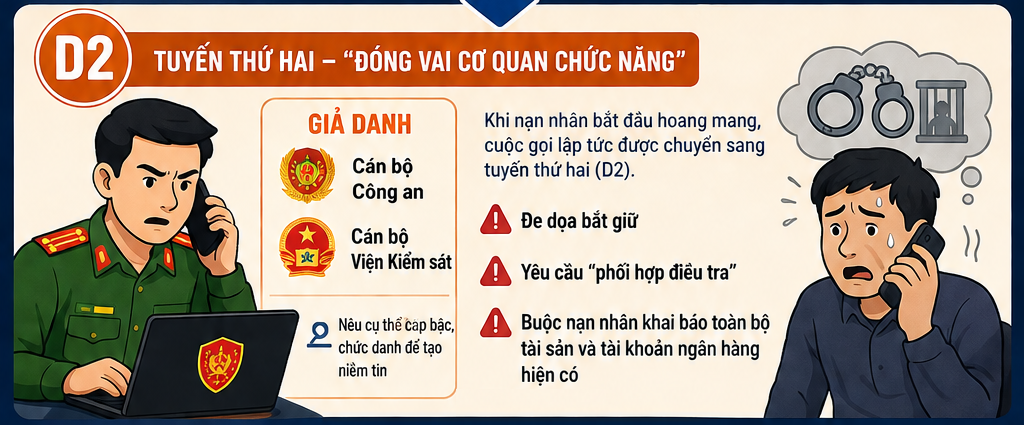
When the victim begins to panic, the call is immediately transferred to the second line (D2) – a group of individuals posing as police officers or prosecutors with specific ranks and titles. Here, the scenario escalates with threats of arrest, demands for "cooperation in the investigation," and pressure to disclose all assets and bank accounts.
All the information is then passed to the final line (D3) - the ringleader, who acts as the "brain" of the network. These are the individuals who directly manipulate and instruct victims to provide OTP codes or carry out money transfer transactions.
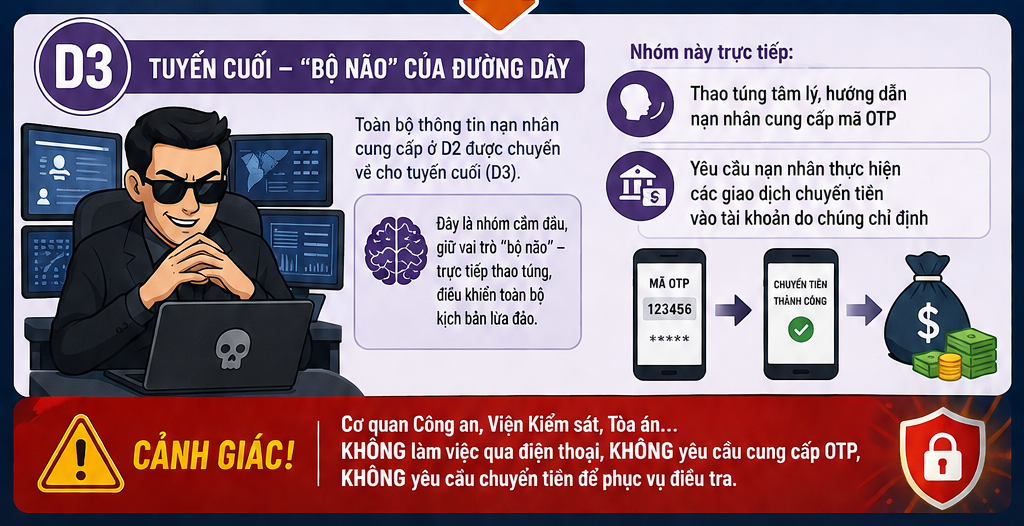
Notably, this entire process is designed to be a closed loop, giving victims no respite whatsoever. The perpetrators maintain constant contact, requiring victims to be alone and not to communicate with others. This relentless pressure causes many to lose their ability to verify information, becoming swept along by each step of the pre-planned scenario.

The sophistication is further demonstrated by the supporting tools behind the scenes, including disposable SIM cards, rented bank accounts, and fake identities, forming a closed network. Each stage has a person in charge, and each situation has a script for handling it – like a production line, but the "product" is scams worth hundreds of millions, even billions of dong.
According to the report of the People's Committee of Nghe An province on crime prevention and control in 2025, functional forces have arrested and prosecuted 62 cases related to high-tech crimes, clarifying the amount of money embezzled exceeding 2,500 billion VND.

According to police assessments, online fraud crimes tend to increase year by year, with increasingly sophisticated methods that are constantly "updated" to suit different target groups.
According to Lieutenant Colonel Ha Huy Duc, a common tactic is to create a sense of urgency, fear, or absolute trust in a very short time, leaving victims no time to think or verify the information. When placed under constant pressure, many people lose their ability to judge and follow all the instructions of the scammer.


The monetary losses can be quantified, but the psychological consequences, the breakdown of trust, and the family pressure are immeasurable. In this silent war, the line between safety and total loss is sometimes just a moment of hesitation – when the victim fails to realize they are caught in a pre-planned scenario. This raises the question: How can each individual protect themselves and avoid becoming the next link in the web of online scams?
(The victim's name in this article has been changed - PV)
------o0o------
(To be continued)


