
General Secretary: Standards and classification of administrative units should be issued soon.
Regarding standards for administrative units, classification of administrative units, and urban areas, General Secretary To Lam suggested that they should be issued soon and implemented in accordance with planning and development orientations.
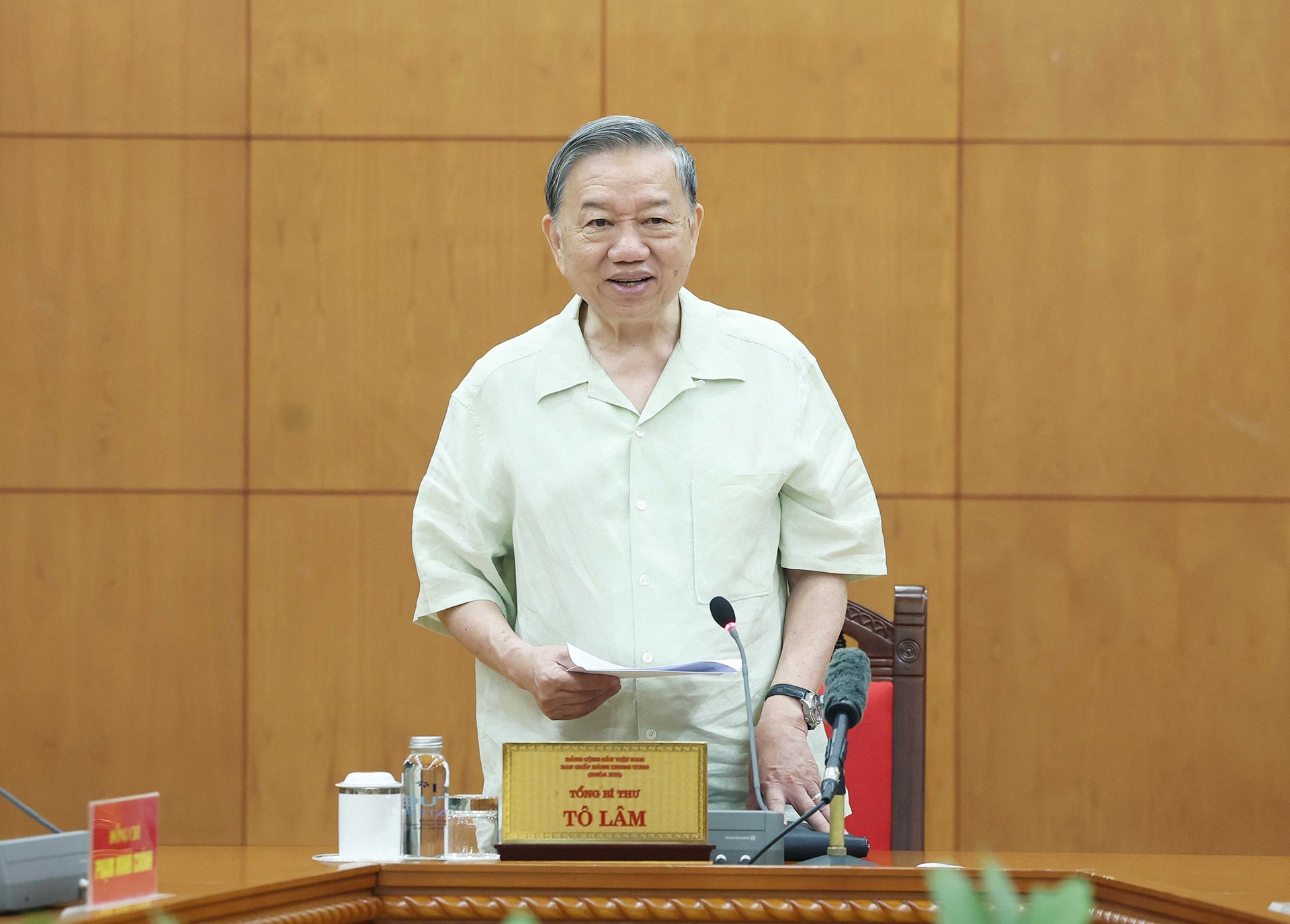
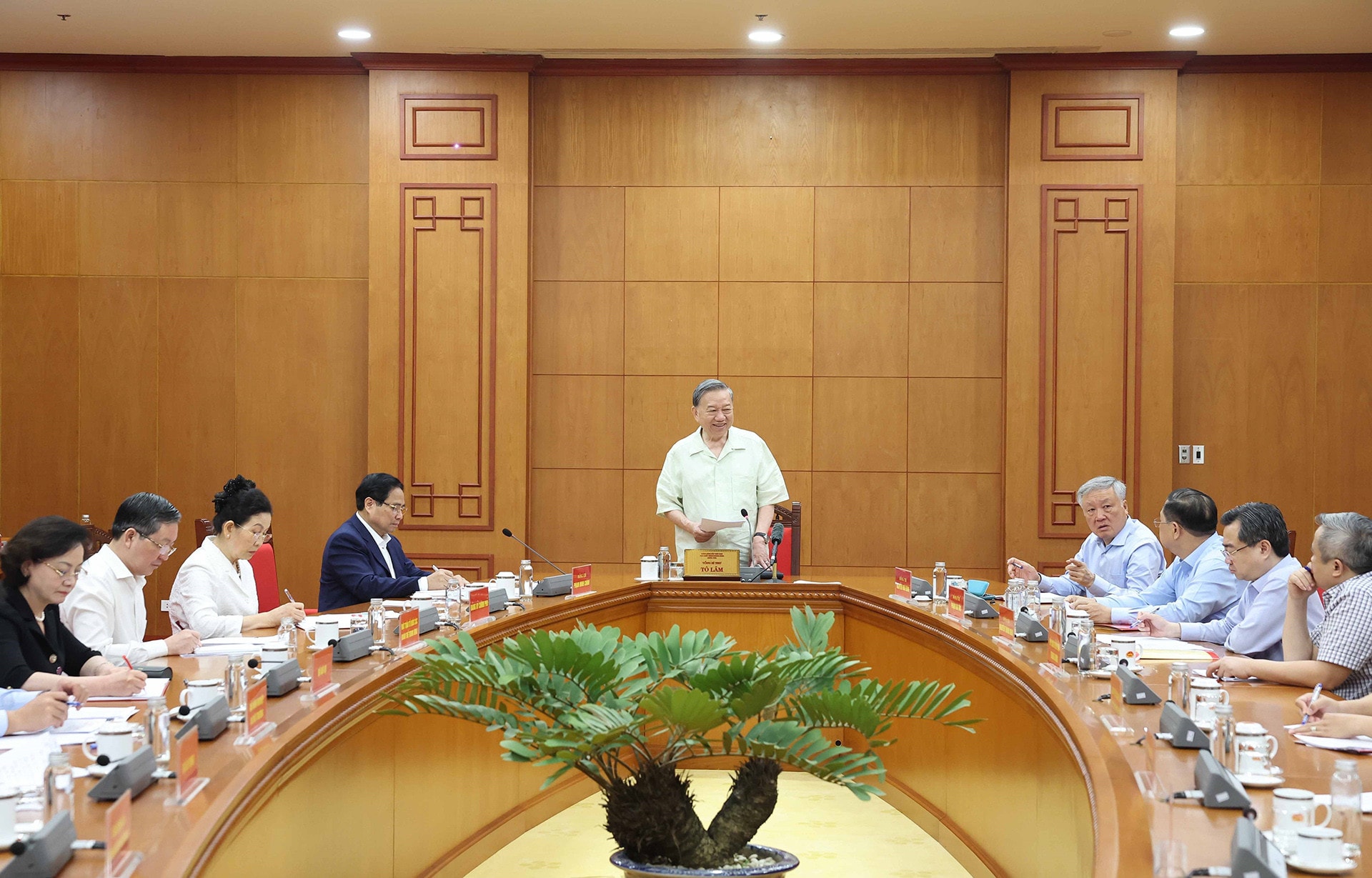
This morning (September 17), General Secretary To Lam chaired a working session with the Standing Committee of the Government Party Committee on the situation of the three-year implementation of Resolution No. 19 of the Central Committee on agriculture, farmers, and rural areas until 2030, with a vision to 2045, and Resolution No. 06 of the Politburo on planning, construction, management, and sustainable development of Vietnamese cities until 2030, with a vision to 2045.
Reporting on the three-year implementation of Resolution 19, a representative from the Central Policy and Strategy Committee summarized some of the results in developing "ecological agriculture, modern rural areas, and civilized farmers".
In particular, agricultural production and business have developed quite stably; maintaining its role as a pillar of the economy, contributing to macroeconomic stability; and shifting strongly from a production-oriented agricultural mindset to an agricultural economy. Exports of agricultural, forestry, and aquatic products are projected to reach US$62.5 billion in 2024; US$45.37 billion in the first eight months of 2025, and are forecast to reach US$65-70 billion in 2025.
Rural areas have undergone significant transformation in almost all fields; socio-economic infrastructure has developed rapidly. Farmers are increasingly playing a more active role as key players, actively implementing production restructuring, applying science and technology, and embracing digital transformation; their material and spiritual lives are constantly improving...
Regarding Resolution No. 06, the report clearly states that, from July 1st, after restructuring according to the two-tiered local government model, the number of commune-level administrative units has decreased by approximately 67%, and district-level administrative units have been dissolved. The administrative system has been streamlined, creating conditions for upgrading urban infrastructure and laying the groundwork for the development of modern cities.
The average floor area per capita in urban areas is estimated to reach 31.5 m² by 2025.2/person (exceeded the target by 27 m)2/person). Some technical infrastructure indicators (urban transport, green spaces, drainage) and urban infrastructure in major cities have not met the targets...
These two strategic tasks complement and support each other.
Concluding the meeting, General Secretary To Lam requested an objective and comprehensive assessment of the situation and results of implementing the Resolutions; and a thorough study of new issues arising after the reorganization of administrative units, mergers and consolidations at the provincial and commune levels, and the organization of two-tiered local governments.
The General Secretary requested that issues needing adjustment be identified and compared with the requirements of development tasks in the new phase; and that new trends in modern urban and rural development around the world be studied to supplement and amend Resolutions No. 19 and No. 06 to meet practical needs.
The General Secretary noted that it is necessary to clearly understand that urban development and rural development are two complementary and mutually supportive strategic tasks that cannot be separated.
Urban and rural areas are not only socio-economic issues, but also political, cultural, and welfare issues for the people.
Modern, civilized cities are the driving force of development; at the same time, prosperous, culturally rich, and sustainable rural areas serve as a solid foundation. The relationship between urban and rural areas must be systematically planned, creating a unified whole, developing in a balanced and harmonious way, and complementing and supporting each other.
Regarding the issuance of administrative unit standards, administrative unit classification, and urban classification, the General Secretary suggested that these should be issued early, relevant work should be implemented at the local level, planning and development orientations should be carried out, and a strong government should be strengthened and built.
The General Secretary emphasized the need for an initial assessment of the implementation of the resolutions, identifying limitations and shortcomings, clearly stating new development requirements, and proposing new guiding principles; thorough and in-depth research is required to issue the Politburo's Conclusion.
After the 14th Party Congress, when Resolutions No. 19 and No. 06 had been implemented for five years, consideration was given to issuing a new resolution to better suit the current situation.
The General Secretary stated that these are strategic issues, very large and very difficult, requiring a high level of intellectual focus, the mobilization of experts and scientists, and the drawing on international experience to advise on the direction of urban and rural development commensurate with the requirements of development in the new era.


