
President Trump announces the 'Golden Fleet' and a new class of warships bearing his name.
On December 22nd, at his Mar-a-Lago estate in Florida, US President Donald Trump officially announced plans to build a new class of warships named after him.
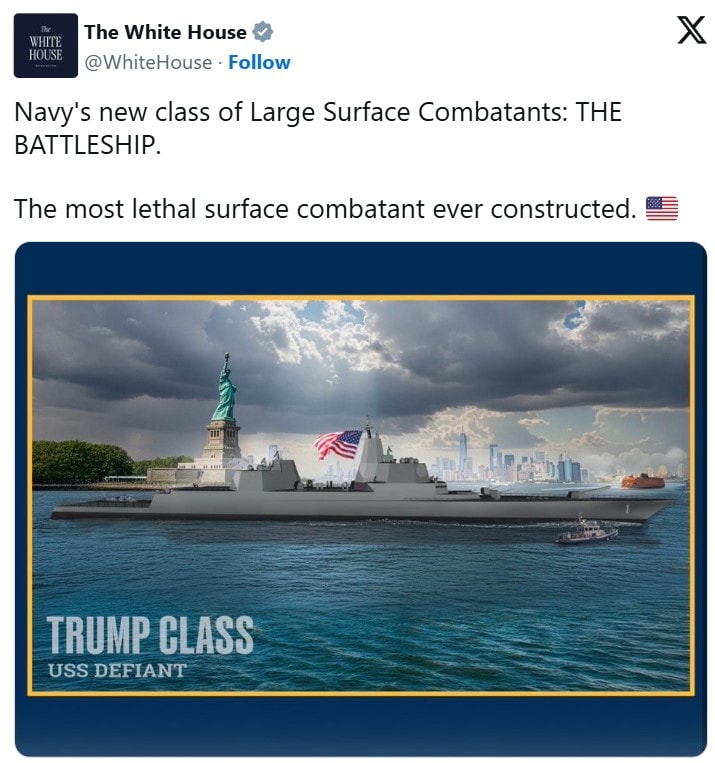
Speaking before Defense Secretary Pete Hegseth, Secretary of State Marco Rubio, and Secretary of the Navy John Phelan, President Trump declared that the "Trump-Class" ships would be "the largest warships in the nation's history."
This ambitious plan, dubbed the "Golden Fleet," will begin with the construction of two ships and is expected to expand to 25 in the future.
One notable detail is the President's direct involvement in the development process. "The U.S. Navy will lead the design of these ships along with me, because I have a very good sense of aesthetics," Trump emphasized.
According to preliminary specifications, these warships will have a displacement of 30,000 to 40,000 tons and may be equipped with nuclear weapons. This is Trump's latest effort to leave a strong personal mark on the U.S. Armed Forces, even though he never served in the military. Typically, U.S. Navy ships are named after states, cities, or historical figures/deceased presidents; naming a class of ships after a sitting president is rare.
The decision to build new ships is not only symbolic but also stems from geopolitical realities. Washington is increasingly concerned about the rapid expansion of the Chinese navy. President Trump has pledged to "restore America's position as a shipbuilding power" to ensure maritime dominance.
Furthermore, this announcement comes amid heightened tensions between the US and Venezuela. The US military is currently implementing a naval blockade against the South American nation. Last week, President Trump ordered the Navy to seize sanctioned oil tankers entering and leaving Venezuela in an effort to pressure the government of President Nicolas Maduro. To date, the US has seized two oil tankers and is pursuing a third.
At the event, Trump issued a stern warning to Maduro, accusing Venezuela of being a "drug trafficking hub." In response, on national television on December 22, President Maduro stated that Trump "should mind his own business" instead of interfering in Venezuela's internal affairs.
Previously, President Trump had repeatedly complained about the deteriorating condition of U.S. warships. At his confirmation hearing in February, Navy Secretary John Phelan revealed that Trump had asked him "countless times" about solutions to address the corrosion and rust on the ships.


