
Toyota Corolla Concept: A hint of the new production version.
The Corolla Concept appears with active air vents, BEV-style body proportions, dual charging ports, and a fuel cap. Toyota confirms the new platform supports ICE, hybrid, PHEV, BEV; FCEV is possible.
Toyota unveiled the Corolla Concept at the 2025 Japan Motor Show, revealing the major direction for the 13th generation. Although presented as a concept, the model shows many details that suggest it's a production vehicle, while Toyota confirmed the new generation will have a platform supporting multiple powertrain options including internal combustion engine (ICE), hybrid, plug-in hybrid (PHEV), and pure electric (BEV). Autocar suggests a hydrogen fuel cell (FCEV) variant may also be considered.
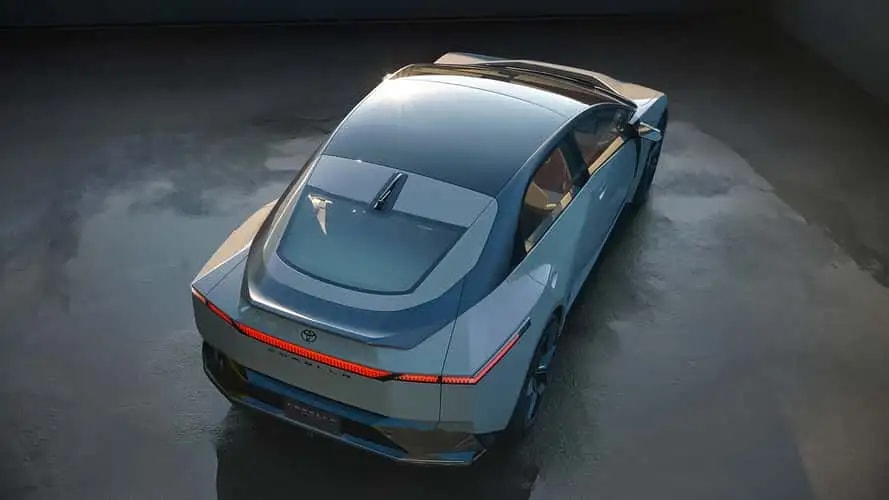
Details suggesting production readiness
Compared to the 12th-generation Corolla, the new concept shifts significantly in terms of aesthetics and aerodynamics. The following details suggest that this is likely a fairly close preview of the production model:
- The signature lighting scheme is similar to the bZ badged models: high-mounted daytime running lights, and low-mounted headlights hidden behind smoked glass.
- There's no traditional grille; instead, there's a central air intake in the front bumper with active louvers that can close when cooling isn't needed.
- BEV-style body proportions: a very short hood, a windshield that extends far forward, and a low-sloping cockpit that creates a fastback design.
- The rear of the car is boxy with a wrap-around taillight strip that cuts deeply into the sides; 21-inch wheels and an integrated spoiler enhance the sense of stability.
- Charging ports are located on either side of the front fenders; there's another cover on the rear left, which could be the fuel filler cap. Toyota hasn't confirmed this, but this detail suggests a PHEV configuration in concept.
Note that this is a fastback, not a liftback: the trunk lid opens independently, and the rear window does not lift with it. This layout prioritizes aerodynamics and a sporty look, while maintaining the separate trunk structure typical of a sedan.
The design follows the bZ style but is sharper.
The Corolla Concept's design language feels like the next evolution from the bZ product line, but with a sharper, sportier finish. This shift also necessitates updates to existing all-electric models, such as the bZ3, if Toyota wants to align its design identity in the electrification era.
A new platform for diverse powertrains.
According to Toyota, the next-generation Corolla will launch on an entirely new platform capable of integrating multiple powertrain options within a single model. This is a significant change from the previous approach, which separated electric and internal combustion engine vehicle platforms. With the new Corolla, customers can choose from ICE, hybrid, PHEV, and BEV options within the same product line.
| Type of drive | Status |
|---|---|
| Internal combustion engine (ICE) | Confirmed by Toyota |
| Hybrid | Confirmed by Toyota |
| Plug-in hybrid (PHEV) | Confirmed by Toyota |
| Bottom Electric Power (BEV) | Confirmed by Toyota |
| Hydrogen fuel cells (FCEVs) | Perhaps, Autocar suggests. |
Consolidating multiple powertrain configurations onto a single platform demonstrates a goal of increasing portfolio flexibility and optimizing industrial costs. Simultaneously, it allows Toyota to respond to market demands in each region – a characteristic that has been a tradition for the Corolla throughout its global commercial history.
BEV body style proportions and ICE integration challenges
The short front overhang and forward-positioned windshield are typical of electric vehicles, where the powertrain module can be placed low and compact. From a production perspective, if an internal combustion engine is still integrated, the design will require certain adjustments to ensure adequate space for the engine and structural safety, although Toyota can optimize the size and placement of the engine. This explains why the production version may differ slightly in proportions from the concept.
Aerodynamics and functional details
The central air intake with active louvers is a technical detail, usually only appearing on near-production vehicles because it directly relates to thermal and aerodynamic performance. The wraparound taillights, integrated spoiler, and squared-off rear not only create a distinctive look but also suggest how Toyota handles airflow away from the body to reduce drag.
Fastback-style cabin and functionality
The low cockpit and sloping roofline give it a fastback stance. However, since it's not a liftback, the separate trunk lid maintains the practicality of a sedan. The actual interior layout, rear passenger space, and trunk capacity have not yet been released by the manufacturer.
Global strategy and launch timing
The Corolla is a global product with a wide variety of body styles and powertrains across markets. This approach is likely to continue in the next generation to suit specific needs. Toyota says the model will be “packed with innovations” and part of a strategy to “create beautiful cars that people will want to drive,” but has not yet shared technical details.
Regarding timing, the new generation model is expected to launch next year or at the latest in 2027, when the current Corolla (launched in 2018) is nearing the end of its lifecycle.
Quick conclusion
The Corolla Concept reveals a new design direction while also disclosing a host of highly practical details such as active air vents, a BEV-style body ratio, and a charging port and fuel cap placement suggesting a PHEV configuration. Toyota confirms the new platform will encompass ICE, hybrid, PHEV, and BEV; an FCEV variant has been suggested by Autocar. With a projected timeline from next year to 2027, this is likely a close preview of the 13th generation Corolla.


