
Over 60% of complaints and denunciations are unfounded.
(Baonghean Newspaper) - According to the Constitution and laws, citizens have the right to file complaints and denunciations. However, in recent times, there have been many cases of citizens filing false complaints and denunciations, causing negative consequences for society. The fundamental reason is that a segment of complainants and denouncers still lack a full understanding of legal regulations. Mr. Hoang Quoc Hao - Director of the Department of Justice - discussed this issue with Baonghean Newspaper.
Reporter: Could you tell us about the current situation regarding the implementation of the Law on Complaints and the Law on Denunciations in our province?
Mr. Hoang Quoc Hao:Over the past period, the number of complaints and denunciations in the province has continued to increase. Specifically, in 2015, relevant provincial agencies received 6,523 visits from citizens filing complaints, denunciations, and petitions; an increase of 15.8% compared to the same period. They also received 7,684 letters of complaint, denunciation, petition, and land dispute reports (an increase of 4.4% compared to 2014).
To date, all levels and sectors have resolved 454 out of 470 complaint cases, achieving a rate of 96.6%; and 206 out of 213 denunciation cases within their jurisdiction, achieving a rate of 96.7%. The resolution of these complaints and denunciations shows: 25 out of 248 complaints were found to be valid, accounting for 10.1%; 74 out of 248 complaints were partially valid, accounting for 29.8%; 149 out of 248 complaints were found to be invalid, accounting for 60.1%; 11 out of 206 denunciations were found to be valid, accounting for 5.3%; and 65 out of 206 denunciations were partially valid, accounting for 31.6%. And the number of false accusations was 130 out of 206 cases, accounting for 63.1%.
Although citizens have the right to complain and denounce, they still do not exercise their rights properly as stipulated in the constitution and laws; the situation of false complaints and denunciations remains common.
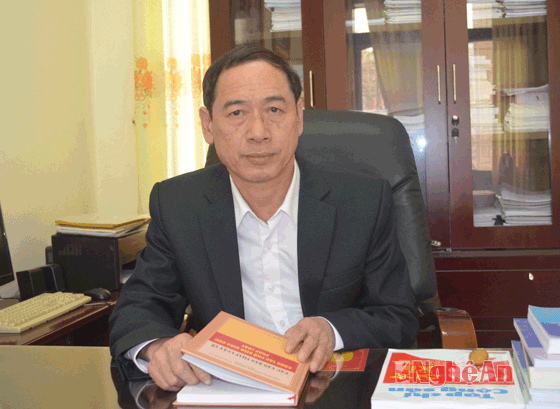 |
| Director of the Department of Justice Hoang Quoc Hao: "The fundamental reason for the increase in false complaints and denunciations is the lack of understanding of the law..." |
Reporter: So, the percentage of citizens filing unfounded complaints and denunciations remains high. In your opinion, what are the reasons for this?
Mr. Hoang Quoc Hao:Clause 1, Article 2 of the Law on Complaints stipulates: “A complaint is the act by which citizens, agencies, organizations, or officials, following the procedures prescribed by this law, request competent agencies, organizations, or individuals to review administrative decisions, administrative actions of state administrative agencies, or disciplinary decisions against officials when there are grounds to believe that such decisions or actions are unlawful and infringe upon their legitimate rights and interests.” Article 2 of the Law on Denunciations stipulates: “Denunciation is the act by which citizens, following the procedures prescribed by this law, inform competent agencies, organizations, or individuals about illegal acts by any agency, organization, or individual that cause or threaten to cause harm to the interests of the State, or the legitimate rights and interests of citizens, agencies, or organizations.”
It is clear that citizens' right to complain is very well-regulated by law; and citizens' participation in complaints and denunciations contributes to purifying social life and promoting social development. However, this applies only to legitimate complaints and denunciations. Incorrect complaints and denunciations, on the other hand, waste the time of the agencies involved in resolving them, as well as the complainants and other related parties; and can even cause negative consequences for society…
In my opinion, the reason for false complaints and denunciations is that the complainants lack understanding or do not fully understand the legal regulations. This doesn't just refer to the Law on Complaints and Denunciations, but also other laws related to the content of complaints and denunciations that are commonly used today, such as the Land Law, Civil Law, and Criminal Law. Complainants and denouncers also need to have a thorough understanding of these laws. Furthermore, once a complaint or denunciation is filed, the complainant must also understand their responsibilities.
 |
| "Q&A on the Law on Complaints and Denunciations" - a book that those involved in filing complaints and denunciations should study to gain a thorough understanding of the law. |
Reporter: Sir, in order to minimize the problem of unfounded complaints and denunciations; to guide complaints and denunciations in the right direction, contributing to socio-economic development, what issues should the Standing Agency of the Provincial Council for Coordination of Legal Education and Dissemination focus on?
Mr. Hoang Quoc HaoBased on the reasons identified, we determine that the dissemination of legal education on complaints and denunciations is extremely important. In 2013, the Central Government issued the Project "Continuing to strengthen the dissemination of legal education on complaints and denunciations in communes, wards, and towns in the period 2013 - 2016," and our province has paid great attention to and focused on implementing this project.
Looking back at the period from 2011 to 2015, under the leadership of the Provincial Party Committee, the Provincial People's Council and People's Committee, and with the active participation of all levels and sectors, the work of disseminating and educating about the law has truly undergone positive changes, bringing practical results, gradually deepening and making a mark in strengthening the awareness of law compliance among officials, civil servants, and the people. As a result, most segments of society have recognized the true values of the law, respect and abide by the law, and know how to use the law to protect their own legitimate rights and interests, as well as those of others, and to protect the interests of society; consolidating solidarity within the community, contributing to a reduction in law violations and the number of complaints filed at higher levels.
However, despite the achievements in general legal education and dissemination, the dissemination of laws on complaints and denunciations in particular still faces certain limitations. Therefore, while the law has reached the people, it is not yet truly widespread, and many legal provisions are not specifically understood by the people, leading to misunderstandings and incorrect application in practice. Specifically, the rate of unfounded complaints and denunciations remains high (over 60%).
2016 was a very significant year, marked by many major national events such as: the 12th National Party Congress; the elections of National Assembly deputies and People's Council members at all levels; and the third year of implementing the Constitution… Therefore, the Department of Justice advised the Provincial People's Committee to direct departments, agencies, districts, cities, towns, and socio-political organizations to focus on legal education and dissemination.
This includes focusing on disseminating and thoroughly understanding the Resolutions of the Party Congresses at all levels and the Resolution of the 12th National Party Congress; promoting the elections of People's Councils at all levels for the 2016-2021 term and the 14th National Assembly. It also involves timely and effective dissemination of laws effective in 2016; focusing on disseminating new laws enacted by the National Assembly, especially those protecting human rights and civil rights such as the amended Civil Code and the amended Criminal Code; laws and codes on procedural matters, etc.; and organizing the introduction and widespread dissemination of policies, guidelines, and legal regulations that are of public interest.
In addition, at the local level, we will promote the implementation of the Law on Mediation; innovate methods and enhance the effectiveness of legal dissemination and education; strengthen the team of legal educators and mediators; and effectively build, manage, and utilize legal libraries in local areas...
Reporter:Thank you, sir.
Nhat Lan
| RELATED NEWS |
|---|


