
North Korea integrates new cruise missiles into Su-25 fighter jets.
North Korea announced a cruise missile mounted on the Su-25 with a multi-layered weapon configuration, allowing it to strike beyond the range of short-range air defenses; the source also mentioned the possibility of exporting the upgrade package.
North Korea unveiled an air-launched cruise missile integrated for the Su-25, announcing it at the 80th anniversary celebration of the Korean People's Air Force (KPAAF) at Kalma Air Base on November 28. The new missile shares many similarities in shape and exposed nose sensors with the Taurus KEPD 350 (German-Swedish) currently deployed by South Korea. This new weapon configuration allows the Su-25 to engage targets beyond the range of short-range air defenses and increases its survivability compared to traditional close-range combat tactics.
Overview
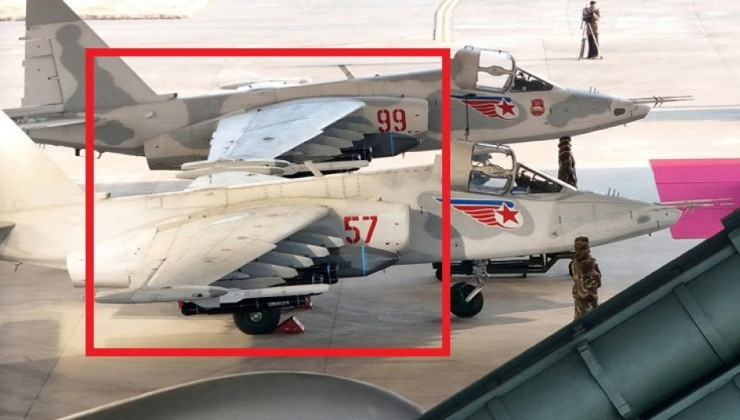
According to sources, North Korea's Su-25 is equipped with a multi-layered weapons package: two new cruise missiles, two triple-barreled launchers carrying small precision-guided missiles or short-range air-to-ground missiles similar to Hellfire, and each wingtip carrying a short-range infrared air-to-air missile. This arrangement significantly expands the target range and attack range, while also enhancing air defense and anti-UAV capabilities.
Technical analysis
The newly unveiled cruise missile features an exposed sensor in the nose section, a visual detail reminiscent of the Taurus KEPD 350. Sources suggest this weapon likely inherits technology from North Korea's advanced ground-launched cruise missile programs over the past decade. Integrating it onto the Su-25 transforms the attack aircraft into a long-range launch platform, reducing the need for low-altitude, slow flight near the front lines, which diminishes its survivability against modern short-range air defense systems.
| Category | Description by source |
|---|---|
| Cruise missiles | 2 units; shape and exposed nose sensors are similar to Taurus KEPD 350. |
| Triple-barreled launcher | 2 clusters; carrying small precision-guided glide bombs or short-range air-to-ground missiles similar to Hellfire. |
| Anti-aircraft missiles | 1 missile/wingtip; short-range infrared guidance for defense and anti-UAV operations. |
Tactics and Survival Skills
The Su-25 and A-10 were originally optimized for close air support missions at low altitudes, but the current short-range air defense environment makes this approach risky. Sources indicate that although Russia and Ukraine have deployed significant numbers of Su-25s, this aircraft has had little significant impact on the current battlefield. With its new configuration, the North Korean Su-25 can engage targets at long and medium ranges, reducing the need to penetrate low-altitude air defense fire zones. Short-range air-to-air missiles on the wingtips provide an additional layer of defense against helicopters and UAVs.
Sources suggest these domestic upgrades could make North Korea's Su-25 fleet the most capable ever seen, and potentially the few Su-25 variants still operating effectively in modern combat.
The context of the rocket industry
North Korea's defense industry is believed to have made rapid progress in ballistic missiles, cruise missiles, and surface-to-air missiles. The emergence of the Pyongae-6 long-range air defense system, described by sources as a counterweight to Russia's S-400, reduces the air defense burden on fighter aircraft, allowing tactical aircraft to focus on precision strike roles. Sources suggest that ground-based missile programs have laid the technological foundation for air-launched missiles, including those equipped on the Su-25.
KPAAF's new air-to-air system.
Sources indicate that the KPAAF first received active radar-guided air-to-air missiles in May 2025, which have been integrated and test-fired on MiG-29s, replacing the previously Soviet-supplied R-27 semi-actively guided missiles. This missile was previously unveiled at the "Self-Defense 2021" Defence Development Exhibition (October 2021) and is likely to be integrated into MiG-23ML and MiG-21bis aircraft.

Export potential and fleet prospects
The source stated that North Korea's export of tens of billions of dollars worth of military equipment to Russia since 2022 raises the possibility that the country may gradually phase out its old fighter jets and receive new aircraft from Russia, possibly including additional Su-25s for domestic modernization. According to the same source, the new weapons package for the Su-25 could be supplied to Russia and other foreign customers such as Belarus and Iran.
Preliminary assessment and missing data
Available information suggests the upgrade focus is on transforming the Su-25 into a platform for carrying long- and medium-range weapons, while also adding basic air defense capabilities. However, the source has not yet released the core technical specifications of the new cruise missile (range, detailed guidance mechanism, penetration capability), so further monitoring is needed to fully assess its combat effectiveness and compatibility with long-range air strike doctrine.


