
Has China surpassed Russia in catapult production?
China's recent announcement of the second successful production and testing of an aircraft catapult system shows that Beijing has surpassed Russia in this technology.
According to China Daily, Rear Admiral Yin Zhuo, Chairman of the Chinese Navy's Expert Advisory Committee, said that Chinese engineers have made remarkable progress in developing aircraft catapults for use on aircraft carriers.
The aircraft launch system, capable of facilitating easier takeoffs from aircraft carriers, can be considered a landmark advancement in China's military industry. Yin Zhuo revealed that the new system has undergone numerous tests with J-15 carrier-based fighter jets and has exceeded expectations.
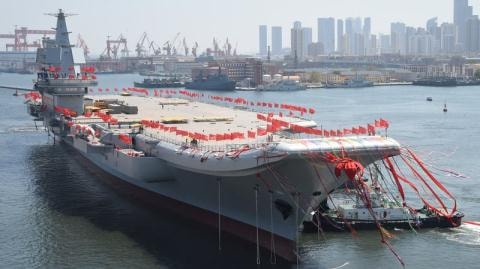 |
| China launched its domestically built aircraft carrier in early 2017. |
Reportedly, this is the second time since 2016 that China has announced the successful development of a carrier-based aircraft catapult system. However, surprisingly, while repeatedly claiming success with catapult technology, the model of China's new aircraft carrier is still designed with a ski-jump launch deck. This suggests that China has not been successful in developing a catapult system similar to that of the United States.
This assessment is entirely justified, as in early March 2015, China's People's Daily reported on Chinese television news broadcasts images showing what is suspected to be a testing ground for China's aircraft carrier catapults. According to military expert Li Li, these images indicate that Beijing is making "foundational" and strategic breakthroughs in the crucial cutting-edge technology of aircraft carriers.
According to Li Li, catapults are classified into steam catapults and electromagnetic catapults. Steam catapults have limited usage conditions, while electromagnetic catapults allow aircraft to take off in conditions that disregard weather, which is of significant strategic importance.
Regarding the type of catapult shown in the image, Chinese expert Cao Weidong suggested that the test area in the image could be used for both steam catapult testing and electromagnetic catapult testing.
According to Cao Weidong, the research and development of catapults is aimed at promoting the future development of aircraft carriers. China's current aircraft carrier, the Liaoning, uses a ski-jump type runway, but this type of runway cannot take off fixed-wing early warning aircraft, limiting the carrier's overall combat capabilities.
Cao Weidong argued that China needs more than just one aircraft carrier; therefore, in the future, it should focus on a more powerful combat capability. "Using catapults is the future direction of aircraft carrier development. If China's industrial level, capital, and technological capabilities are sufficient, the next step could be for domestically built aircraft carriers to utilize electromagnetic catapults."
The catapults on an aircraft carrier are crucial equipment for rapid aircraft takeoffs from the ship. Takeoffs using catapults are more efficient than the ski-jump takeoff method currently used on the Chinese Navy's Liaoning aircraft carrier; catapult takeoffs are currently the only method of launching naval aircraft used by the US military.
The United States was the first country to use electromagnetic catapults on aircraft carriers, and France could only purchase American products. Carrier catapults play a crucial role in enabling naval aircraft to quickly engage in air combat, enhancing operational effectiveness.
China's development of catapults for aircraft carriers is "a reasonable and logical step," Cao Weidong said. Despite confident claims about developing the catapult system, the first images of China's newly built aircraft carrier show a ski-jump launch deck.
According to Baodatviet
| RELATED NEWS |
|---|


