
China proposes a default 0–100 km/h speed limit of 5 seconds.
The Chinese Ministry of Public Security has released a draft safety standard: the default 0–100 km/h acceleration time must be no less than 5 seconds, along with new requirements for battery safety, power steering, doors, and windows. According to Carnewschina, vehicles can still go faster if the driver activates additional features.
China's Ministry of Public Security has released a draft of a new national standard for motor vehicle operation safety, proposing that passenger vehicles must default to accelerating from 0–100 km/h in at least 5 seconds. The goal is to reduce safety risks from excessive acceleration performance, while also tightening requirements for electric vehicles and driver assistance systems.
According to Carnewschina, this regulation does not absolutely restrict acceleration from 0–100 km/h to under 5 seconds. The 5-second time applies to the default mode when starting the car; users can still achieve faster times through additional operations. Given that many car models achieve very fast acceleration, such as the Xiaomi SU7 with 2.78 seconds, the draft regulation, if enacted, could reduce the marketing value of this metric on public roads.
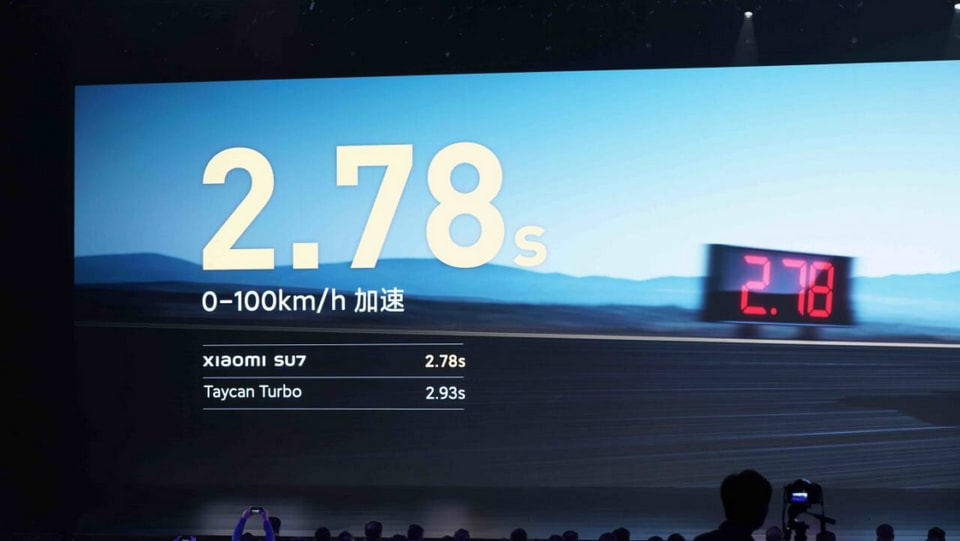
Default acceleration limit: 0–100 km/h in no less than 5 seconds
The draft Technical Conditions for Motor Vehicle Operation Safety sets a minimum default acceleration time of 5 seconds. This approach aims to control the risks from strong acceleration during everyday operation, especially with high-powered electric vehicles.
Impact on high-performance models
In recent years, some brands like Xiaomi and Zeekr have stood out thanks to their acceleration figures. With the new proposal, a 0–100 km/h time of 5 seconds is considered fast enough on public roads; ultra-fast acceleration records will be difficult to continue as a marketing highlight if the vehicle is left in its default configuration.
Active safety requirements for electric vehicles and PHEVs.
The draft adds a series of specific requirements for pure electric and plug-in hybrid vehicles:
- Equipped with anti-accidental acceleration technology, it can detect and limit power output when the vehicle is stationary or moving; and simultaneously provide clear audio and visual warnings to prevent unintended acceleration.
- The electrical circuit is automatically cut off in specific situations, including: when the vehicle speed changes by 25 km/h or more within 150 milliseconds along the longitudinal or lateral axis; or when irreversible limiting devices such as airbags are activated.
Battery safety and thermal incident management
For battery systems, the recommended standards are:
- Electric vehicles must monitor battery status, automatically detect, record, and provide early warnings of abnormalities in battery cells; when a heat problem is detected, it should provide clear audio and visual warnings to the occupants.
- The battery must have a directional pressure relief and pressure balancing device; the pressure relief channels must be designed so as not to endanger the occupants of the vehicle.
- For all-electric or plug-in hybrid buses that are 6 meters or longer, the battery compartment must not catch fire or explode for at least 5 minutes after a battery alarm is triggered, in order to ensure sufficient evacuation time.
Driver assistance, driver monitoring, and entertainment functions.
- Vehicles equipped with driver assistance systems must verify, through biometric identification or account login, that the driver has completed the appropriate training before being allowed to resume operation.
- With a combined driver assistance system, when activated at speeds above 10 km/h, the vehicle must continuously monitor driver engagement using at least two methods: hand movement detection and eye tracking.
- To avoid distractions, entertainment video playback and gaming functions on the dashboard screen must be turned off when the vehicle exceeds 10 km/h.
Door safety, emergency exits, and glass
- Passenger vehicles must ensure that each passenger can exit through at least two different doors; each door (except the trunk door) must have a mechanical handle both inside and outside.
- With an electronic door locking system, the non-collision side door should automatically open when the airbag deploys or a battery overheating issue occurs.
- Window regulations: reflective window film is prohibited; driver's visibility must be at least 70% of visible light transmission.
- Emergency exit windows must be made of tempered glass no thicker than 5 mm and must not have heat-insulating film applied, as this makes them easy to break in an emergency.
Summary of key thresholds and requirements
| Category | Threshold/Requirement |
|---|---|
| Default acceleration: 0–100 km/h | Not less than 5 seconds |
| Disconnect the electrical circuit when the speed varies. | ≥ 25 km/h for 150 milliseconds (vertical or horizontal) |
| Monitoring driver engagement | Above 10 km/h, at least two methods (hand + eye) are required. |
| Video/Game Entertainment | Turn off above 10 km/h |
| View through the glass | Visible light transmission rate ≥ 70% |
| Emergency exit window glass | Tempered glass ≤ 5 mm, no film applied. |
| Electric/hybrid buses (≥ 6 m) | The battery compartment does not catch fire/explode for at least 5 minutes after the alarm. |
Draft status and market context
The draft is currently undergoing public consultation as part of the national standard revision process. According to Carnewschina, the acceleration regulation emphasizes the default mode, not completely prohibiting achieving 0–100 km/h in under 5 seconds if the driver activates an additional timeframe. On public roads, 5 seconds is considered fast enough for everyday driving needs.
If implemented, the new standard would standardize default operating parameters and raise the safety requirements ceiling for electric vehicles, from preventing accidental pedal misfires and managing thermal hazard risks to monitoring the driver, doors, and windows. Extreme performance parameters may still be present, but they will no longer be the default configuration when the vehicle is in motion.


