
China introduces YKJ-1000: a low-cost hypersonic missile.
Lingkong Tianxing has launched the YKJ-1000, which has a range of 1,300 km, a speed of Mach 7, and a price of around 700,000 yuan; it uses civilian materials, putting cost pressure on the SM-6 and THAAD.
Lingkong Tianxing last week unveiled the YKJ-1000 hypersonic glide missile with a maximum range of 1,300 km and a speed of up to Mach 7, according to the South China Morning Post. Documents circulating online indicate that this missile has entered mass production after undergoing field testing. The estimated cost is around 700,000 yuan per missile (nearly $99,000), significantly lower than interceptor missiles such as the SM-6, Patriot PAC-3, or THAAD.
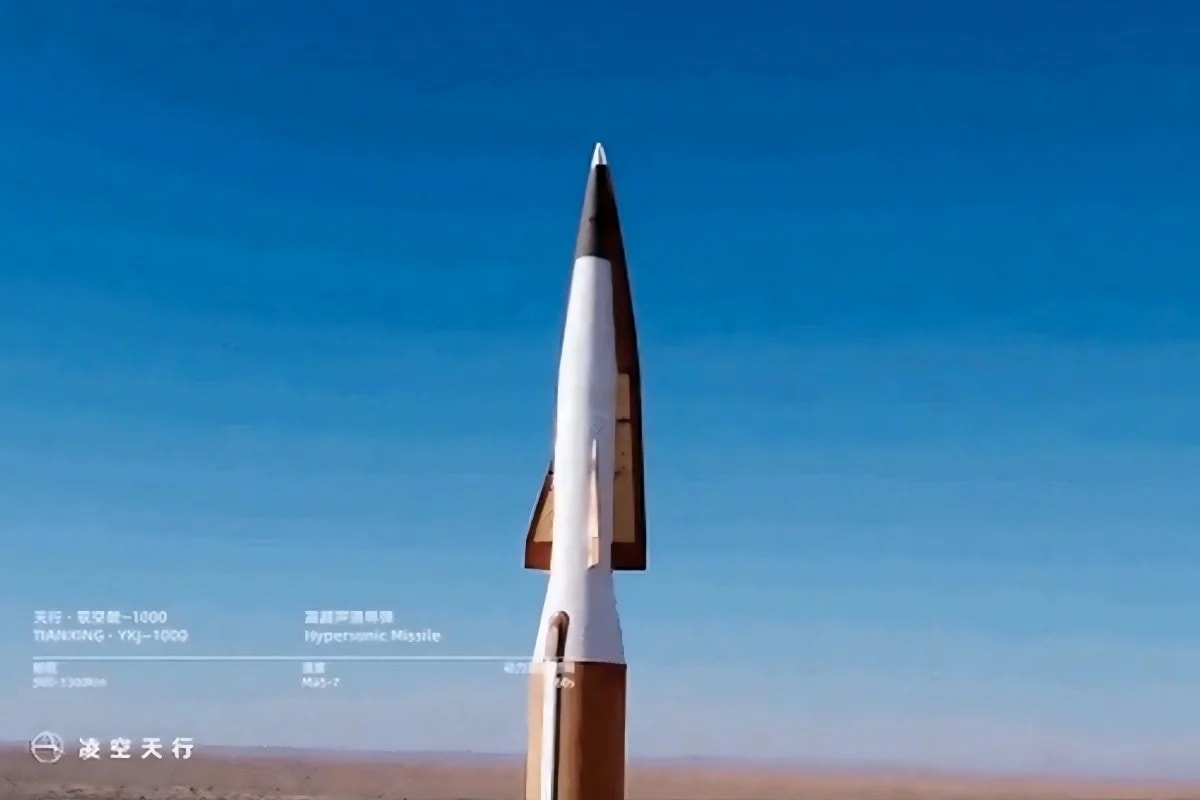
Overview and new features
According to the description, the YKJ-1000 is nicknamed the "cement-coated missile" due to the use of civilian materials to reduce costs, including foamed concrete as a heat-resistant coating for the warhead. This approach leverages the civilian supply chain to create high-performance, low-cost weapons.
Technical analysis
- Flight type:It glides at supersonic speeds, with a stated top speed of Mach 7.
- Operational range:Maximum 1,300 km.
- Materials and technology:Heat-resistant coatings utilize foamed cement and civil engineering materials; many structural components are manufactured using the mold casting method; explosion-proof bolts are replaced with electrically operated ones.
- Commercial components:The camera module and Beidou positioning chip, which are common and inexpensive in the consumer drone market, are used in this application.
- Production status:According to leaked presentation materials, it has entered mass production after field testing.
These details emphasize the design philosophy of "technically good enough, cost-effective," relying on readily available components in the consumer sector to shorten lead times and reduce costs.
Cost-Contrast Problem
The cost difference between inexpensive offensive weapons and expensive defense systems can significantly impact strategic thinking. The reality on the Ukrainian battlefield shows that a few hundred-dollar drone forced the defending side to use anti-aircraft missiles costing hundreds of thousands of dollars. With inexpensive offensive missiles, salvo firing to saturate the defense becomes more feasible, especially when interspersed with some more modern missiles like the DF-17 produced by Chinese state-owned defense corporations.
Cost comparison table (by source)
| System | Classify | Estimated cost/ammunition |
|---|---|---|
| YKJ-1000 | Hypersonic glide missile | Approximately 700,000 yuan (nearly $99,000) |
| SM-6 | Interceptor missile | Approximately $4.1 million (more than 40 times more expensive than the YKJ-1000) |
| Patriot PAC-3 | Interceptor missile | Approximately $3.7 – $4.2 million |
| THAAD | Interceptor missile | Approximately $12-15 million |
Operational and market implications
Military commentator Wei Dongxu told CCTV that if the YKJ-1000 were to enter the international defense market, the competition would be intense because many countries have not yet developed hypersonic missiles on their own. A weapon with "great range, powerful destructive force, good penetration capability, and surprisingly low cost" could attract attention.
If exported, smaller countries could use their numbers to challenge modern navies, posing a threat to warships, including aircraft carriers. An example is the scenario where Venezuela possesses enough missiles to threaten US carrier strike groups near its coast, forcing Washington to adjust its calculations given the effective operational range of Ford-class nuclear aircraft carriers is approximately 1,100 km. Since the beginning of the year, Houthi forces in Yemen have repeatedly claimed to have attacked US aircraft carriers; the availability of inexpensive missiles is expected to make such attacks more difficult to intercept.
Industrial and organizational capacity
Lingkong Tianxing stated that the model of combining defense technology with civilian industrial capabilities helps lower costs. Chairman Wang Yudong shared on social media that the company “stands on the shoulders of giants,” leveraging the achievements of the “Made in China” strategy, reflecting the “overall production capacity of Chinese society.” According to him, behind the results is a systemic transformation: from R&D thinking, supply chain organization, storage and maintenance methods, to management and procurement models. The R&D team mainly comes from major aerospace corporations; Wang himself was formerly the chief designer and deputy chief engineer at the China Academy of Satellite Launch Technology.
Wang said on CCTV that if the YKJ-1000 is indeed "that cheap," it could support China's development of advanced missile defense systems in the future. In September, Vice Premier Zhang Guoqing visited the company's factory in Chengdu, Sichuan province.
Points needing clarification
Some online comments have questioned the pricing, particularly regarding fuel and engine costs. Lingkong Tianxing stated that a detailed explanation will be published soon. Besides the specifications mentioned, other important factors such as the sensor, navigation algorithm, and interference resistance have not been detailed in the source.


